
For the first time in nearly seven years, the HDB resale market in Singapore has recorded two consecutive quarters of decline. The Resale Price Index, which tracks the overall price movement of HDB flats, dropped by 0.1 per cent in Q1 2026, and flash estimates now suggest a further drop of 0.3 per cent in Q2 2026. On the surface, these numbers may seem small, but they mark a turning point in a market that has been climbing steadily since the pandemic years. The last time the Resale Price Index dropped in two consecutive quarters was Q2 2019.
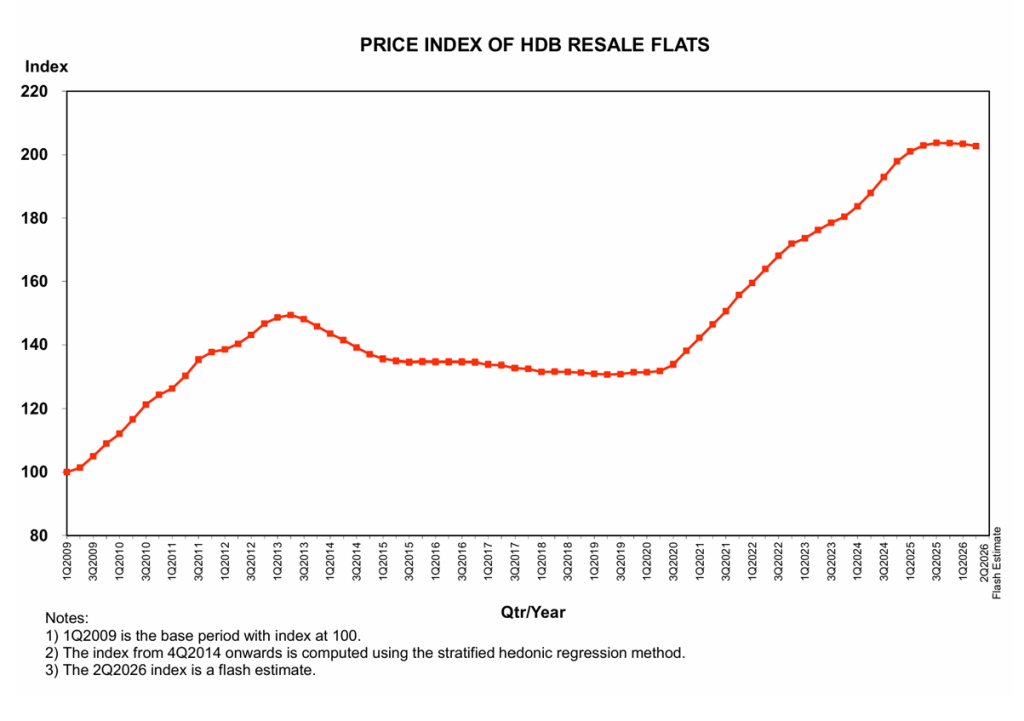
Source: HDB
The Market Is Cooling But Not Collapsing
These declines, reflected in the Resale Price Index, are modest. They do not erase the gains homeowners have built up over the past decade.
After all, new record highs are still being set, such as a 5-room flat at Henderson Road which went for $1.72 million in April 2026. Furthermore, million-dollar HDB flat transactions are more common than ever. 491 flats crossed the million-dollar mark in Q2 2026, up from 411 in Q1 2026 and 350 in Q4 2025.
However, year-on-year, overall momentum has slowed. Transaction volumes fell by more than 10 per cent, with 6,196 resale deals in Q2 2026 compared to 6,823 in the Q2 2025.
While there are slightly fewer BTO flats launching in 2026 than in 2025, the overall demand for BTO flats remains high, reducing the demand for resale flats. The June 2026 BTO launch offered nearly 7,000 flats, including highly sought-after projects in Bukit Merah and Bishan.
At the same time, resale flat supply is also catching up. About 13,500 flats reach their Minimum Occupation Period (MOP) in 2026, nearly double last year’s figure. This combination of reduced demand and increased supply of resale flats is arguably the main factor causing prices to cool.
That said, economic headwinds are also at play. Rising retrenchments and slower job growth have made buyers more cautious, reducing their willingness to pay premiums. Existing cooling measures, including loan restrictions and a 15-month wait-out period for private property owners, continue to weigh on demand. Together, these forces have created a more subdued environment for resale transactions.
Read Also: Is The HDB Monthly Household Income Ceiling Still Relevant Amid Higher Wages & Inflation?
What This Means For Sellers
Two quarters of small declines do not automatically mean homeowners have suffered a major loss. But the impact varies depending on your situation.
If you bought your flat a decade or more ago, you are still sitting on healthy gains. Even with the dip, resale prices remain far above levels seen in the mid-2010s. If you plan to sell your flat, nothing has really changed for you, though the key is in pricing realistically to attract buyers in a more cautious market.
However, if you purchased during the peak over the past two years, selling as soon as you reach MOP may yield limited profit, or perhaps even a small loss once transaction costs are factored in. Unless you urgently need to move, holding on for property prices to rise again may be the wiser choice.
For upgraders who need substantial proceeds from their current flat to fund their next home, expectations must be tempered. Buyers are pushing back against peak-level pricing, and Cash-Over-Valuation (COV) premiums are harder to secure. Sellers who benchmark their asking prices against last year’s record transactions risk overpricing, which could mean longer listing times and missed opportunities.
With one more BTO launch this year and more MOP flats entering the market, expect resale flat transactions to stay muted in the second half of 2026, as prices continue to moderate.


Family Planning
Cost Guide To International School Fees In Singapore


