The financial weight of raising a family in Singapore is heavy, but in recent years it seems to have spiked. With a recent surge in housing prices, COE premiums, education and childcare costs, the past ten years have been particularly expensive for Singaporean families. But just how much more expensive is it to raise a family in 2026, compared to a decade ago? We took a look back at the data from the 2017/2018 Housing Expenditure Survey (HES) and compare them to today’s prices. The HES is conducted every five years.
To estimate 2026 figures, we adjusted values found in HES 2023 to reflect price changes between 2023 and 2026. This method may therefore not accurately reflect household expenditure today, but it is the best we can do until the next Household Expenditure Survey in 2028.
Additional 2026 data is derived from the Singapore Department of Statistics (SingStat) study “What Did Married Couple-Based Households with Young Children Spend On?”, published in 2025 and based on the HES 2023.
Average Household Expenditure: 2017/2018 vs 2026
The average household expenditure in 2017/2018 was $5,163. This rose to $5,931 in 2023, or an estimated $6,328 in 2026. This represents a 22% increase between 2018 and 2026, or about 2.75% per year.
In contrast, a married couple-based household with the youngest child aged 6 years and below had an average monthly household expenditure of $8,533 in 2023, or an estimated $9,105 in 2026.
A married couple-based household with the youngest child aged 7 to 15 years had an average monthly household expenditure of $8,622 in 2023, or an estimated $9,200 in 2026. That’s almost twice the average resident household expenditure in 2017/2018, before factoring in inflation.
Read Also: How Much Does The Average Singaporean Household Spend Each Month On Groceries?
Housing: 2016 vs 2026
According to the SingStat study, among households with young children, most live in HDB flats: 33.1% in HDB 4-room flats and 26.6% in 5-room and executive flats. About 23.7% stay in condominiums and private apartments.
HDB resale prices were relatively stable between 2016 and 2020 but climbed significantly shortly after. Despite the recent drop in resale prices, HDB resale prices still remain high today.
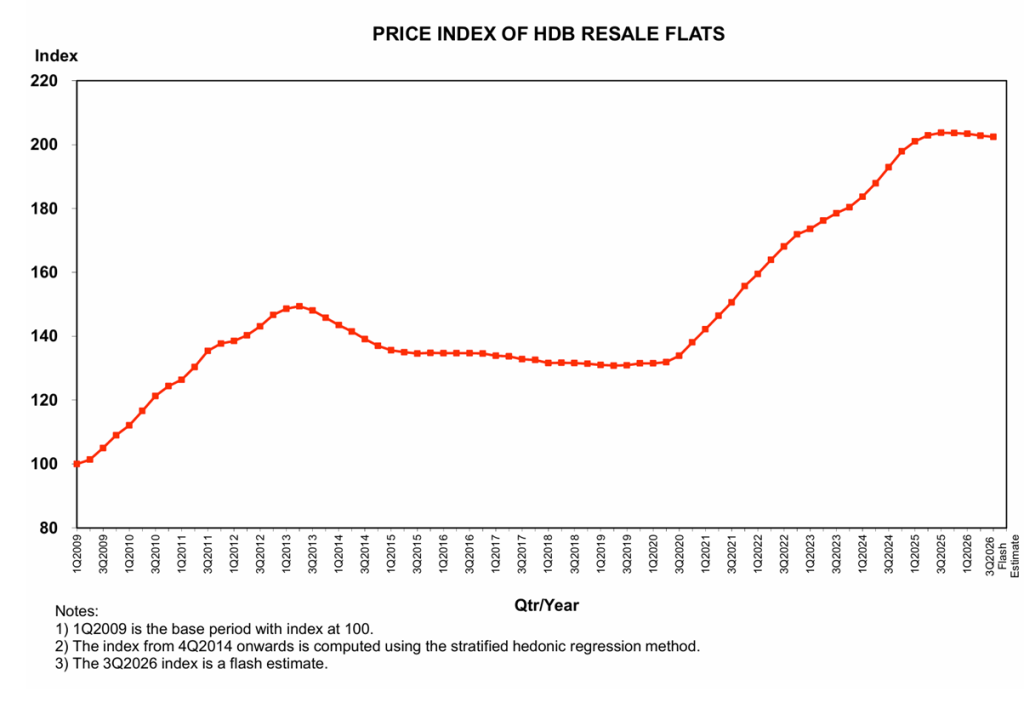
Source: HDB
Based on the Resale Price Index, resale flat prices have climbed from 134.7 in Q1 2016 to 203.4 in Q1 2026, a 51% increase since 2016.
For perspective, the median price of a resale 4-room flat in Bishan in Q1 2016 was $545,000. In Q1 2026, it is now $788,000.
For families with young children looking for a larger space, a 5-room flat in Tampines went from $526,500 in Q1 2016 to $828,000 in Q1 2026.
An executive flat in Jurong West increased from $570,000 in Q1 2016 to $800,000 in Q1 2026.
As for housing and related expenditure, the average resident household spent $2,122 monthly in 2023, or an estimated $2,264 in 2026. This is a 33% increase from $1,703 in 2018.
Understandably, households with young children spent more on housing and related expenses, with many spending more on salaries for migrant domestic workers. Their housing and related expenditure came up to $2,703 in 2023, or an estimated $2,884 in 2026.
Transport: 2016 vs 2026
The average resident household spent $1,038 monthly on transport in 2018. Surprisingly, this number fell in 2023 to $951, or an estimated $1,015 in 2026. This appears to represent a general shift from private to public transport over the past decade.
However, households with young children are more likely to own cars, and even if they don’t, school-going children would likely increase public transport use.
Households with young children spent $1,499 monthly on transport in 2023, or an estimated $1,599 in 2026. This represents an increase of about 54% from 2018.
Category A COE premiums reached a high of $55,200 in 2016, but have since soared to $133,009 in September this year. That’s almost 150% higher than a decade ago.
Public transport fares have also risen since 2016. Adult card fares rose by about 65 cents over a 10-year period, representing a 44% increase.
Education: 2018 vs 2026
Households with young children are naturally spending more on education, including on school fees and private tuition.
Households with the youngest child aged 7 to 15 years spent the most on education in 2023, at $1,058 per month. Households with the youngest child aged 6 years and below spent $984 per month. Both of these figures are more than double the average expenditure of all resident households of $404. In 2026 terms, households with children spend between $1,129 to $1,050 per month on average.
Compare this to 2018, when the average resident household expenditure was just $374 per month on education.
Read Also: From $318 To $677: Why Singaporeans Are Spending More On Tuition?
Incomes Are Also On The Rise
The silver lining in all of this is that household income growth has outpaced household expenditure growth among households with young children. They saw their average household income grow by 4.9% per year between 2018 and 2023. This exceeded the average household expenditure growth of 4.1% per year over the same period.
In general, households with young children tended to earn more than the average resident household.
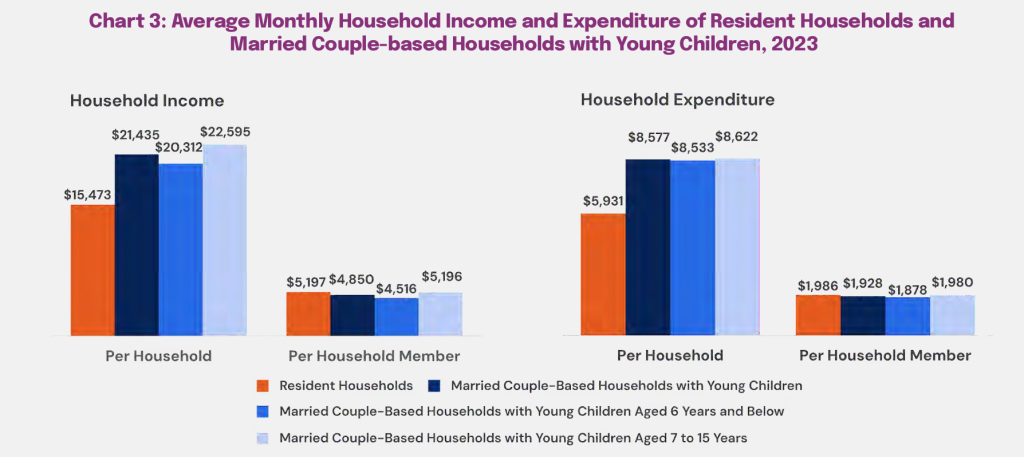
Source: SingStat
Advertiser Message
Thinking Of Switching Brokers Or Consolidating Your Holdings?
Tiger Brokers is currently running a transfer-in campaign where eligible clients can receive an iPhone 17 Pro Max* when they transfer in their assets.
For SGX investors, there is also a CDP Transfer promotion with 0* commissions on Singapore stocks.
Find out more here. *T&Cs apply.