
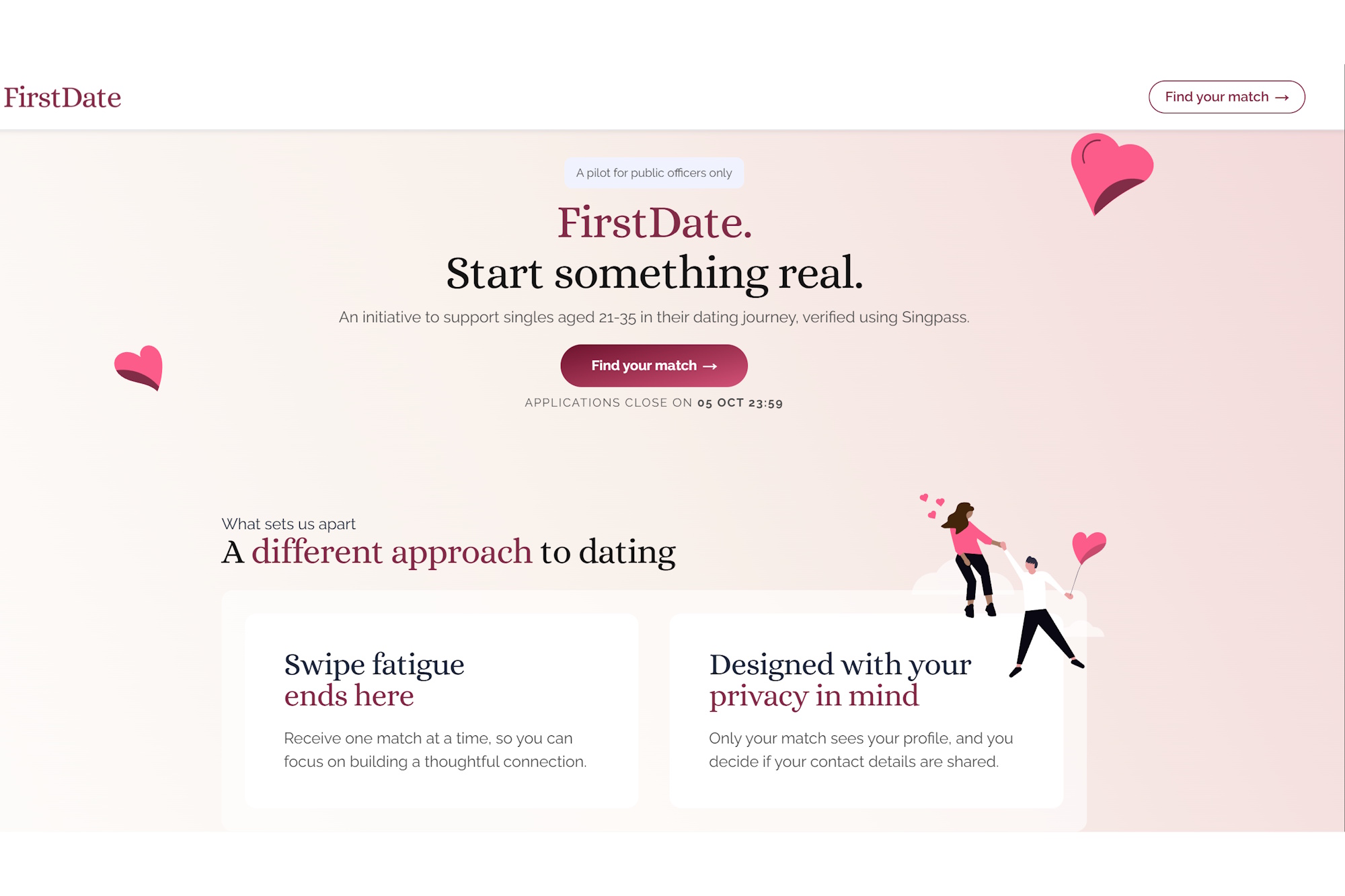
On 29 September 2026, GovTech launched FirstDate, a new Singpass-verified dating platform that hopes to provide a “different approach” to finding a suitable match. By having applicants answer 30 multiple-choice and open-ended questions on topics such as interests, habits, and values, FirstDate aims to understand what they may be looking for in a potential partner. Then, using an established mathematical approach known as the Gale-Shapley algorithm, it generates pairings and recommends matches based on compatibility.
In launching this dating pilot, GovTech is challenging applicants to look beyond the popular dating apps that often provide multiple potential matches. Some, like Tinder, rely almost entirely on physical attractiveness, with very little emphasis on one’s values and preferences. In that sense, FirstDate is more like dating sites such as OKCupid, Bumble and Hinge, which create multiple opportunities beyond physical appearance to determine compatibility.
The Nobel Prize-Winning Algorithm Used By FirstDate
Although it has been in practice since 1952, what eventually became known as the Gale-Shapley algorithm was published in 1962. It eventually won the Nobel Prize in Economics in 2012. Named for mathematicians and economists David Gale and Lloyd Shapley, the algorithm essentially solves the stable matching problem.
In basic market economics, prices adjust so supply and demand are equal. In other words, the price is determined when supply and demand match, where neither buyer nor seller can find a better arrangement. But what happens when these elements are less clear? Gale and Shapley used marriage as one of their examples.
The stable matching problem they came up with was: How would you pair off 10 men and 10 women so that each person ends up with someone they wouldn’t leave for someone else? In this scenario, “stable matching” or “stable marriage” means every pair consists of a man and a woman who know they can’t do better.
The solution is for every man and woman to list their preferences in order. Then, each woman proposes to the man at the top of their list. This means that some men can receive multiple proposals, and some men may receive none. Each man who has received a proposal chooses the woman they prefer most from among the proposals and rejects the others. This is the end of the first round.
Rejected women then propose to the next man on their list. This means that some men may now receive a proposal from a woman they prefer more than the woman they chose in the first round. In that case, they reject the woman from the first round and choose the woman they prefer most from the second round.
This cycle repeats until no woman has been rejected, and the men and women accept the choice as final.
Now, in this illustration, it may seem like it’s the women who keep getting rejected, while the men seem to have all the power to reject, but the mathematical proof reveals that this ends up benefiting the women more than the men – that is, the women always end up with their best possible outcome, while the men always end up with the worst possible outcome.
The opposite would therefore be true if the roles were reversed. If men proposed and women rejected, men would end up with their best possible outcome, while women would end up with the worst possible outcome.
The key to remember is that this algorithm is meant to find a “stable match”: each pair consists of a man and a woman who both know there’s no one better out there, even if the one they’re with isn’t their top choice.
Why This Algorithm Works Better For Job Hunting
The details aren’t spelt out on the FirstDate website, but it says the pairings are generated based on how compatible the two people are, based on their answersto the 30 questions.
The matched pair then decides whether they want to meet, with contact details shared only if both say yes. Notably, there are no physical aspects to this pairing, so you presumably won’t know what the other person looks like until you agree to the first meeting.
By pairing applicants this way, FirstDate seems to take on the proposing process, while giving both parties the power to reject. However, as we pointed out earlier, the party doing the rejecting often ends up with the worst possible outcome. Perhaps the team behind the FirstDate platform already knows this, which is why they encourage “building a thoughtful connection” over the “swipe fatigue” of the most popular dating apps.
But here’s what the algorithm actually won the Nobel Prize for – in 1984, academic Alvin Roth realised that medical internships in the US had been offered since 1952 using an algorithm closely related to Gale-Shapley. Later, after studying similar medical markets in the UK in the 1990s, Roth developed an improved algorithm to distribute medical internships more equitably among applicants.
This algorithm also proved useful for matching students and high schools in US cities, and even kidneys and patients in several US states.
In New York City public high schools, for example, until 2003, applicants were asked to rank their five most preferred choices. Schools would then receive these preference lists and choose which students to admit, reject, or place on waiting lists. As a result, about 30,000 students each year ended up at schools they had not listed, especially if they were honest about their preferences. The system’s limitations meant students often chose a more realistic option as their first choice instead of their preferred school.
In a similar job-hunt scenario, job applicants should be able to rank the roles they want to apply for, and only after being rejected should they be able to apply to their next preferred role. Employers, on their part, should only be allowed to reject an application if they find one that is better for them. This would create a truly stable matching process.


Street Smart
Singapore Gym Membership Price Guide (2026 Edition)


