
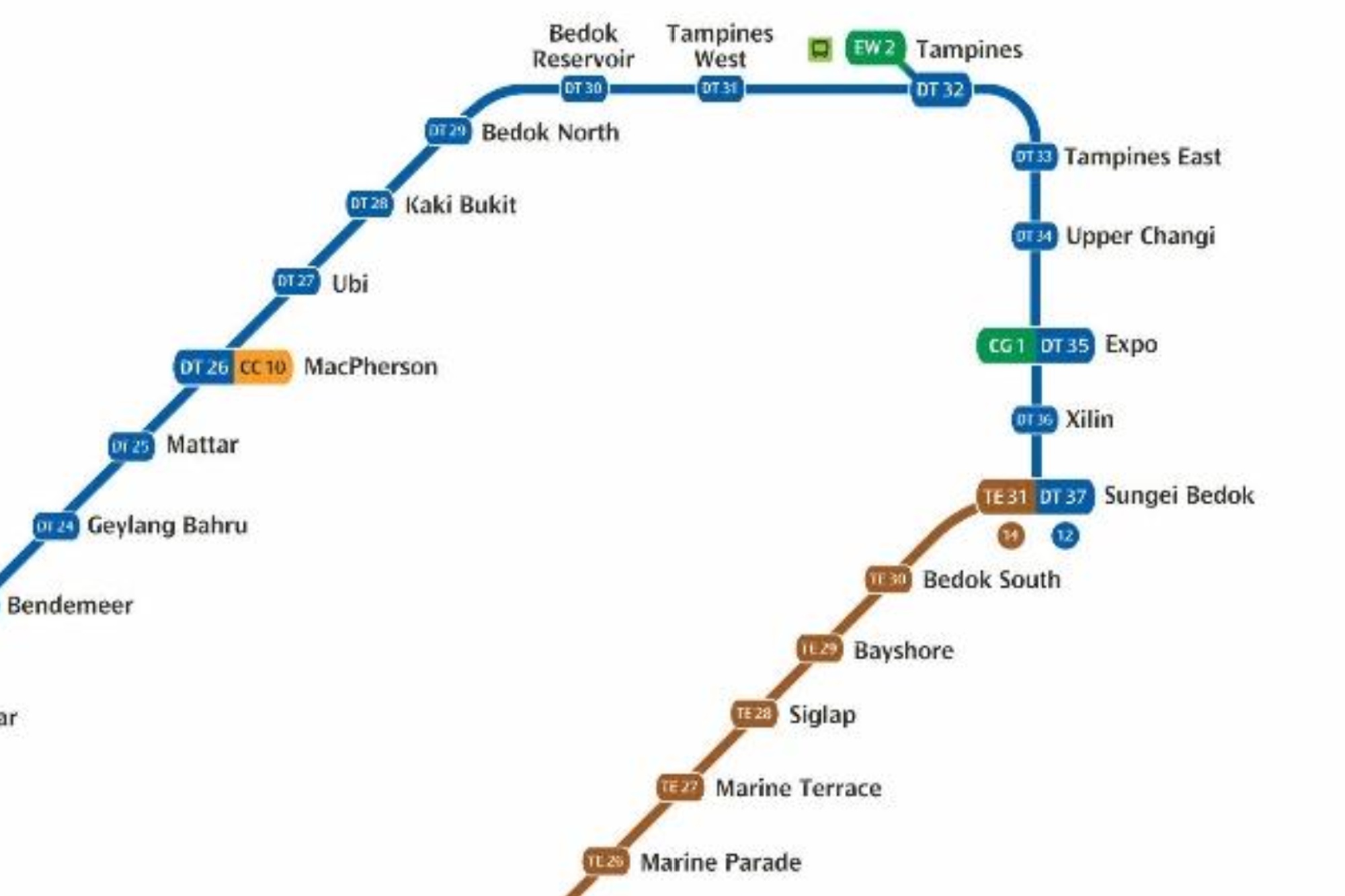
Three new MRT stations will open on 26 December 2026, representing the final stage of the Thomson-East Coast Line (TEL) and creating a new interchange between the TEL and Downtown Line (DTL). These three new stations are Bedok South, Sungei Bedok and Xilin. Sungei Bedok MRT is the second interchange between the TEL and DTL after Stevens, which is on the other side of the island.
These stations make major employment centres such as Changi Business Park and Tampines Regional Centre more connected than ever. The Land Transport Authority (LTA) says the new stations will improve access to these employment nodes while providing faster and more convenient journeys for those living and working along the East Coast corridor.
#1 Bayshore
While Bayshore is officially part of Bedok, it deserves its own mention because of how the new stations will benefit it directly. It is already served by the TEL since mid-2024, with services terminating at Bayshore MRT station.
However, once the Bedok South, Sungei Bedok and Xilin MRT stations open at the end of the year, Bayshore residents will have even easier access to destinations such as Expo, Tampines and Changi Business Park through its connection to the Downtown Line.
This gives commuters more options and convenience when travelling to these locations, since they previously had to use a combination of bus and rail.
With the upcoming development of Bayshore into an urban waterfront estate, and several BTO projects in the area already launched, this extra connectivity has already been priced into many developments.
Read Also: Which MRT Station In Singapore Is The Most Valuable To Live Near To
#2 Marine Parade
Beyond the Downtown Core, many major job centres are found in the East, including Tampines Regional Centre, Changi Business Park, Changi Airport and the surrounding industrial clusters. Naturally, many of those working here would live close by. This is where Marine Parade now benefits further.
Already served by the Thomson-East Coast Line since 2024, Marine Parade residents now have even more commuting options, with easier access to the Downtown Line. This not only saves them commuting time but also boosts the rental market in these areas, as they are now more enticing to workers in the major job centres in the East. LTA estimates that commuters travelling from Marine Parade to Tampines via TEL and DTL can save up to 10 minutes compared to today. In addition, a journey from Marine Terrace to Expo, which currently takes about 40 minutes via bus service 47, would only take 25 minutes via TEL and DTL, saving 15 minutes.
#3 Bedok
While we’ve already mentioned Bayshore earlier, the rest of the Bedok town may not initially seem to benefit from additional connectivity with the opening of these three stations. After all, Bedok MRT already connects to Tampines and Expo on the East West Line, giving workers and residents sufficient transport options.
However, for the many Bedok residents already working in Changi Business Park, the addition of Xilin MRT station will be a huge relief for those who previously had to walk to Expo MRT station or take one of the many shuttle buses to reach the East West Line.
Read Also: URA Draft Master Plan 2025: Transforming New Spaces In The East To Live, Work And Play
#4 Tampines
Tampines, already connected to parts of Bedok thanks to being an interchange for the Downtown Line and East West Line, now becomes better connected to the Thomson-East Coast Line and vice versa.
With the opening of Sungei Bedok MRT interchange, those living in Marine Parade, Bayshore and Bedok gain easier access to Tampines Regional Centre and surrounding business districts.
Residents gain improved access to workplaces, while employers gain improved access to labour. Given Tampines’ role as one of Singapore’s largest regional commercial centres, making it more accessible would further enhance its position as a place to live and work.
#5 North-East Towns Like Sengkang And Punggol
In its press release announcing the stations’ upcoming launch, LTA noted that journeys between Havelock and Changi Business Park could fall from around 70 minutes to about 45 minutes after the new stations open, saving approximately 25 minutes. This makes one wonder where the workers of Changi Business Park tend to live.
According to the latest General Household Survey 2025, about 61,100 Singapore residents work in Bedok, with 35,500, or 58.1%, already taking a combination of rail and bus to get to work. That number is even larger for the 87,800 who work in Tampines, where 54,400 (61.9%) already take a combination of rail and bus to get to work.
The data’s limitations mean we’ll only know which region these workers live in. Naturally, the bulk come from the East Region, but the next biggest region served is the North-East Region. 12,600 residents who work in Bedok and 20,900 residents who work in Tampines come from the North-East Region.
While there is still no direct MRT line from the North-East Region to Changi Business Park, the opening of Xilin station makes commuting more convenient for workers there.
Top Image Credit: LTA
Advertiser Message


