
If you have noticed your Integrated Shield Plan (IP) rider premiums rising each year, you might be wondering whether it is still worth paying for the extra coverage.
You are not alone. According to a Straits Times report, about 112,300 policyholders dropped their IP riders in 2025, a 72% increase from 2024. Another 69,400 policyholders chose to downgrade their riders instead.
While dropping an IP rider can help reduce our annual insurance premiums, it also means taking on a larger share of our hospitalisation expenses. More importantly, we may not be able to get some of the benefits back in the future.
Before deciding whether to cancel our existing IP rider, ask ourselves these five questions.
#1 Do You Have Pre-Existing Medical Conditions That May Affect Your Coverage?
One important consideration before dropping your IP rider is whether you have developed any medical conditions since purchasing your insurance policy.
For example, you may have purchased your IP and rider when you were healthy, but subsequently developed a chronic illness, undergone surgery or received treatment for a serious medical condition. As long as you maintain your existing policy, you continue to enjoy coverage for these conditions.
However, if you cancel your rider and later decide to purchase one again, the insurer may require medical underwriting. Depending on your medical history, the insurer could impose exclusions, charge higher premiums or even reject your application altogether.
Do note that cancelling your rider does not mean losing the coverage provided by your underlying IP. You would still be covered for eligible medical expenses under your existing IP. However, you may bear a larger portion of the hospital bill through higher deductibles and co-payments.
#2 Does Your Existing Rider Offer Better Coverage Than New Riders?
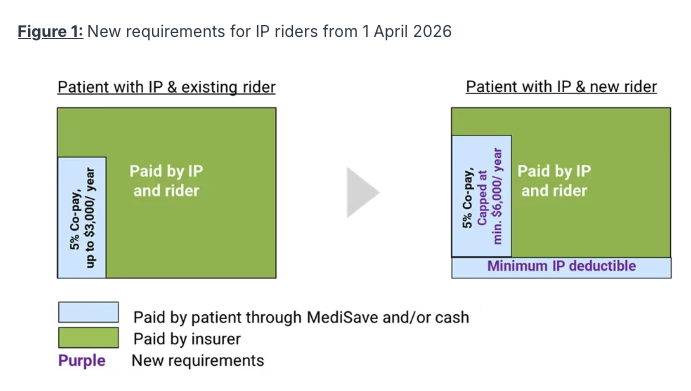
Another consideration is that your existing IP rider may offer benefits that are no longer available under newer riders. From 1 April 2026, the Ministry of Health (MOH) introduced new requirements for IP riders to address rising healthcare costs and insurance premiums.
Under the new requirements, IP riders can no longer cover the minimum deductible, which ranges from $1,500 to $3,500 depending on the ward class. The minimum annual co-payment cap has also increased from $3,000 to $6,000, excluding the deductible.
Source: MOH
This means someone purchasing a new rider today may have to pay a larger portion of their hospital bill than someone still covered under an older rider.
However, policyholders who purchased their riders before 27 November 2025 are not automatically required to switch to the new riders. Individual insurers will determine how to manage their existing policies.
While the new riders are around 35% to 40% cheaper on average compared to older riders offering maximum coverage, they also provide less protection against out-of-pocket medical expenses.
If you currently hold an older rider with more generous benefits, cancelling it could mean giving up coverage that you may no longer be able to purchase again.
#3 What If You Change Your Mind About Dropping Your Rider?
Even if you are currently healthy and have no pre-existing medical conditions, there is no guarantee you will be able to purchase an IP rider again in the future.
For example, you may decide to cancel your rider today to save on premiums, only to reconsider your decision five or ten years later when you are older and more concerned about your healthcare needs. However, your health may have changed during this period. You could develop a medical condition that makes it harder or more expensive to obtain insurance coverage.
Unlike MediShield Life, which provides coverage regardless of pre-existing medical conditions, private insurers offer IP riders and generally subject them to medical underwriting when you apply for a new policy.
This means that even if you can afford the premiums in the future, you may not necessarily qualify for the same level of coverage you previously enjoyed.
Before cancelling your rider, consider whether you are comfortable with the possibility that this decision may be difficult to reverse.
#4 Can You Afford Higher Out-Of-Pocket Medical Expenses Without Your Rider?
While dropping your IP rider can help you save on insurance premiums, you should also be prepared to pay a larger portion of your hospital bills if you require medical treatment.
Without a rider, you would typically need to pay the deductible and co-insurance under your IP.
For example, suppose you incur an eligible hospital bill of $50,000 and your IP has a deductible of $3,500 and a co-insurance rate of 10%.
Without a rider, you would pay the $3,500 deductible, followed by $4,650 in co-insurance, bringing your total share of the hospital bill to $8,150.
In comparison, someone with an existing rider that covers the deductible and caps co-payments at $3,000 annually may only need to pay $3,000 for the same bill, assuming the claim qualifies for the cap.
Source: MOH
Rather than viewing the decision to drop your rider purely as a way to save on premiums, you should also channel these savings toward future healthcare expenses.
For example, if you save $2,000 annually by dropping your rider, setting aside that amount would let you accumulate $10,000 over five years, excluding interest. This could help cover future deductibles and co-insurance payments.
Ultimately, dropping your rider should be a deliberate decision to take on more of your future healthcare costs, rather than simply a way to reduce your insurance premiums.
#5 How Much Are You Actually Saving By Dropping Your Rider?
Ultimately, the decision to drop your IP rider should also depend on how much you save in premiums compared to the additional financial risk you take on.
For example, someone paying $500 annually for their rider may find that the savings are relatively modest compared to the additional protection they would be giving up. However, for someone paying $5,000 annually, the savings could be substantial, particularly over a longer period.
This is especially relevant for older Singaporeans, as IP rider premiums generally increase with age. What may have been affordable when you were younger could become a significant expense during retirement, when you no longer have a regular employment income.
It is also worth considering whether you still need the same level of hospitalisation coverage. For example, if you are already retired and are now comfortable seeking treatment at a public hospital instead of a private hospital, you may wish to review whether your existing IP and rider remain suitable for your needs.
Photo Credit: iStock/tang90246
Advertiser Message


Bonds and Fixed Income
6 Investments In Singapore That Provide Guaranteed Principal And Returns

Health Insurance
5 Questions To Ask Before Dropping Your Integrated Shield Plan Rider


Bonds and Fixed Income
6 Investments In Singapore That Provide Guaranteed Principal And Returns


