

Retrenchments are on the rise in Singapore, reaching 4,620 in Q2 2026, according to the Ministry of Manpower’s latest Labour Market Report. This is the highest level since Q4 2020, in the midst of the pandemic. At the same time, global interest rates are on the rise, with the US Fed increasing its benchmark interest rate last week, the first time since 2023. It is expected to increase it once more before the end of the year. For households with home loans in Singapore, the question is if they can still afford to repay their home loans should they experience a change in household income.
Read Also: 3 Ways The Fed Raising Interest Rates Could Affect Our Money In Singapore
MAS Regularly Conducts Assessments Of Singapore’s Financial System
In its annual Financial Stability Review, MAS uses a three-pronged stress-test scenario to assess how resilient households are under severe conditions. The stress test assumes changes in household income, employment rate and a rise in home loan rates.
The criteria for stress tests constantly change year to year. This is because MAS aims to portray a severe stress scenario for that period. For example, in 2024, as home loan rates were expected to peak, the stress test assumed an immediate increase to 5.5%, along with a simultaneous 10% drop in household income.
In 2025, amidst “macroeconomic uncertainties”, MAS assumed a 20% drop in household income and a 1% increase in mortgage rates.
Read Also: What A 1% Increase In Interest Rates Could Mean For Your Home Loan Repayment
What Is MAS’ Severe Stress Scenario in 2026
These “macroeconomic uncertainties” continue to affect households in 2026, as ongoing energy supply disruptions have kept oil prices high.
In the latest Financial Stability Review 2026, the MAS stress test assumes a 10% drop in household income, higher unemployment, and a 2% increase in mortgage rates.
According to MAS, this scenario represents the possibility of a sharp retrenchment in AI-related investment that affects global growth, business investment and semiconductor demand. Such a sharp global AI-related downturn would adversely affect households in Singapore.
Read Also: Singapore’s Economy Grew 5.9%. So Why Does Economic Growth Feel Less Tangible For Workers Today?
Households In Singapore Remain Financially Resilient
The good news is that, according to MAS, the “significant majority” of households servicing home loans will be able to manage income and employment shocks even in this stress test scenario.
This is because households in Singapore generally hold more liquid assets, such as cash deposits, than household debt. Over the past 10 years, Singapore households almost doubled their liquid assets from $381 billion in Q2 2016 to $714 billion in Q2 2026 (an 87.4% increase). During that same period, household debt increased from $320 billion to $423 billion (a 32.2% increase)
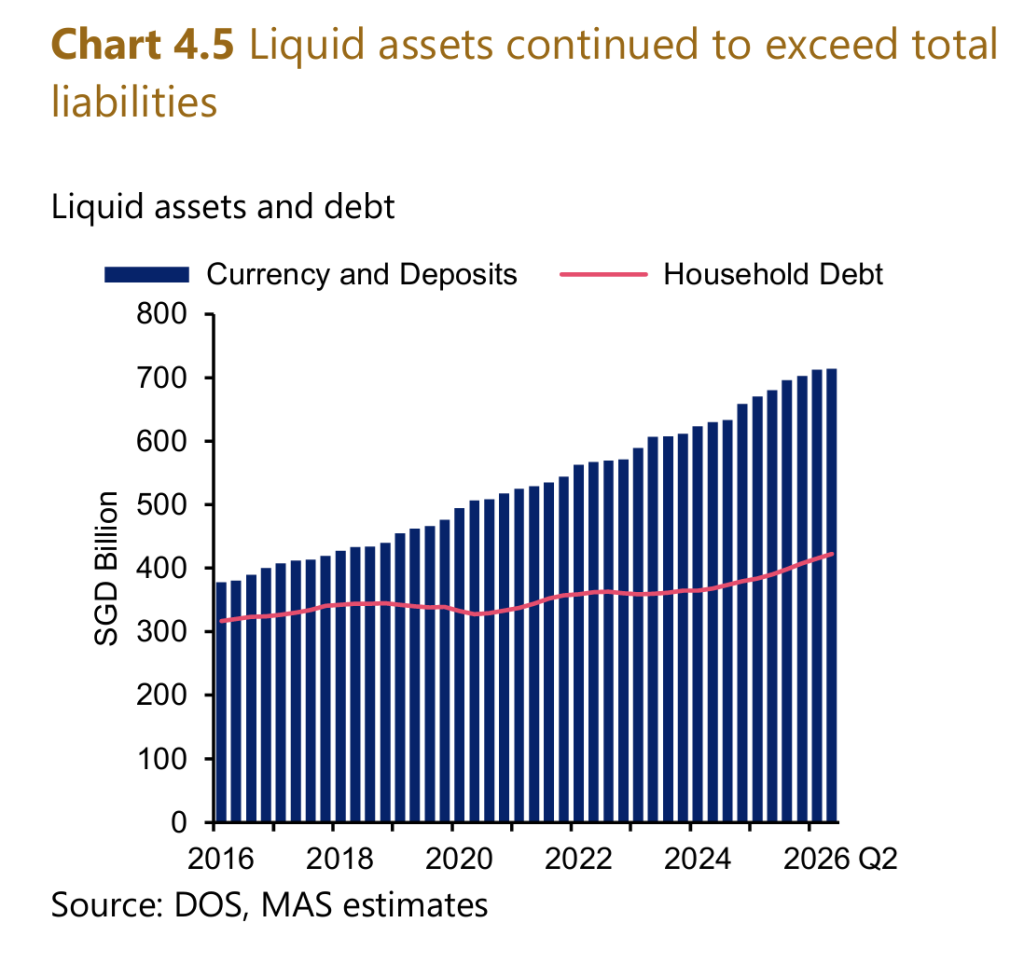
Source: Financial Stability Review 2026
That said, as property prices increase, MAS noted that there has been an increase in personal loans and mortgage borrowing. This is reflected in the slight increase in the household debt to personal disposable income ratio, which increased from 1.04 in Q2 2025 to 1.08 in Q2 2026.
However, MAS is also quick to point out that this is still very much below the 10-year average.
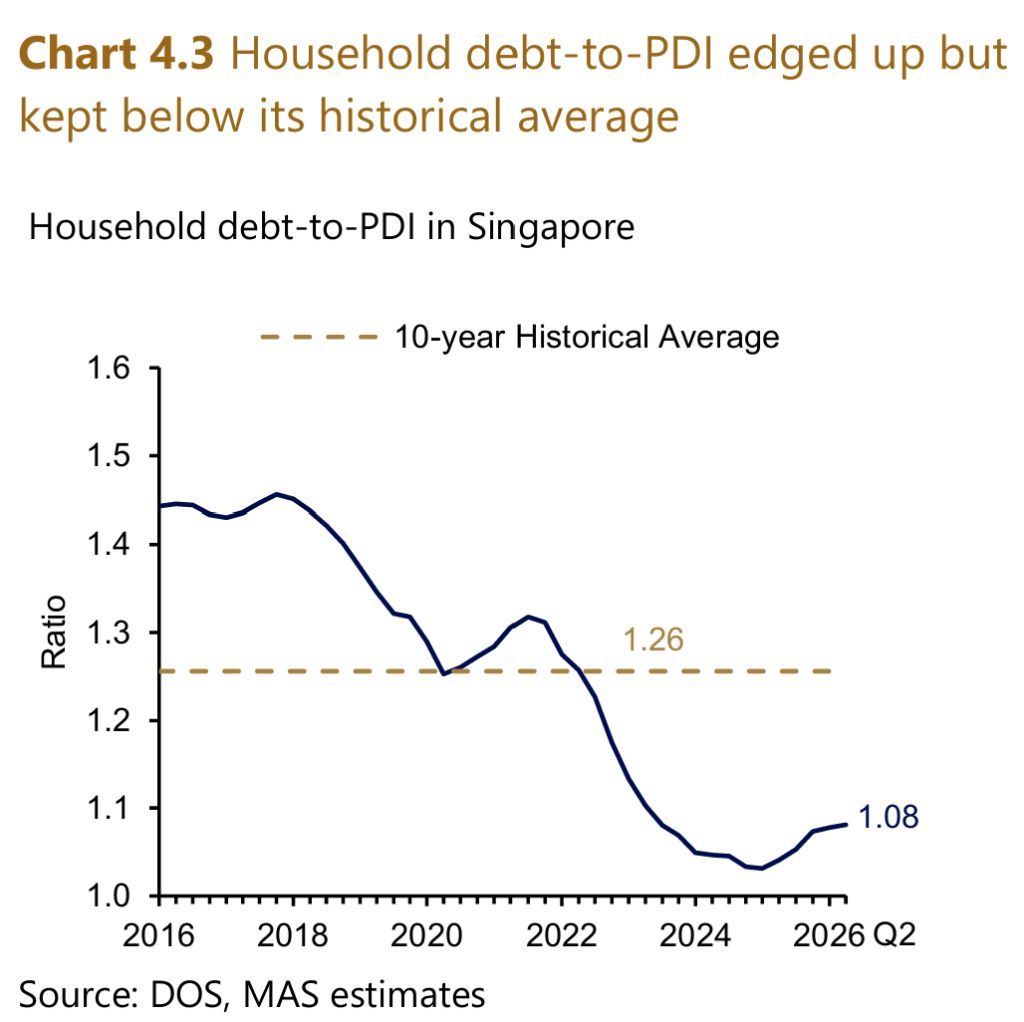
Source: Financial Stability Review 2026
That said, what has increased steadily since 2022 and has gone past the historical average is the rollover balances as a share of personal disposable income. This refers to the outstanding balances on credit cards and personal loans. It is currently at 2.5% the personal disposable income, coming close to pre-pandemic levels.
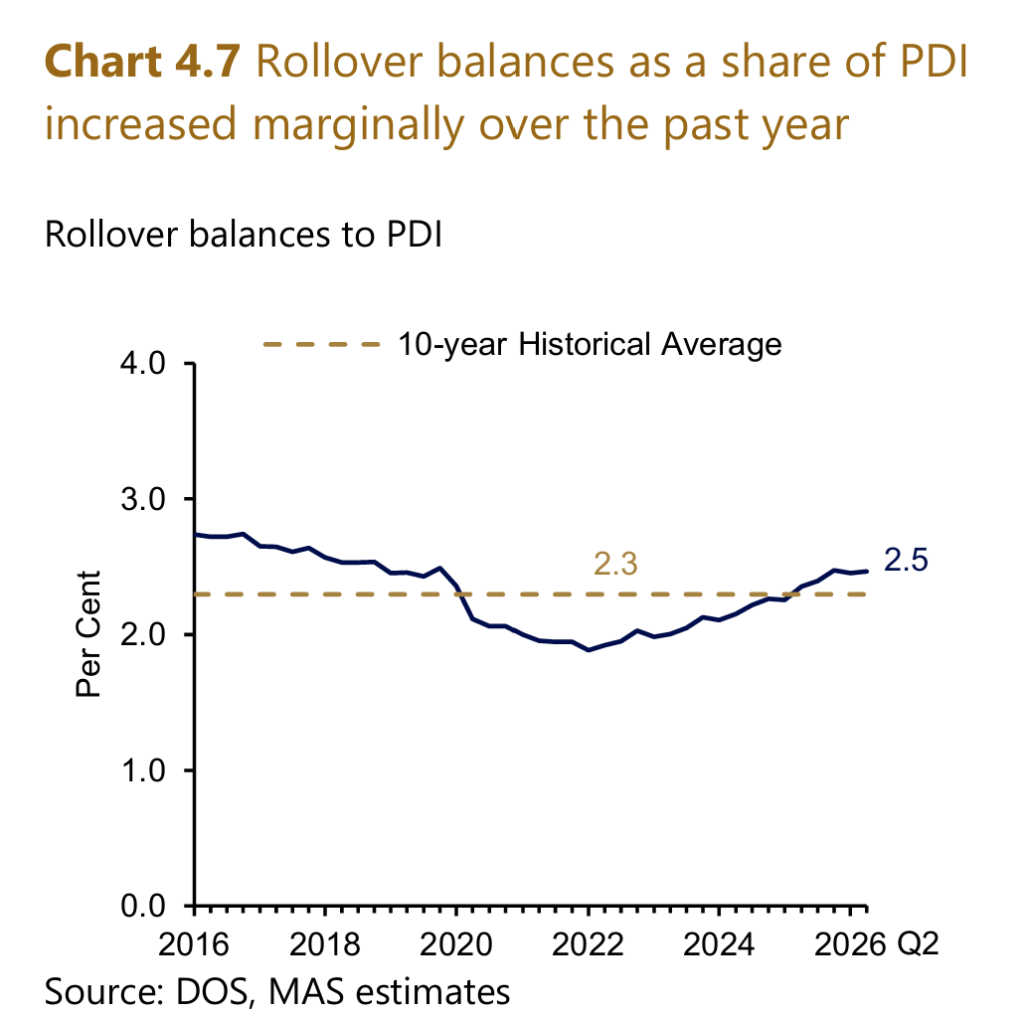
Source: Financial Stability Review 2026
Around 1% Of Borrowers Are More Vulnerable Under The Stress Scenario
Under the MAS stress test, around 1% of borrowers could experience negative cash flow under the severe stress scenario and have existing savings covering less than six months of the resulting cash-flow shortfall.
A three-to-six month savings buffer is the standard benchmark for financial resilience, especially in temporary income loss due to retrenchment, illness or injury.
MAS revealed that these vulnerable households are mainly “middle-aged HDB dwellers with relatively lower income”, with a minority made up of “middle-income borrowers with sizeable private housing loans”.
In order to ensure financial resilience, in light of the continued uncertain macroeconomic outlook, households should therefore maintain a three- to six-month savings buffer, and where possible, avoid taking on additional leverage.
Read Also: Interest Rates Are Going Up. Should I Be Refinancing My Mortgage As Soon As Possible?


Lifestyle
15 Of The Cheapest EV Cars In Singapore


Budgeting 101
7 Ways Being Frugal Is Different From Being Cheap


Street Smart
Singapore Gym Membership Price Guide (2026 Edition)
Street Smart
Singapore Gym Membership Price Guide (2026 Edition)


