

The term “middle-class” has no clear definition. Everyone thinks they know what it means, but when asked directly, definitions may vary wildly. This is especially true in Singapore, where people can define middle-class in a variety of ways. These can include income, lifestyle, housing type, or simply the ability to afford holidays and enrichment classes without worrying about bills.
Median National Income
The Organisation for Economic Co-operation and Development (OECD) defines middle-income households as earning between 75% and 200% of the median national income. Using the latest median monthly household market income of $12,446 in 2025, a middle-income household in Singapore earns between $9,335 and $24,892 every month.
Note that these values are obtained under the new definition of “market income”, which includes both employment and non-employment income.
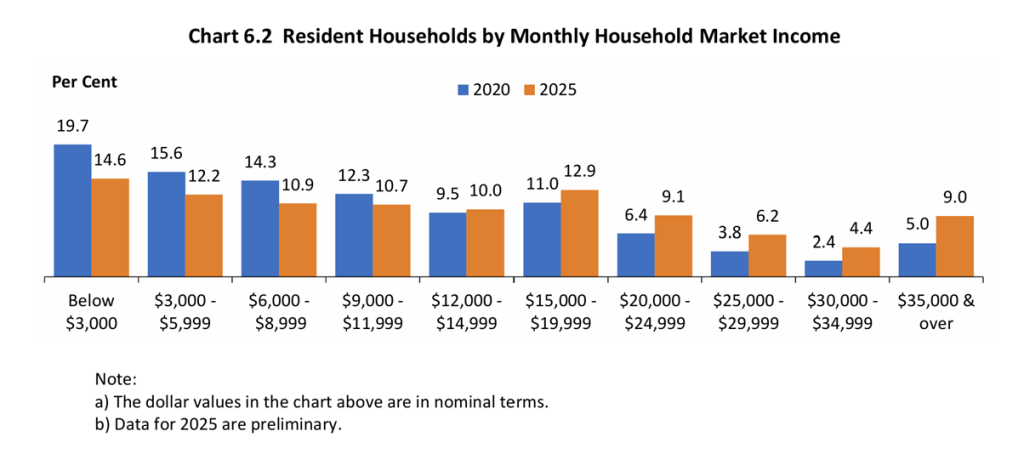
Another way to define the middle class is the range between the 25th percentile and the 75th percentile. In 2025, based on monthly household market income, a middle-class resident household earns between $6,000 and $24,999 each month.
Read Also: What Is The Household Income For Singapore Families? (Based On Flat Types, Household Members)
Median National Income Per Household Member
After accounting for household size, the median monthly household market income per household member is $4,160 in 2025. This means each member of a middle-income household earns between $3,120 and $8,320 per month.
Once again, these values are based on the updated definition of “market income”, so both employment and non-employment income are factored in.
By this definition, each member of a middle-income household earns between $37,440 and $99,840 per year. This is a relatively wide range, as those on the lower end would still qualify for the government’s GST Voucher-Cash payout, which has an income threshold of $39,000.
Yet all will qualify for the government’s Enhanced Cost-of-Living Special Payment 2026 this September, with an assessable income of $100,000 or less.
Read Also: How Much Will You Receive From The Enhanced Cost-Of-Living Special Payment In September?
This wide range means that households at the lower end may feel more affected by the rising cost of living, while also enjoying greater government benefits. On the other end of the spectrum, many households would be more than comfortably described as “upper middle-class”.
Housing Type
Another way to define middle-class is to look at where the average Singaporean lives. According to the General Household Survey 2025, Singapore has 1,487,000 resident households. Of these, 77.2% live in HDB flats.
More than half of resident households (54.2%) live in 4-room (31.2%) or 5-room and executive (22.1%) flats. The median resident household lives in a 4-room HDB flat.
One difference between HDB living and living in a condominium or other private property is the government benefits such as U-Save and S&CC rebates, which are only given to HDB households.
Read Also: From CDC Vouchers To Cash Payouts: How Much Is A Middle-Income Family Receiving In 2026
Source Of Income
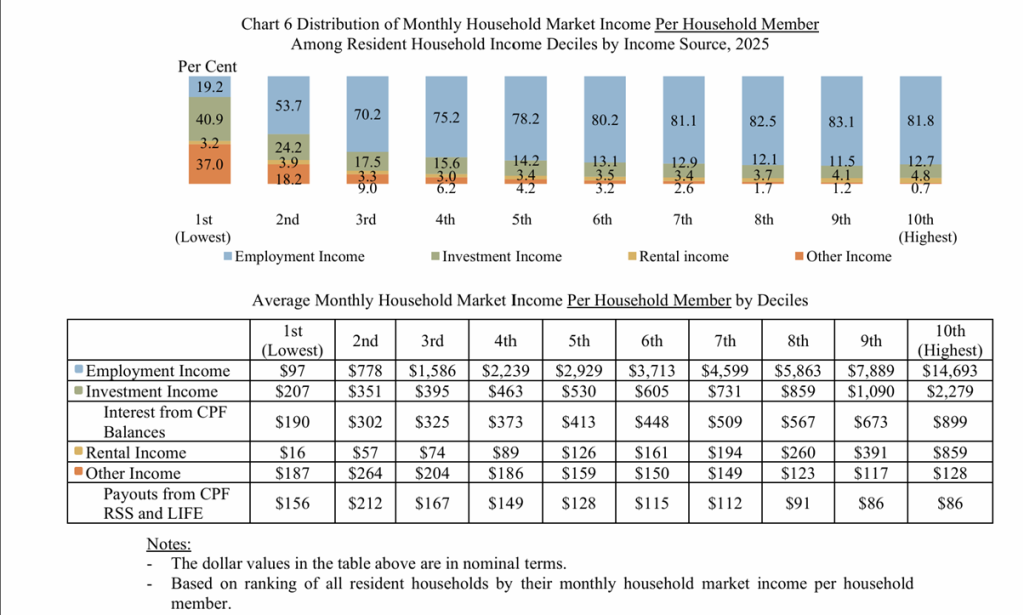
In the latest Key Household Income Trends Report, data revealed that employment income formed the largest share of income for most resident households. For those in the middle-class, average monthly employment income per household member ranged from $1,586 to $4,599. Investment income, which includes interest from CPF balances, ranged from $395 to $731 each month.
Notably, investment income tended to make up a larger share of household income for those at the lower end of the “middle class”. Those on the higher end of the spectrum had a slightly larger proportion of employment income.
Why It’s Difficult To Determine What Middle-Class Truly Is
Pinning down what “middle class” means in Singapore requires looking at multiple factors. On paper, economists can define it neatly using income brackets relative to the median household income. But the wide range this results in, where it could include families earning just enough to cover rising costs, to those comfortably affording private enrichment and overseas holidays, shows how diverse the middle-class experience can be in Singapore. A household earning $9,500 a month and another earning $24,000 both technically qualify, yet their lifestyles and financial concerns can feel worlds apart.
Income alone therefore doesn’t capture the full picture. Household size, housing type, and other expectations will shape what Singaporeans perceive as “middle-class.” A family in a 4-room HDB flat may feel firmly middle-class, while another in a condominium might still identify the same way despite earning a much higher income.
Read Also: Are Larger Households Getting Less Support Per Household Member
Advertiser Message
Thinking Of Switching Brokers Or Consolidating Your Holdings?
Tiger Brokers is currently running a transfer-in campaign where eligible clients can receive an iPhone 17 Pro Max* when they transfer in their assets.
For SGX investors, there is also a CDP Transfer promotion with 0* commissions on Singapore stocks.
Find out more here. *T&Cs apply.




Family Planning
Cost Guide To International School Fees In Singapore


