

When it comes to understanding the income levels in Singapore, we can reference a few key statistics. According to the Ministry of Manpower (MOM), as of 2025, full-time employed residents’ median gross monthly income is $5,775 (including employer CPF contributions). Excluding employer CPF contributions, Singapore’s median monthly income is about $5,000 in gross wages.
At first glance, this might seem reasonable, but when we consider the median gross salary of fresh graduates, the picture changes slightly. The Graduate Employment Survey for 2025 shows that the median salary for fresh graduates is $4,500. This creates a sense of disconnect, as the median salary of a fresh graduate is almost on par with the median gross monthly income of all workers in the country.
While individual salaries may appear relatively high, especially for fresh graduates, it’s essential to consider how this translates into household income. According to data from the Department of Statistics Singapore, the median monthly household market income from work (including employer CPF contributions) was $12,446 in 2025. If we exclude employer CPF contributions, the gross median monthly household income would be approximately $10,591.
According to Singstat, the 2025 household market income figures are based on an expanded scope that now includes non-employment income such as rental income, investment income, annuity and Central Provident Fund (CPF) payouts. This change reflects Singapore’s ageing population of households, particularly households that comprise entirely of non-employed persons aged 65 and above.
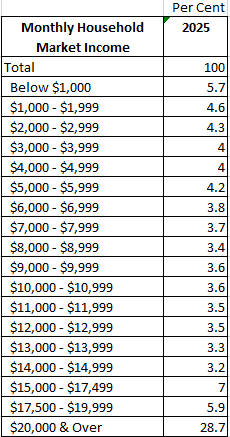
Here’s a breakdown of monthly household market income, excluding employer CPF contributions.
Source: Department of Statistics Singapore
Firstly, we can observe that around 23% of Singapore households earn less than $5,000 per month, with about 6% of households earning $1,000 or less. The middle-income group, earning between $5,000 and $13,000 (or double the median income), makes up about 30% of households. Meanwhile, a significant share of households earns $13,000 and above, with the largest group of around 29% earning $20,000 or more.
If your household earns $20,000 or more per month from work, you are within Singapore’s top 30% of income earners.
While these figures might seem substantial, it’s important to remember that this income is shared among all the household members. Since household sizes vary, it can be more insightful to consider household income on a per-member basis to get a clearer picture of the financial situation. This gives a better understanding of the income available to each person in the household, helping to contextualise the overall financial well-being of different families.
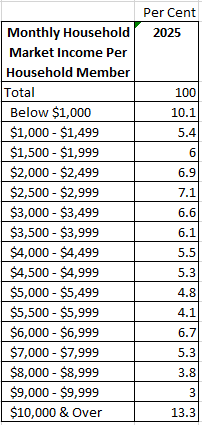
For instance, a family of six with a household income of $20,000 (two adults, three children, and an elderly non-working parent) may be in Singapore’s top 15% of household incomes. However, when you break it down per household member, their income is $3,333 per person, placing them closer to the lower-median income range.
In contrast, a household earning close to the median household income of $11,000 but consisting of only two members would have a household income per person of $5,500. This puts them in a much higher position, closer to the top 35% of households by income per member.
In other words, while total household income is important, the number of people in the household is equally crucial. A household earning $20,000 with six family members (two adults and three children, and an elderly non-working parent) might feel less financially comfortable than a DINK couple earning a combined $11,000. The financial pressures differ significantly based on household size.
Thou Shall Not Compare With Your Neighbours
We all know that comparing ourselves to our neighbours isn’t something we should do — but sometimes, it’s hard to resist. Whether it’s seeing the new car they just bought or hearing about their latest holiday, it’s natural to feel curious, or even envious, about how others are doing.
However, it’s important to remember that everyone’s financial situation is unique. What may appear as wealth or success on the outside might not entirely reflect their underlying financial commitments or lifestyle choices.
For example, household income can also be broken down into the type of property you live in.

Four-room HDB flats are the most common type of dwelling in Singapore, so it’s not surprising that the average monthly household income from work for these households — $11,097 — closely aligns with the gross median monthly household income, which is $10,591.
On the higher end of the spectrum, households living in private properties have an average income that is easily above $20,000, which coincides with the upper range of household incomes. Earning $20,000 or more places a household within the top 15% of earners in Singapore. This is also reflective of the fact that nearly 80% of Singaporeans live in HDB flats – while the remaining 20% live in private properties.
Read Also: What’s The Median Salary In Singapore (At Every Age, Gender, Education and Race)


