

In August 2026, eligible Singaporeans can receive up to $850 in cash as part of the GSTV-Cash payout. For those receiving GST Vouchers (GSTV), this is a welcome support to help with the rising cost-of-living expenses. However, the GSTV is not something new to Singaporeans. In fact, the GST Voucher Scheme is a permanent scheme introduced in Budget 2012 and has been around for more than a decade.
Read Also: Singapore Budget 2026: 5 Announcements That Will Benefit Everyday Singaporeans Financially
GST Voucher Scheme Was Implemented To Offset GST
Singapore’s tax system is generally progressive. This means the lower-income earners receive more benefits compared to the taxes they pay, and higher-income earners pay more taxes. According to the Budget 2012 speech, the top 20% of households pay 80% of income tax collected in Singapore.
However, Good & Services Tax (GST) is a tax on domestic consumption. While we can expect wealthier individuals to spend more, and thus pay more GST, it can also be seen as a regressive tax – as it is a flat tax and impacts all buyers equally.
To offset the effects of GST on the lower income group, the Singapore Government initially implemented a series of temporary offsets to support Singaporeans through the transition when GST rate was raised from 5% to 7% in 2007. In 2012, the GST Voucher scheme was made permanent to carry on the transitional offsets and provide assurance that GST will not hurt the poor. It is one of the permanent transfer schemes that help lower-income Singaporeans benefit from our tax system.
The GST Voucher (GSTV) Scheme comprises four components that provide support for various household needs: Cash for immediate needs; MediSave for seniors to support their medical needs; U-Save to offset utilities bills; and S&CC Rebate to offset S&CC bills.
Read Also: 6 Things Every Singaporean Should Know About The GST
#1 GSTV-Cash For The Immediate Needs Of Lower-Income Singaporeans
The most obvious form of support is cash and GSTV-Cash is the government’s way of supporting lower-income Singaporeans for their immediate needs. The cash payout is paid out every August, and mainly paid via PayNow-NRIC.
To qualify for GSTV-Cash in 2026, you will need to:
- be a Singapore citizen, residing in Singapore;
- aged 21 or above;
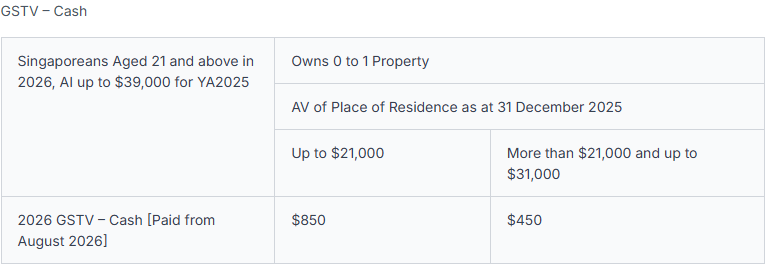
- have an Income Earned in 2024 as assessed by IRAS (Assessable Income (AI) for the Year of Assessment (YA) 2025) not exceeding $39,000;
- have the Annual Value (AV) of your home (as indicated on your NRIC) as at 31 December 2025 not exceeding $31,000; and
- not own more than one property
From 1 January 2025, the government raised the Annual Value (AV) threshold for the second tier of GSTV-Cash coverage from [$21,000 – $25,000] to [$21,000 – $31,000]. This means eligible Singaporeans living in homes with AV of less than $21,000 will continue to receive the enhanced GSTV-Cash of $850, while those living in homes with AV of more than $21,000 to $31,000 will be eligible to receive $450.
Source: govbenefits
Read Also: Annual Value (AV) Of Your Residential Property: Here’s How Its Calculated And Why It Matters
#2 GSTV-MediSave For The Medical Needs Of Seniors
For seniors, medical care is one of the areas that requires more support and GSTV-MediSave addresses this with MediSave top-ups for eligible seniors. The top-ups will be credited directly into CPF MediSave account in August.
To qualify, you need to:
- be a Singapore citizen, residing in Singapore;
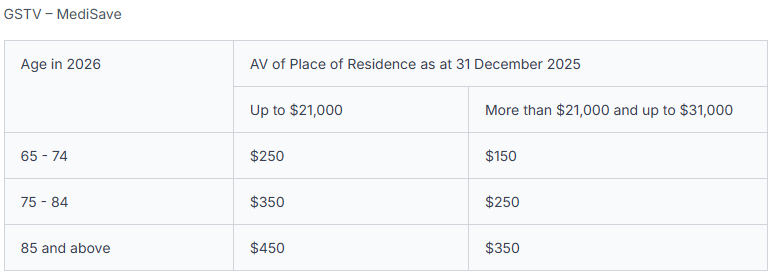
- be aged 65 or above in 2026;
- have the Annual Value (AV) of your home (as indicated on your NRIC) as at 31 December 2025 not exceeding $31,000; and
- not own more than one property
The MediSave top-ups are between $150 to $450, depending on the age and annual value of your home. Note that income is not a factor for GSTV-MediSave and eligible seniors will continue to receive their GSTV-Cash if they qualify.
Read Also: 9 Ways You Can Use Your MediSave To Pay For Your Healthcare Expenses
#3 GSTV-U-Save Reduces HDB Households’ Utilities Expenses
Utility expense is something that every household incurs and is one of the basic expenditures that may disproportionately affect lower-income groups.
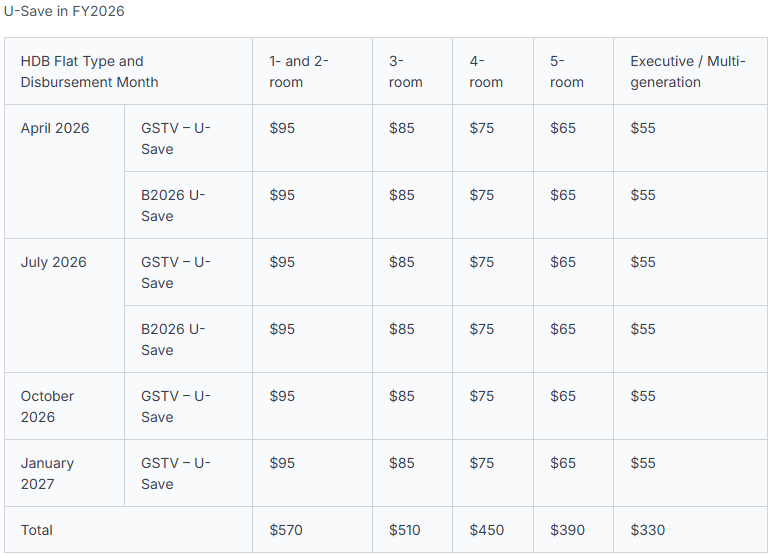
To offset the effect of higher GST rate on our utility bills, GSTV-U-Save rebates is given out to HDB households. This is a quarterly rebate on our utilities bills and is paid out in January, April, July and October each year.
Only HDB households are eligible for the GST Voucher-U-Save. To receive the GST Voucher-U-Save, your household has to fulfil the following conditions:
- If your HDB flat is not rented out, there must be at least one Singapore citizen owner or occupier in the flat; or
- If you rent an entire flat, there must be at least one Singapore citizen tenant;
And
- If your HDB flat is not rented out, all owners and essential occupiers must not own or have any interest in more than one property; or
- If you rent an entire flat, all tenants must not own or have any interest in more than one property.
Source: govbenefits
The U-Save rebates will be credited directly into the household’s utilities account managed by SP Services and any unused U-Save rebates will be rolled over to help offset subsequent month’s utilities bills.
#4 GSTV-S&CC Rebate To Offset HDB Household Expenses
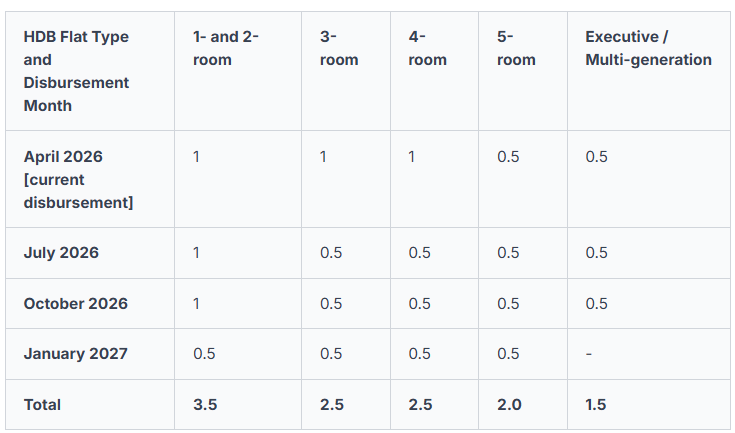
Similar to utilities, Service & Conservancy Charges (S&CC) are one of the base expenditures that every HDB household incurs. To offset these charges, the eligible HDB households will receive GSTV-S&CC Rebates. This is a quarterly rebate and is paid out in January, April, July and October.
Initially given out as a temporary support measure, the S&CC rebates were rolled into the permanent GSTV scheme since FY2022.
Only Singaporean households living in HDB flats are eligible for the GST Voucher (GSTV) – S&CC Rebate. To receive the GSTV – S&CC Rebate in 2026, you must fulfil the following criteria:
- There must be at least one Singapore citizen flat owner or occupier in the flat;
- The flat owner(s) and essential occupier(s) of the flat do not own or have any interest in a private property; and
- The flat owner(s) have not rented out the whole flat.
In general, eligible HDB households will receive between 1.5 to 3.5 months of rebates. As announced in Budget 2026, eligible HDB households receive additional U-Save rebates in April 2026 and July 2026 on top of the regular GSTV–U-Save rebates.
Source: govbenefits
Read Also: How Much Service & Conservancy Charges (S&CC) Do You Pay Each Month (And Rebates You Receive)?


Budgeting 101
7 Ways Being Frugal Is Different From Being Cheap


Street Smart
Singapore Gym Membership Price Guide (2026 Edition)


Street Smart
Singapore Gym Membership Price Guide (2026 Edition)


