

At the National Day Rally in 2019, then-Prime Minister Lee Hsien Loong announced that Singapore’s statutory Retirement Age and Re-Employment Age would be gradually raised, as Singaporeans live longer and healthier lives.
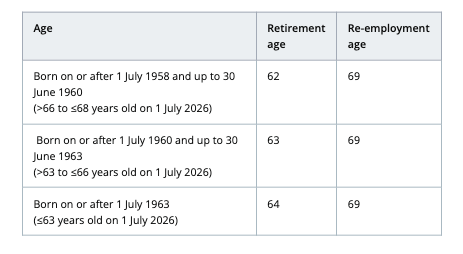
The latest increase took effect on 1 July 2026, when Singapore’s minimum Retirement Age rose from 63 to 64, while the Re-Employment Age increased from 68 to 69. The Government remains on track to raise these further to 65 and 70 respectively by 2030.
While the two ages are related, they serve different purposes. Understanding the distinction can help us better plan how long we want to remain in the workforce and what options we have as we approach retirement.
Read Also: 3 Simple Ways For S’poreans To Stay Ahead In Their Career
The Retirement Age Is Different From Re-Employment Age
The first thing to know is that Singapore’s official retirement age differs from the re-employment age.
Retirement Age: Currently 64 years as of 1 July 2026. This is to be increased to 65 by 2030
From 1 July 2026, Singapore’s minimum retirement age is 64. Employers generally cannot retire an employee on the basis of age before the employee reaches the applicable statutory retirement age.
This does not mean that an employee below 64 cannot be dismissed for legitimate reasons such as poor performance or retrenchment. However, dismissing an employee simply because of their age is not allowed.
Employees who believe they have been wrongfully dismissed because of their age may appeal in writing to the Minister for Manpower within one month of their dismissal.
Re-Employment Age: Currently 69 as of 1 July 2026. This is to be increased to 70 by 2030
Reaching the retirement age does not necessarily mean that we have to stop working. Employers must offer eligible employees who reach the applicable retirement age re-employment so they can continue working, up to age 69.
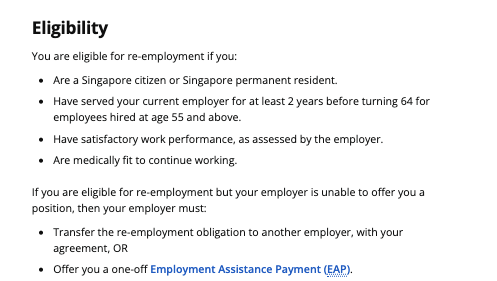
It’s worth noting the definition of “eligible employees”. The screenshot below is taken from MOM.
Source: MOM
Simply put, if you are healthy and have performed well in the past, your employer must offer you a re-employment contract if you wish to continue working.
Your Employment Contract
One important point is that being offered re-employment does not necessarily mean continuing under exactly the same terms of employment.
The employer and employee may agree on a different job scope, responsibilities or employment terms that better suit the employee at this stage of their career. This is one reason Singapore has a separate re-employment framework rather than simply extending the retirement age indefinitely.
A re-employment contract should generally be for at least one year and can be renewed annually until the employee reaches the maximum re-employment age of 69.
For example, an eligible employee who turns 64 on 1 August 2026 would reach the retirement age on that date, and their initial re-employment contract should also start on 1 August 2026.
Read Also: What Are The Different Types Of Unemployment
What Happens If Your Employer Cannot Re-Employ You?
An employer may sometimes be unable to find a suitable position for an eligible employee who wishes to continue working.
In this situation, the employer can transfer its re-employment obligation to another employer, provided both the new employer and the employee agree to the arrangement.
If the employer has considered the available re-employment options but is still unable to offer a suitable position, it may instead provide a one-off Employment Assistance Payment (EAP) as a last resort.
The EAP is equivalent to 3.5 months’ salary, subject to a minimum of $6,250 and a maximum of $14,750.
For employees who have already been re-employed for at least 30 months since age 64, a lower EAP of two months’ salary may be considered, subject to a minimum of $4,000 and a maximum of $8,500.
Key Difference Between Retirement Age And Re-Employment Age
The simplest way to understand the distinction is this:
The Retirement Age determines the minimum age at which an employer can retire an employee. The Re-Employment Age determines how long an eligible employee who wants to continue working must generally be offered re-employment.
As of July 2026, these ages are 64 and 69 respectively.
This means reaching 64 does not automatically end our working life. Eligible workers who want to continue working can be offered re-employment, potentially with revised job responsibilities or employment terms, until age 69.
Retirement Age & Re-Employment Age Does Not Mean You Have To Continue Working Till Then
One of the biggest misconceptions is that an increase in the Retirement Age or Re-Employment Age means Singaporeans are expected to keep working until those ages.
That is not the case.
The statutory ages are intended to protect the employment opportunities of older workers who want to continue working. They do not prevent us from choosing to stop working earlier if our finances and personal circumstances allow.
Someone who has accumulated enough retirement savings may still decide to retire at 55, 60 or any other age. Conversely, someone who enjoys working or wants to continue earning an income has stronger employment protections and re-employment opportunities later in life.
Ultimately, the Retirement Age and Re-Employment Age determine the protections and opportunities available to older workers — not the age at which we personally have to stop working.


Street Smart
Singapore Gym Membership Price Guide (2026 Edition)


