

If you bought an insurance policy from AXA Singapore a decade ago, you may already have seen the name on your policy change once. This is because HSBC completed its acquisition of AXA Singapore in 2022, with the business subsequently operating under HSBC Life.
Now, those same policyholders would see another change in ownership.
On 24 July 2026, Allianz announced that it had agreed to acquire HSBC Life Singapore as part of a deal with a combined consideration of €2.0 billion, or about S$2.7 billion. In addition, there will also be a 15-year exclusive distribution partnership between Allianz and HSBC Singapore worth S$200 million.
For someone who originally bought an AXA policy or bought a policy in the last few years from HSBC Life, they may be wondering what actually happens to their insurance policies when the insurer that issued them is acquired.
Here is what policyholders should understand when an insurer changes hands.
For Policyholders, Nothing Changes Immediately
For existing HSBC Life policyholders, the most important thing to know is that nothing changes.
In a letter to policyholders, HSBC Life have stressed that existing policies and services will continue as normal, and there will be no changes to the terms, conditions or benefits of existing policies as a result of the announcement. Following completion of the transaction, policies will be provided by Allianz, which will continue to service them.
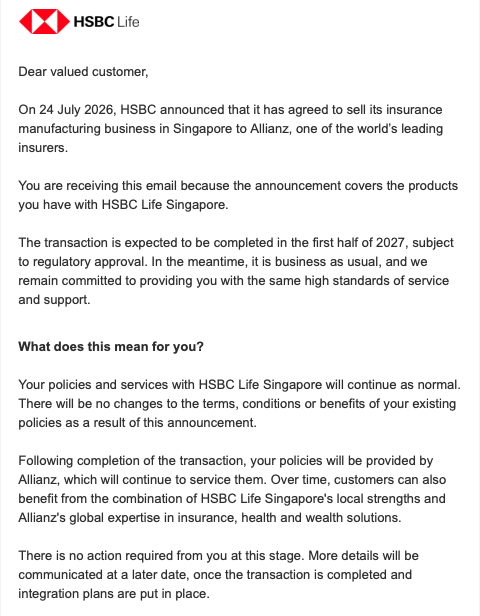
This means that if you are currently paying premiums on an HSBC Life policy, you should continue paying them according to your existing schedule. Neither is there any immediate action required from policyholders.
An Insurer Cannot Simply Sell Its Business And Walk Away From Its Policy Obligations
Insurance policies are contractual obligations. An insurer being acquired does not allow those obligations to simply disappear.
For example, suppose you bought a whole life policy from AXA Singapore in 2015 that provides $300,000 of death coverage and requires premiums to be paid for 20 years. The fact that AXA Singapore was subsequently acquired by HSBC did not, by itself, change the $300,000 benefit or cancel the remaining contractual obligations under the policy. Similarly, the proposed acquisition of HSBC Life Singapore by Allianz does not affect any existing HSBC Life policies.
This is also why policyholders should distinguish between the insurer changing ownership and their insurance policy itself changing. The former can occur through a corporate transaction, while the latter is governed by the policy’s terms and Singapore’s insurance regulatory framework.
What May Change After An Insurer Is Acquired?
While the policy contract itself continues to govern your coverage, some practical aspects of dealing with the insurer may change after an acquisition is complete.
For example, policyholders may eventually see a new company name and branding, a different customer service hotline or mobile app they have to download, or even a new financial adviser that is assigned to them. Letters, annual statements, and other official notices may also start to arrive under the new insurer’s name. However, these are largely administrative changes rather than changes to the insurance protection itself.
The benefits, exclusions, premium obligations and definitions used to assess claims should continue to be based on the terms of the existing policy contract.
Insurance Policies Can Outlast The Insurance Brand
Some Singaporeans may buy insurance through a bank and think the policy is a “bank insurance product”. In reality, the bank is often acting as the distributor through a bancassurance arrangement, while a separate insurance company underwrites the policy, assumes the insurance risk and pays valid claims.
This helps explain how HSBC can sell HSBC Life Singapore to Allianz while still maintaining a long-term insurance distribution partnership with Allianz.
For policyholders, the important lesson is that insurance policies can outlast the brands they’re attached to. A whole life policy, endowment plan or retirement income plan may remain in force for 20, 30 or even 50 years. During that time, insurers may merge, rebrand, be acquired or sell their businesses. The same can apply to long-term health insurance products, including Integrated Shield Plans and riders, as well as term life insurance policies with lengthy coverage periods.
That is why the most important factor for policyholders when deciding is the policy contract itself. While brand reputation is vital, we must recognise that when ownership changes, it is the terms of the policy contract that continue to determine the coverage, benefits, exclusions and obligations of both the insurer and the policyholder.
Photo Credit: iStock/ean-Luc Ichard


Family Planning
Cost Guide To International School Fees In Singapore


