
In September 2026, the Ministry of Education announced a small but important change to Primary 1 registration. Starting with the 2027 Primary 1 Registration Exercise, children starting Primary 1 in 2028 onwards will see an increase in reserved places for Phase 2C, from 40 to 60. Phase 2C is open to all children, regardless of whether they have prior connections to the school. All other Phases in Primary 1 registration remain the same.
The Phases Of Primary 1 Registration
Phase 1 is for children with siblings currently studying in the same primary school. All eligible Phase 1 applicants will be offered a place.
Phase 2A is for children studying in the MOE Kindergarten at the primary school, whose parent or sibling is a former student of the primary school, or whose parent is a member of the School Advisory, Management Committee, or a staff member of the primary school.
Phase 2B is for children whose parent is a parent volunteer of the primary school with at least 40 hours of voluntary service, whose parent is a member endorsed by the church or clan directly connected with the primary school, or whose parent is endorsed as an active grassroots leader. Each primary school reserves 20 places for Phase 2B.
Since The newly added reserved places for Phase 2C mean fewer places for children under Phase 2A.
Home-School Distance
If there are more applicants than vacancies, priority is given based on the child’s citizenship, followed by how close they live to the school. This is known as the Home-School Distance (HSD) category. The family is expected to reside at the address used for registration for the duration of the child’s primary school studies.
Priority admission is given to Singapore Citizens living within 1km of the school, followed by Singapore Citizens living between 1km and 2km of the school, and finally living outside 2km of the school. Priority is then given to Permanent Residents living within 1km, 2km, and beyond.
Read Also: From Birth To P1 Registration: Guide To Navigating Your Child’s Key Milestones
For example, in the 2025 Primary 1 Registration Exercise, the popular Rosyth School in Serangoon had 270 vacancies. Phase 1 children with siblings currently studying there took 134 places. This left 76 vacancies in Phase 2A, of which 47 went to Singapore Citizens living within 1km. The remaining 29 vacancies had to be balloted among the 35 citizen applicants residing between 1km and 2km. This meant that Singapore Citizens living beyond 2km from the primary school, and any Permanent Residents, were unsuccessful in their application.
Because the address used for registration is so crucial to priority admission, some families may try to find loopholes, especially for entry into popular schools. MOE has therefore implemented a requirement that the child must reside at the address used for registration for at least 30 months from the start of the P1 registration exercise. If the 30-month stay requirement is not met, MOE will transfer the child to any school, in its sole discretion.
Thus, while the HSD category is implemented with the family and child’s convenience in mind, it has naturally led to higher demand for residences within the crucial 1km to 2km range of popular schools.
This creates a new dilemma, where “some schools have a narrower socio-economic mix of students, reflecting the profile of their immediate neighbourhoods”, according to MOE.
MOE identified 12 schools where public housing accounts for less than 40% of residences within a 2km radius. Some, like Raffles Girls’ Primary School and Singapore Chinese Girls’ Primary School, both along Dunearn Road, don’t have any public housing within a 1km radius and less than 10% within a 2km radius.
For these 12 schools, MOE is therefore implementing a Two-Track Scheme in Phase 2C, starting with the 2027 Primary 1 Registration Exercise, for children starting Primary 1 from 2028 onwards.
Read Also: From Birth To 17: Guide To The New SG Child Support Package
How Does The New Two-Track Scheme In Phase 2C Work
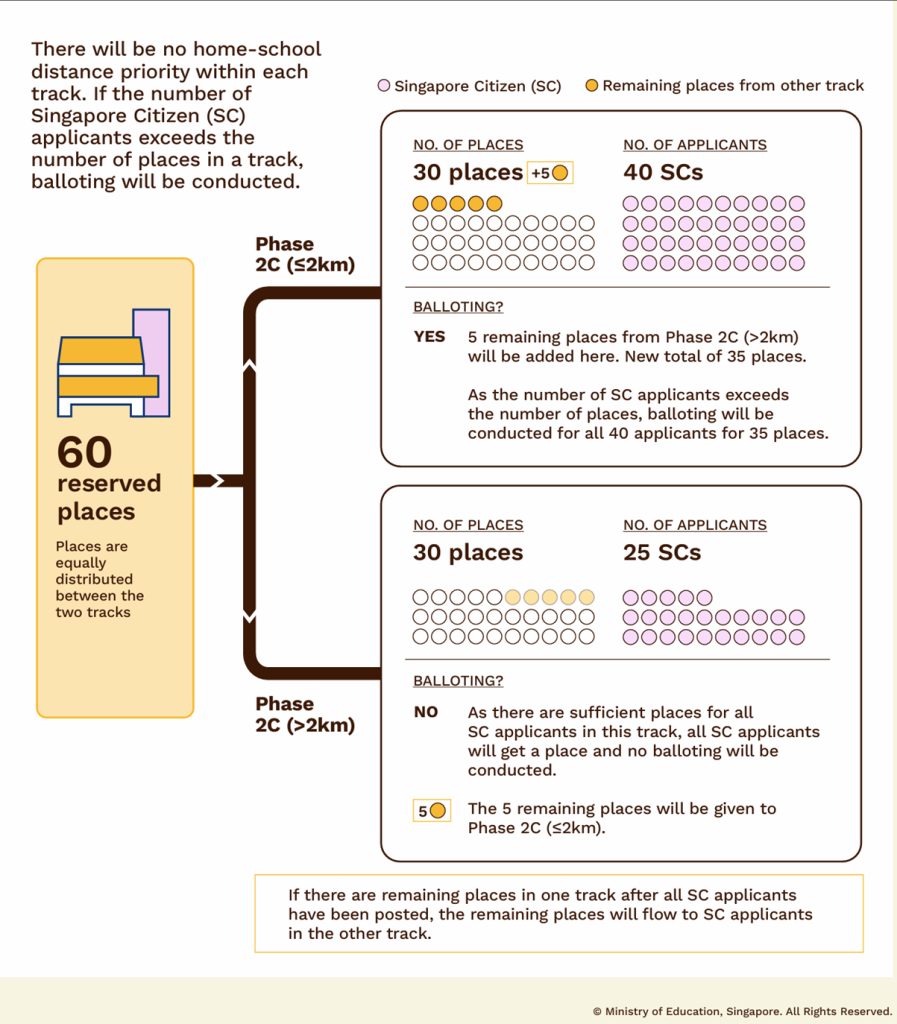
Under this scheme, Phase 2C places (which will have at least 60 reserved places) will be equally distributed across two tracks: those who live within 2km of the school and those who live beyond 2km of the school.
Crucially, home-school distance priority will not factor into either track. This means it doesn’t matter how near or far you stay from the school. Your chances are the same as everyone else within the same track.
MOE will review the list of schools implementing the Two-Track Scheme periodically, though they “do not expect frequent changes to the list”.
Source: MOE
While it remains to be seen how this will affect property values, we can make five educated guesses.
#1 Properties Within 1km Radius Of These 12 Primary Schools No Longer Have The Clear Admission Advantage They Used To
The Two-Track Scheme, combined with the increase in reserved places in Phase 2C from 40 to 60, effectively reduces the priority admission advantage of living near the primary school.
In the past, Phase 2C’s 40 reserved vacancies would often be snapped up by those who live within 1km of the primary school.
For example, consider Fourth Avenue Residences, a condominium in Bukit Timah launched in 2019. It is within 1km of Raffles Girls’ Primary School, which is one of the 12 schools in the Two-Track Scheme.
In the 2025 Primary 1 Registration Exercise, under the current rules, residents of Fourth Avenue Residences would have easily gotten a place at Raffles Girls’ Primary School, since there were 115 vacancies under Phase 2C, and 107 applicants lived within 2km of the school.
Under the Two-Track Scheme, however, these vacancies would be split evenly, meaning only 57 to 58 vacancies would be available to those living within 2km of the school. Instead of a guaranteed spot by staying within 1km, there is now closer to a 50% chance of getting a place.
Ironically, all 36 applicants who lived beyond 2km of the school would get a guaranteed place under the Two-Track Scheme.
Read Also: How Much More Expensive Is It To Raise A Family Today Compared To 10 Years Ago
#2 Properties Within 2km Radius Have Slightly More Advantage Than Before
Let’s keep the same example of Fourth Avenue Residences, which is within 2km of Henry Park Primary School, Methodist Girls’ School (Primary), and Nanyang Primary School. Other than Henry Park, two of the three schools fall under the Two-Track Scheme.
In the 2025 Primary 1 Registration Exercise, under the current rules, residents of Fourth Avenue Residences would not have been able to get into any of these three schools. They are so popular that even those living within 1km of them have to ballot for a place in Phase 2C.
However, under the Two-Track Scheme, because home-school distance no longer gets priority admission, applicants living within 2km now have a slight chance of getting into Methodist Girls’ (Primary) and Nanyang Primary by balloting for the 30 reserved places in Phase 2C. It’s still unlikely, but it’s better than nothing.
Since Henry Park is not under the Two-Track Scheme, it will still remain out of reach.
#3 Possible Advantage For Those Who Stay Close But Not Close Enough To Schools
The intention behind the introduction of the Two-Track Scheme is the belief that schools should remain “open and accessible”, according to MOE.
This recognises a need to “widen access beyond the school’s immediate neighbourhood”, as some schools currently have “a narrower band of socio-economic student profiles” due to the existing Primary 1 Registration Exercise.
Places in Phase 2C for most of the 12 schools within the Two-Track Scheme go to applicants living within 1km of the school, so there is no clear data on how many applicants there are from beyond 2km.
While it is still too early to say, the new Two-Track Scheme may encourage more applicants despite living beyond the 2km radius. As mentioned earlier, based on 2025’s Primary 1 Registration Exercise, all 36 applicants who lived beyond 2km of Raffles Girls’ Primary would qualify for a place under the Two-Track Scheme.
This could mean that the property values just outside the 2km radius of a school may improve, now that there is a higher possibility that residents could qualify for admission.
Read Also: How Much Does It Cost To Raise A Child In Singapore Till Age 18?
#4 Proximity To The School Goes Beyond Priority Admission
All that said, while properties near one of the 12 primary schools under the Two-Track Scheme may no longer offer the same advantage as before, that doesn’t mean you can ignore the benefits of living close to the school.
Although many of the 12 schools are now accessible by MRT, thanks to the Downtown Line and Thomson-East Coast Line, as well as major bus routes, a shorter commute between school and home still saves time and money.
Although property values, especially within the 1km radius around these 12 schools, may decline due to the lower likelihood of admission, their overall value proposition remains high.
#5 The Two-Track Scheme Could Evolve Further
While MOE has indicated it will review the list of schools implementing the Two-Track Scheme periodically, it does not expect “frequent changes to the list”.
While we wait to see how property values around these 12 schools may change, it raises the question of whether the introduction of this scheme will change how homebuyers choose their property location. After all, if home-school distance becomes less crucial to admission, then there is one less reason to pay a premium for a property near a popular school.
That said, Singapore currently has 179 primary schools, many of which are popular outside this list of 12 and could also eventually benefit from the Two-Track Scheme. Until MOE indicates which schools could be added to the list, however, it is safe to say that property values around other popular schools will likely remain high.
Read Also: 6 Ways For Singapore Parents To Maximise The Child Development Account (CDA)


