
In December 2026, eligible Singaporeans will receive the final payout under the Assurance Package (AP), the end of a five-year benefits programme that the Government introduced to cushion the impact of the GST increase from 7% to 9%.
The first announcement of a 2% GST rate increase came in the 2018 Budget. Back then, Minister of Finance Heng Swee Keat explained that the GST increase was “necessary” because there was still a “gap” between “future expenditures” and the recurrent “healthcare, security and other social spending”. According to his Budget 2018 speech, “increasing GST by two percentage points will provide us with revenue of almost 0.7% of GDP per year”.
At Budget 2020, Mr Heng, now also Deputy Prime Minister, announced that the GST rate increase would not happen in 2021. This was due to the “current state of the economy” with the onset of the COVID-19 pandemic. He also announced the $6 billion Assurance Package to cover “at least five years’ worth of additional GST expenses incurred” for a “majority of Singaporean households”, with lower-income households receiving more. Mr Heng suggested that for lower-income Singaporeans, it would effectively be “no increase” for 10 years.
Read Also: From CDC Vouchers To Cash Payouts: How Much Is A Middle-Income Family Receiving In 2026
The Assurance Package Is More Than Just AP Cash
To be clear, the Assurance Package comprised cash payouts, CDC vouchers, additional utility rebates and various other top-ups for seniors and children. Initially costing $6 billion, the package received an additional top-up of $640 million in Budget 2022 and an additional $3 billion in Budget 2023.
The purpose, as explained by then-Deputy Prime Minister and Minister for Finance Lawrence Wong, was to “account for higher inflation”. Ultimately, this was to “maintain the commitments… to offset additional GST expenses for at least five years for the majority of Singaporean households, and for about 10 years for the lower-income households”.
Later in September 2023, a further $1.1 billion Cost-of-Living Support Package was announced, including a $0.8 billion enhancement to the Assurance Package. This would bring the AP to “over $10 billion”, according to the Ministry of Finance.
In Budget 2024, additional CDC vouchers, Cost-of-Living Special Payments, U-Save Rebates and Service & Conservancy Charges Rebates were described as further enhancements to the Assurance Package, costing an additional $1.9 billion. However, further cost-of-living support in Budget 2025 and Budget 2026 was no longer tied to the Assurance Package.
With the final AP Cash payment arriving next month, it is worth looking back at how much Singaporeans received, and whether those payouts were sufficient to offset the GST increase.
Read Also: When Will Singaporeans Receive Their Budget 2026 Payouts? Key Dates To Know
How Much Did Singaporeans Receive In AP Cash?
The Assurance Package Cash component was paid annually from December 2022 to December 2026.
Depending on income and property ownership, eligible Singaporeans received between $700 and $2,250 in total cash payouts over the five-year period. Broadly speaking, lower-income earners would expect to receive up to $2,250 in AP Cash; middle-income Singaporeans earning less than $100,000 a year generally received around $1,350, while higher-income individuals and owners of multiple properties would have received about $700 over the five years.
| Disbursed On | Assessable Income of $34,000 or less (raised to $39,000 or less in 2025 and 2026) | Assessable Income of more than $34,000 (revised to $39,000 in 2025 and 2026) and up to $100,000 | Assessable Income of more than $100,000 / Owns more than 1 property |
| December 2022 | $200 | $150 | $100 |
| December 2023 | $600 | $350 | $200 |
| December 2024 | $600 | $350 | $200 |
| December 2025 | $600 | $350 | $100 |
| December 2026 | $250 | $150 | $100 |
The year of Assessable Income for each AP Cash disbursement changes. For example, the upcoming AP Cash disbursement in December 2026 is based on your Assessable Income earned in 2024. For AP Cash disbursed in 2023, payout amounts were based on Assessable Income earned in 2021.
Importantly, these figures refer only to the cash component of the Assurance Package. They exclude CDC vouchers, U-Save rebates, MediSave top-ups and other forms of support that many households also received. They also do not include the AP Cash Special Payments that were occasionally disbursed over these five years.
Estimating The Cost Of The GST Increase
Determining the exact cost of the GST increase is not straightforward, so we will need to make several assumptions. Since not every dollar of household expenditure is subject to GST, and households differ significantly in their spending habits and expenditure levels, we need to base our calculations on averages.
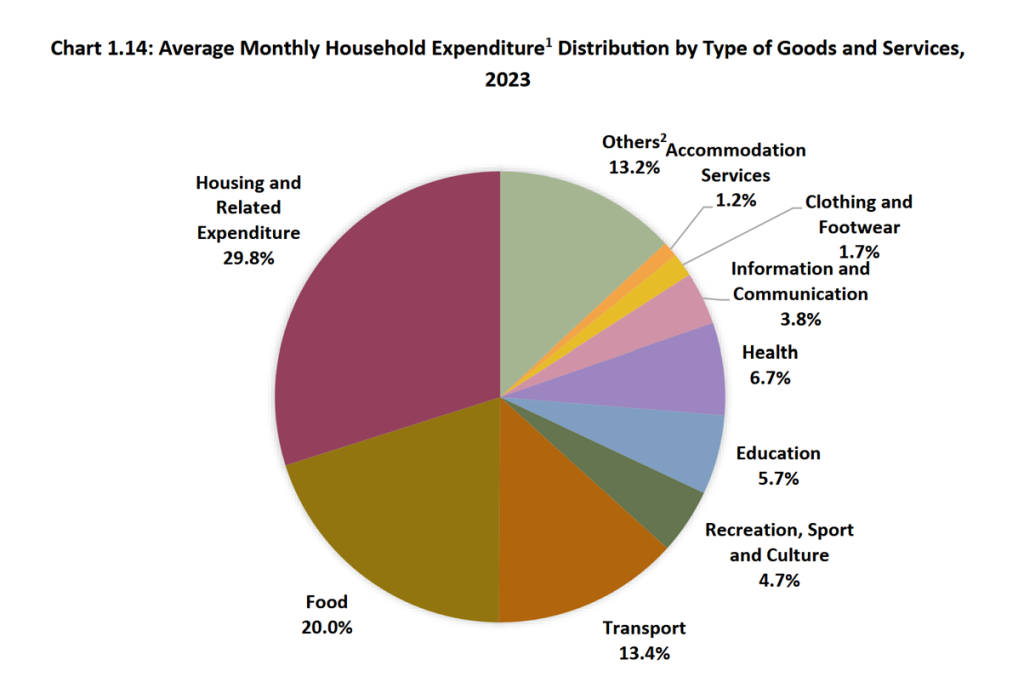
The latest Household Expenditure Survey conducted by the Department of Statistics found that resident households spent an average of $5,931 per month in 2023, or about $71,172 a year. Not all of that household spending attracts GST.
Source: Household Expenditure Survey 2023
For example, costs incurred on rent, healthcare, and education are often exempt from GST. For simplicity’s sake, let’s assume only 55% of expenditure incurs GST.
With an additional 1% increase in GST in 2023 and a 2% increase in GST from 2024 onwards, and expenditure growing at an inflationary rate of 2.8% per year, we can calculate the extra cost of GST over the five years from 2023 to 2027 inclusive to be about $3,748, based on the average household expenditure of $71,172 in 2023.
Read Also: 5 Ways To Reset Your Finances & Lower Your Cost Of Living In Singapore
Household Size Matters More Than Most People Realise
One frequently overlooked aspect of the Assurance Package is that AP Cash was paid on an individual basis, while expenditure is typically measured at the household level.
Consider a household with two eligible middle-income adults. They would generally have received around $2,800 in AP Cash over the five-year period. Based on our earlier assumptions, the AP Cash amount alone would have covered about 75% of the GST increase of $3,748 for the average household.
This amount excludes the CDC vouchers, U-Save rebates or other support measures disbursed during this time, which should cover the remaining $948.
That Said, The Assurance Package Was More Than GST Increases
We cannot forget that the GST increase coincided with a period of elevated global inflation, rising food prices, higher electricity tariffs and increased transport costs. In the Parliamentary debate following Budget 2025, the suggestion that the GST increase could further affect inflation was raised. In response, Prime Minister Lawrence Wong affirmed in his Budget debate round-up speech that “they understand these concerns” and will “continue to provide cost-of-living support for as long as needed, and within our means”.
For lower-income Singaporeans who received the maximum AP Cash payout, the evidence suggests the cash component alone likely went a long way towards offsetting the direct cost of the GST increase. Once other forms of support such as CDC vouchers and utility rebates are included, the total value of assistance becomes significantly larger.
For middle-income Singaporeans, the AP Cash payouts were substantial and likely offset a meaningful portion, if not all, of the direct GST impact depending on household spending patterns.
For higher-income Singaporeans receiving the minimum payouts, AP Cash was clearly not intended to fully compensate for every additional dollar of GST paid.
Ultimately, the Assurance Package was deliberately structured to provide greater support to those most affected by higher living costs. When the final AP Cash comes in December, the Assurance Package will ensure that most households receive an offset for additional GST expenses for at least five years.
Read Also: GSTV, CDC Vouchers And LifeSG Credits: How Much Government Support Are Households Receiving In 2026?
Advertiser Message


Bonds and Fixed Income
6 Investments In Singapore That Provide Guaranteed Principal And Returns

Health Insurance
5 Questions To Ask Before Dropping Your Integrated Shield Plan Rider


Bonds and Fixed Income
6 Investments In Singapore That Provide Guaranteed Principal And Returns


