

This article was written in collaboration with Amova Asset Management Asia Limited. All views expressed in this article are the independent opinion of DollarsAndSense.sg based on our research, and are purely for informational purposes and should not be relied upon as financial advice. DollarsAndSense.sg is not liable for any financial losses that may arise from any transactions, and readers are encouraged to conduct their own due diligence. You can view our full editorial policy here.
When it comes to stocks and bonds, the difference is generally simple. If you are looking for growth, you could invest in stocks, also known as equities. However, investing in just one type of asset might be risky, and one way to reduce risk is to diversify your investments, such as investing in bonds or fixed income.
How does this work? Stocks and bonds do different jobs in a portfolio. In other words, think of the components within your portfolio (i.e., stocks and bonds) as players within a team sport, as opposed to thinking of investing as an individual sport.
Instead of asking which is better, investors should consider how each asset class fits into their overall portfolio.
Stocks Are Built for Growth, But That Growth Comes with Volatility
Stocks give investors ownership in companies and the opportunity to participate in their earnings growth over time. Because equities can offer capital growth potential, they are commonly used as the growth component of a long-term investment portfolio.
However, that growth comes with volatility. Equity markets can decline substantially during recessions, financial crises or periods of severe uncertainty.
Thus, while an all-equity portfolio may offer stronger growth potential, investors also need to be prepared for painful periods along the way.
Bonds Can Add Stability & Income to a Portfolio
When you buy a bond, you are lending money to an issuer, such as a government, statutory board or company, that promises interest payments and repayment of the bond’s face value at maturity, subject to its ability to pay. High-quality bonds may offer more predictable income as compared to equities.
This makes bonds useful alongside stocks. During periods of economic stress, when equity markets fall sharply, high-quality bonds, particularly government bonds, have often held up better or even risen in value as investors move towards lower-risk assets.
Because bonds and equities do not always move in the same direction, holding both may help smooth the ride across market cycles. By holding bonds alongside equities would help diversify a portfolio, potentially reducing the extent of portfolio drawdowns, and may provide another source of funds while equities recover. This can be useful for investors who need to fund living expenses from their portfolios rather than focus solely on long-term capital growth.
How The ABF Singapore Bond Index Fund (A35) Adds Bond Exposure For Investors
For Singapore retail investors, building the fixed income portion of a portfolio has traditionally meant buying individual Singapore Government Securities (SGS) through MAS auctions or holding Singapore Savings Bonds (SSBs). These can play a role in a portfolio, but investors who want broader bond exposure can also consider bond ETFs.
A bond ETF holds a basket of bonds within a single listed fund. This allows investors to gain exposure to different bonds and maturities without having to manage individual positions, track maturity dates, or reinvest potential proceeds from each bond separately as it matures.
The ABF Singapore Bond Index Fund (SGX: A35), managed by Amova Asset Management Asia Limited, is one option for investors looking to add Singapore Dollar-denominated Singapore government bond exposure to their portfolios.
The fund aims to track the iBoxx ABF Singapore Index and invests in Singapore Dollar-denominated bonds issued or guaranteed by Asian governments and government-related entities. As of 31 August 2026, much of the fund is invested in Singapore Government Securities.
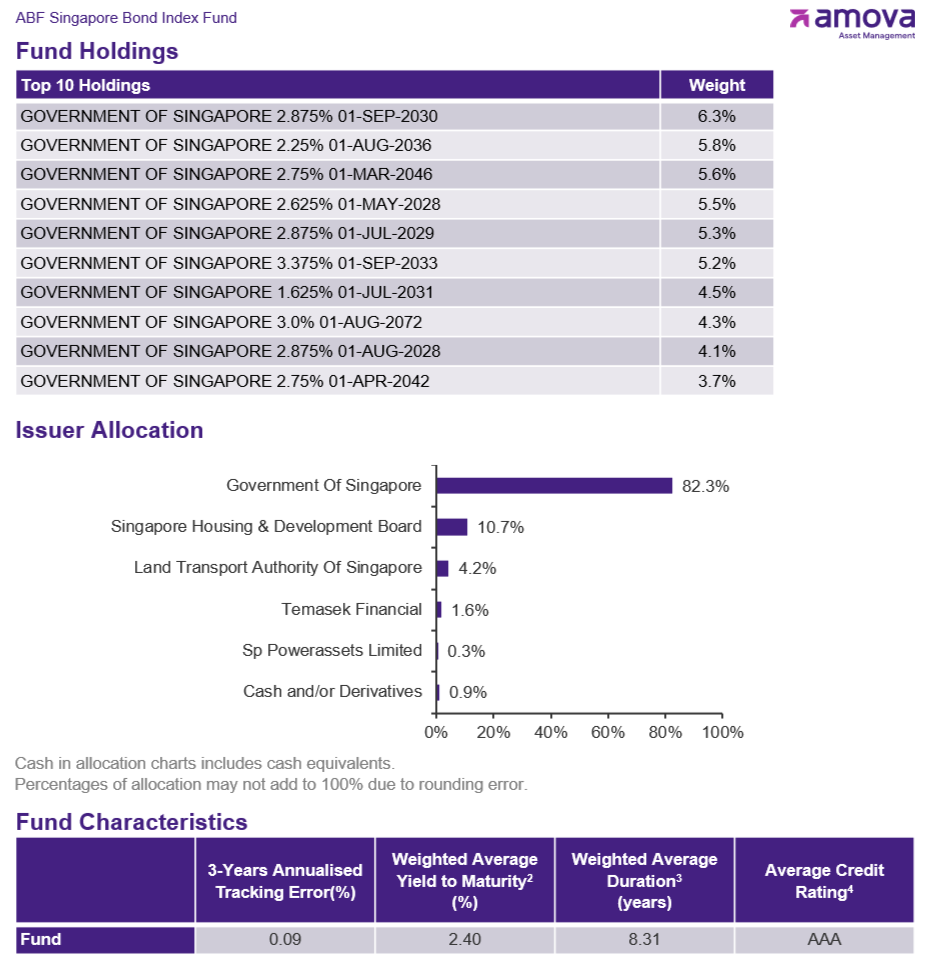
Source: Amova Asset Management, as of 31 August 2026
2 Yield to Maturity (YTM) of a bond is the average annualised rate of return expected if held to maturity. Weighted Average YTM (%) is calculated by weighting the bonds with market capitalisation and duration. The figure is in local currency yield terms and on an unhedged foreign exchange basis. Please note that the weighted average YTM does not represent the fund’s actual rate of return or distribution yield.
3 Duration is a measure of a bond’s sensitivity to interest rate changes. Weighted Average Duration (years) is weighted by the market value of each bond relative to the total portfolio market value. Please note that this figure is provided for reference only.
4 Cash is included in the calculation of the average credit rating and is rated as AAA regardless of currencies held. The credit ratings of the underlying fixed income securities are determined by S&P and/or Moody’s, and where official credit ratings are unavailable, Amova Asia’s internal credit ratings are used.
The ETF has been listed on SGX since 2005. For investors who already hold Singapore equities, REITs or global equity ETFs, the ABF Singapore Bond Index Fund provides another way to add fixed income exposure while investing in Singapore Dollars. This may be especially relevant for investors who expect to spend most of their retirement income in Singapore dollars.
The fund intends to distribute income* to unitholders rather than accumulating it, allowing investors to receive distributions from the income generated by the underlying bonds. It is also eligible for investment through CPFIS-OA and SRS, as well as regular savings plans on selected platforms.
Your Stock-Bond Mix Should Reflect Your Financial Situation
There is no single stock-and-bond allocation that works for everyone. The 60/40 portfolio, with 60% in stocks and 40% in bonds, is often used as a reference point for a balanced portfolio, but the appropriate allocation depends on an investor’s financial circumstances, risk tolerance and need for income.
For instance, someone aged 55 and older with the Full Retirement Sum (FRS) in their CPF Retirement Account, a fully paid-off home, and low monthly expenses may have a different capacity and willingness to take investment risk from someone of the same age, but with a large property loan and dependants to support. Rather than starting with a fixed percentage, it may be more useful to consider what each part of the portfolio needs to achieve.
Understanding The Risks Of The ABF Singapore Bond Index Fund
Bonds are not risk-free, and investing through a bond ETF does not guarantee stable returns. Bond prices generally move in the opposite direction to interest rates, so when interest rates rise, bond prices tend to fall. Thus, there may be a period when the market value of the ETF declines even if its underlying bonds continue paying interest.
Credit risk also exists. The ABF Singapore Bond Index Fund invests predominantly in Singapore government and government-related bonds, and its average portfolio credit rating was AAA as at 31 August 2026. An AAA rating is the highest credit rating category and generally indicates a very strong capacity to meet financial obligations, although it does not mean the investment is risk-free.
The purpose of holding bonds alongside equities is therefore not to remove risk entirely, but to diversify the portfolio and reduce its dependence on equity market performance.
Stocks And Bonds Work Better When They Play Different Roles
We should not be asking whether stocks or bonds are better. Instead, we should ask ourselves what each asset class is doing for our investment portfolio. For Singapore investors who have spent years building their equity exposure and now want to add fixed income, a bond ETF such as the ABF Singapore Bond Index Fund is one way to do so without managing individual bonds.
Ultimately, the right mix depends on your circumstances. Equities can provide long-term growth, while bonds can provide income and help reduce portfolio volatility. What matters is that the balance between them reflects what you actually need from your portfolio.
Footnote
* Distributions are not guaranteed and are at the absolute discretion of the Manager. Any distribution is expected to result in an immediate reduction of the Fund’s NAV. Distributions will only be paid to the extent that they are available for distribution pursuant to the Trust Deed and covered by income received from the underlying investments of the Fund. Please refer to the Fund Prospectus and Product Highlight Sheet for further details.
Disclaimer
Important Information: The Central Provident Fund (“CPF”) Ordinary Account (“OA”) interest rate is the legislated minimum of 2.5% per annum, or the 3-month average of major local banks’ interest rates, whichever is higher, reviewed quarterly. The interest rate for Special Account (“SA”) is currently 4% per annum, or the 12-month average yield of 10-year Singapore Government Securities plus 1%, whichever is higher, reviewed quarterly. Only monies in excess of $20,000 in OA and $40,000 in SA can be invested under the CPF Investment Scheme (“CPFIS”). Please refer to the website of the CPF Board for further information. Investors should note that the applicable interest rates for the CPF accounts and the terms of CPFIS may be varied by the CPF Board from time to time.
The performance of the ETF’s price on the Singapore Exchange Securities Trading Limited (“SGX-ST”) may be different from the net asset value per unit of the ETF. The ETF may also be suspended or delisted from the SGX-ST. Listing of the units does not guarantee a liquid market for the units. Investors should note that the ETF differs from a typical unit trust, and units may only be created or redeemed directly by a participating dealer in large creation or redemption units.
This document is purely for informational purposes only with no consideration given to the specific investment objective, financial situation and particular needs of any specific person. It should not be relied upon as financial advice. Any securities mentioned herein are for illustration purposes only and should not be construed as a recommendation for investment. You should seek advice from a financial adviser before making any investment. In the event that you choose not to do so, you should consider whether the investment selected is suitable for you. Investments in funds are not deposits in, obligations of, or guaranteed or insured by Amova Asset Management Asia Limited (“Amova Asia”).
Past performance or any prediction, projection or forecast is not indicative of future performance. The Fund or any underlying fund may use or invest in financial derivative instruments. The value of units and income from them may fall or rise. Investments in the Fund are subject to investment risks, including the possible loss of the principal amount invested. You should read the relevant prospectus (including the risk warnings) and product highlights sheet of the Fund, which are available and may be obtained from appointed distributors of Amova Asia or our website (https://sg.amova-am.com) before deciding whether to invest in the Fund.
The information contained herein may not be copied, reproduced or redistributed without the express consent of Amova Asia. While reasonable care has been taken to ensure the accuracy of the information, Amova Asia does not give any warranty or representation, either express or implied, and expressly disclaims liability for any errors or omissions. Information may be subject to change without notice. Amova Asia accepts no liability for any loss, indirect or consequential damages, arising from any use of or reliance on this document. This advertisement has not been reviewed by the Monetary Authority of Singapore.
The index referenced herein (the “Index”) is a product of S&P Dow Jones Indices LLC or its affiliates (“SPDJI”), and has been licensed for use by Amova Asset Management Asia Limited.
S&P®, S&P 500®, US 500, The 500, iBoxx®, iTraxx® and CDX® are trademarks of S&P Global, Inc. or its affiliates (“S&P”); Dow Jones® is a registered trademark of Dow Jones Trademark
Holdings LLC (“Dow Jones”); and these trademarks have been licensed for use by SPDJI and sublicensed for certain purposes by Amova Asset Management Asia Limited. The Fund is not sponsored, endorsed, sold or promoted by SPDJI, Dow Jones, S&P, their respective affiliates, and none of such parties make any representation regarding the advisability of investing in such product(s) nor do they have any liability for any errors, omissions, or interruptions of the Index.
Amova Asset Management Asia Limited. Registration Number 198202562H.


