
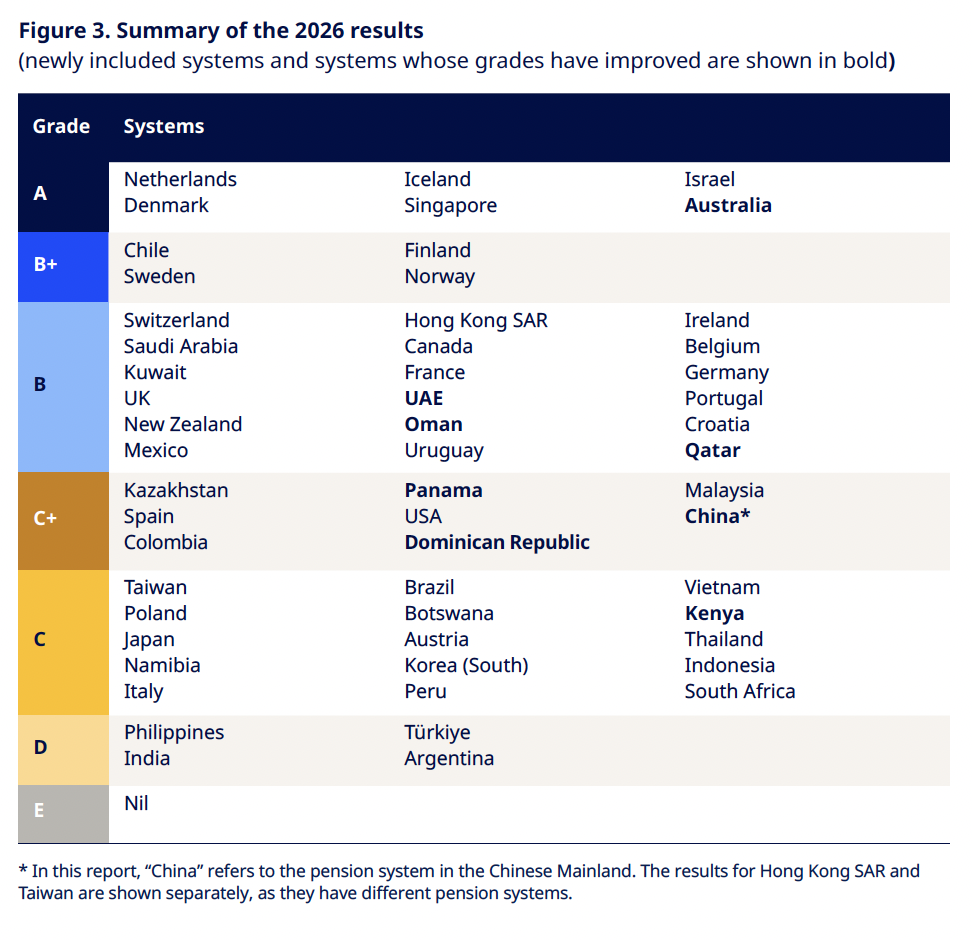
In a country that values grades, Singapore retained its A grade in the Marsh CFA Institute Global Pension Index 2026, with its overall score increasing from 80.8 last year to 82.0. It remained fourth among the retirement income systems assessed, with only the Netherlands (85.8), Denmark (84.1) and Iceland (84.0) scoring higher. Singapore also had the highest score in Asia.
How Does The Global Pension Index Assess Retirement Systems?
The index evaluates the retirement systems across three areas.
Firstly, adequacy considers whether retirement benefits are sufficient. Next, sustainability examines whether the system can continue supporting retirees over the long term. Finally, integrity looks at governance, benefit protection, communication, and operating costs.
Here are Singapore’s scores in each area.
| Assessment | Weighting | 2025 score | 2026 score | 2026 global ranking |
|---|---|---|---|---|
| Adequacy | 40% | 79.4 | 82.8 | 8th |
| Sustainability | 35% | 75.5 | 75.3 | 7th |
| Integrity | 25% | 90.4 | 90.4 | Joint 2nd |
| Overall | 100% | 80.8 | 82.0 | 4th |
An overall score of at least 80 earns an A grade. Singapore was one of six systems to achieve this in 2026, alongside the three systems ahead of it, Israel and Australia.
Adequacy (82.8 In 2026; 79.4 In 2025)
Singapore’s adequacy score increased from 79.4 to 82.8, lifting its grade from B+ in 2025 to A in 2026. Its position in this category improved from joint 11th to eighth globally. This was the main contributor to Singapore’s higher overall score in 2026.
For members, CPF’s role begins with regular employee and employer contributions during their working years. These contributions, together with interest, build savings that support housing, healthcare and retirement needs.
Retirement adequacy also requires turning accumulated savings into income. CPF LIFE provides monthly payouts for as long as members live, helping address the risk of outliving their retirement savings.
Housing is another consideration in the index. Owning a fully paid home can reduce the need to rent during retirement. However, using more Ordinary Account savings for housing also means leaving less in our CPF for retirement.
Read Also: How Much CPF Interest Do You Actually Earn On $100,000?
Sustainability (75.3 In 2026; 75.5 In 2025)
Singapore’s sustainability score slipped slightly from 75.5 to 75.3, retaining its B+ grade and seventh-place global ranking. This remained its lowest-scoring assessment area.
CPF requires members to accumulate savings in their own accounts during their working lives. Setting aside resources ahead of retirement helps prepare for future needs. The report also highlights CPF as an exception to the common investment approach of private pension funds: CPF invests its savings primarily in Special Singapore Government Securities.
An ageing population nevertheless creates challenges. Longer lives mean retirement income must last longer, while lower birth rates change the balance between working-age residents and retirees. Continued employment can help individuals accumulate more savings and shorten the period they need to fund entirely from retirement income.
CPF LIFE addresses longevity risk through insurance pooling. Members receive lifelong payouts, including when their own premium and interest have been used up. Its sustainability therefore involves more than simply paying each person back their accumulated savings.
Read Also: Understanding CPF LIFE And Your Monthly Payouts When You Retire In Singapore
Integrity (90.4 In 2026; 90.4 In 2025)
Singapore’s integrity score remained 90.4, its strongest assessment area. It ranked joint second, behind Finland’s 90.5.
Protection of savings is a key part of understanding CPF. CPF monies are invested in Special Singapore Government Securities issued and guaranteed by the Singapore Government. Members’ savings and interest are protected from fluctuations in investment market performance.
Communication and costs matter too. Members can access retirement information through CPF’s online services, while planning tools help them estimate payouts and assess top-ups. CPF LIFE is administered on a non-profit basis, without advertising costs or agents’ commissions. These are practical features relevant to the index’s integrity assessment.
Read Also: Guide To Helping Your Elderly Parents Safeguard Their CPF Account With A Trusted Contact
CPF Provides The System But How We Use It Matters Too
An A grade reflects a strong retirement system. However, as most of us already know, individual outcomes still depend heavily on our earnings, contribution history, and the CPF decisions we choose to make (or not make).
Under CPF’s rules, we can use eligible savings for housing, top up our retirement savings, invest our CPF savings, or leave money in our accounts untouched to earn the default interest rate. Over a long period, these choices we make ultimately affect the savings available for future retirement income.
Read Also: What Happens To Your CPF LIFE Payout If You Migrate Overseas?


