
This article was written in collaboration with UOB. All views expressed in this article are the independent opinion of DollarsAndSense.sg based on our research, are purely for informational purposes, and should not be relied upon as financial advice. DollarsAndSense.sg is not liable for any financial losses that may arise from any transactions, and readers are encouraged to do their own due diligence. You can view our full editorial policy here.
Cashback cards have long been a popular choice among Singaporeans for one simple reason: they give us cash for spending on what we are already going to purchase.
Whether it is grocery shopping at the supermarket, dining out with the family, taking public transport to work or paying for online purchases, cashback cards offer a practical way to get a little something back from our regular expenses.
But while many of us already use a cashback card, relying on just a single card may mean missing out on cashback across other types of spend. That’s because not all spending fits neatly into a single card’s cashback structure. While many cards give you cashback on specific spending categories, other types of transactions may earn little or no cashback at all.
This is why some cardholders adopt a two-card cashback strategy. By pairing cards that serve different purposes, we increase our ability to earn the most amount of cashback across a wider range of expenses.
Why A Single Cashback Card May Not Cover All of Your Spending
Broadly speaking, cashback cards usually fall into two categories: category cashback cards and flat cashback cards.
Category cashback cards typically reward higher cashback rates for spending within specific categories such as groceries, dining and transport. However, these cashback cards usually come with conditions such as minimum monthly spend requirements, cashback caps or exclusions on certain transaction types.
Flat cashback cards, on the other hand, offer a consistent cashback rate across a much wider range of spend categories. While the cashback rate is often lower than category-specific promotional rates, they can provide broader coverage for expenses that may not qualify under category cashback structures. In addition, many flat cashback cards come with fewer restrictions, often featuring no cashback caps and no minimum spend requirements, making it easier for cardholders to earn cashback on their everyday spending.
Rather than viewing these two cards as competing options, it may be more useful to consider how they can complement each other as part of a broader cashback strategy. The key is understanding how each card works and using them together in a way that helps you maximise savings across different types of spending.
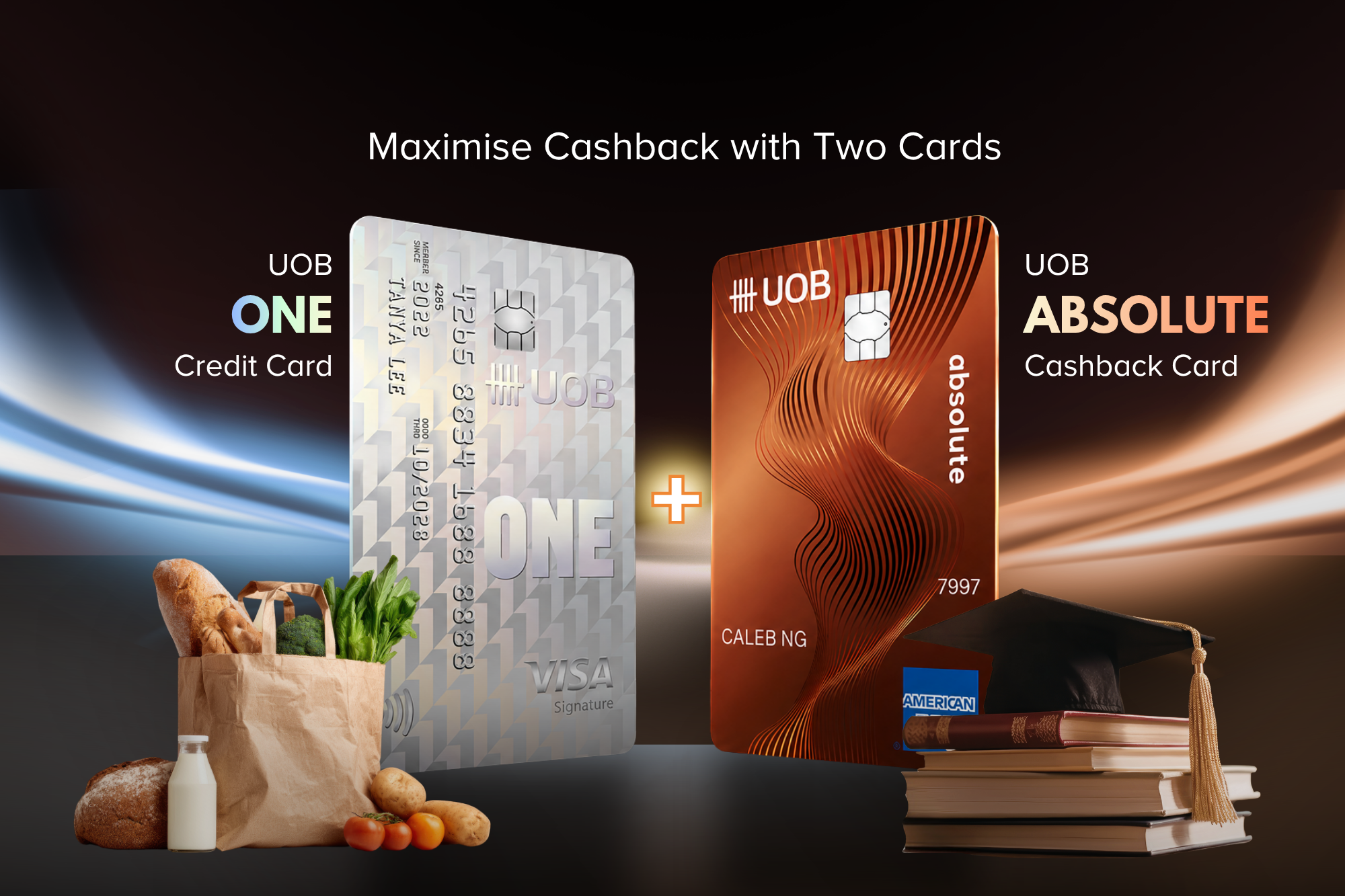
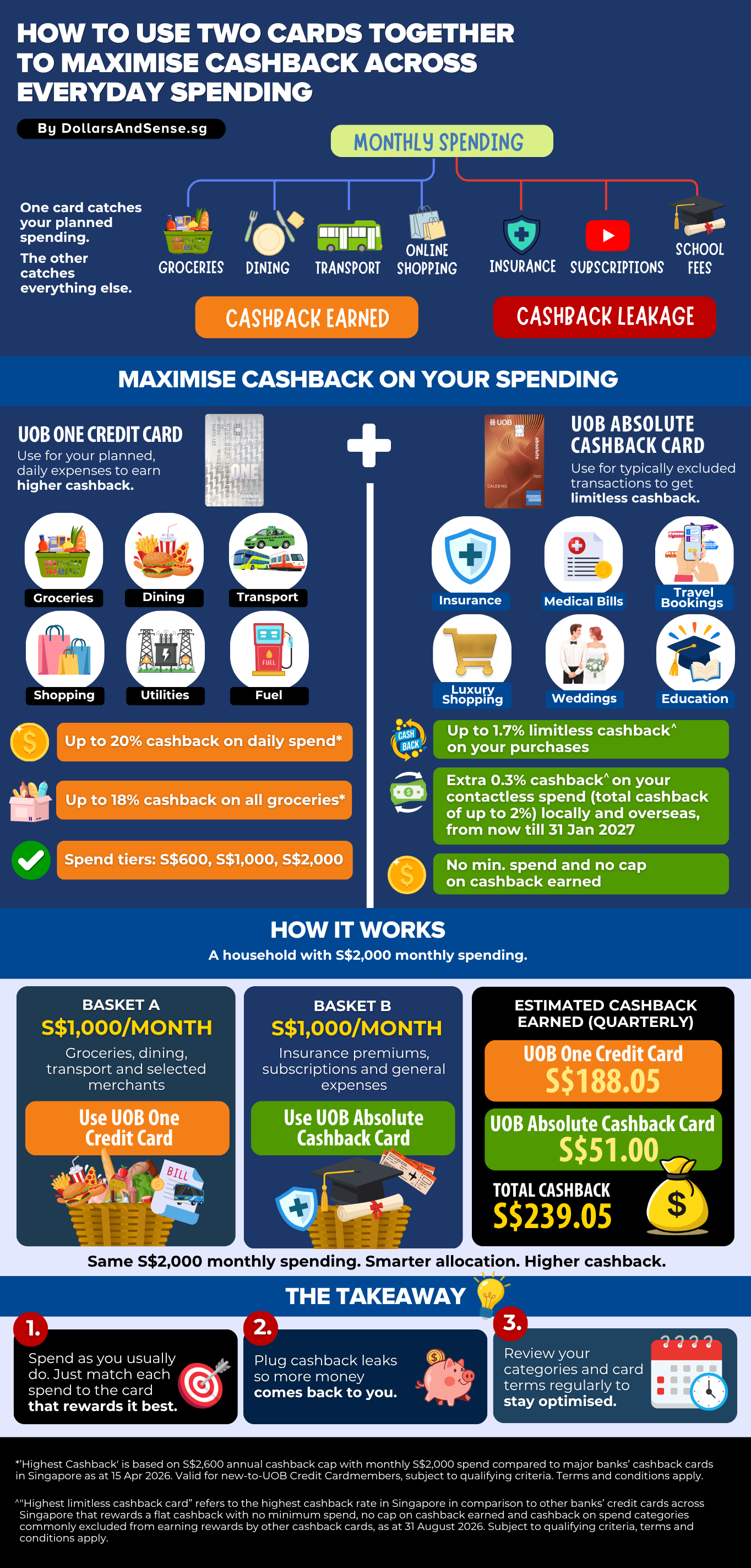
For example, one combination that works naturally well is to pair the UOB One Credit Card with the UOB Absolute Cashback Card. Used strategically, the two cards can complement each other to help households optimise cashback across both planned recurring expenses and broader spending categories, which could help ease the impact of rising prices.
How The UOB One Credit Card Rewards Everyday Spending
The UOB One Credit Card is designed to reward Cardmembers for consistent spending across common day-to-day categories with the highest cashback* of up to 20% on daily spend and up to 18% on all groceries. With spend tiers of S$600, S$1,000 and S$2,000 per month, Cardmembers can still earn cashback even if they spend below the S$800 typically required by many cashback cards.
For New-to-UOB Credit Cardmembers who apply from now till 30 September 2026, the UOB One Card offers enhanced cashback of up to 20% on daily spend and up to 18% on all groceries. Existing UOB One Cardmembers can also continue to enjoy up to 10% cashback on daily spend. Terms and conditions apply.
Beyond these enhanced cashback benefits, Cardmembers can also enjoy up to 4.33% cashback on utilities with Singapore Power, up to 3.33% cashback on all eligible spend, and up to 22.66% fuel savings at Shell and SPC.
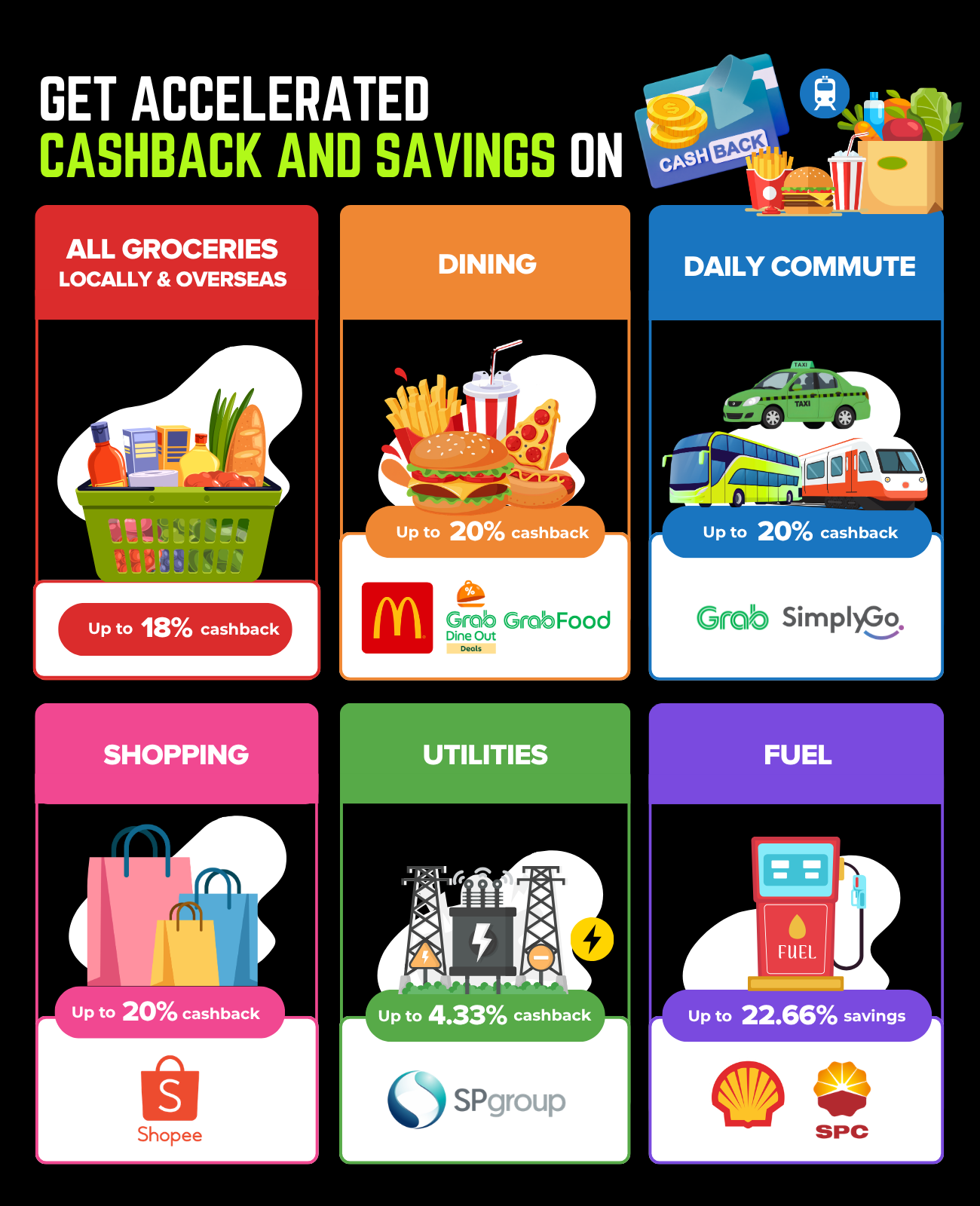
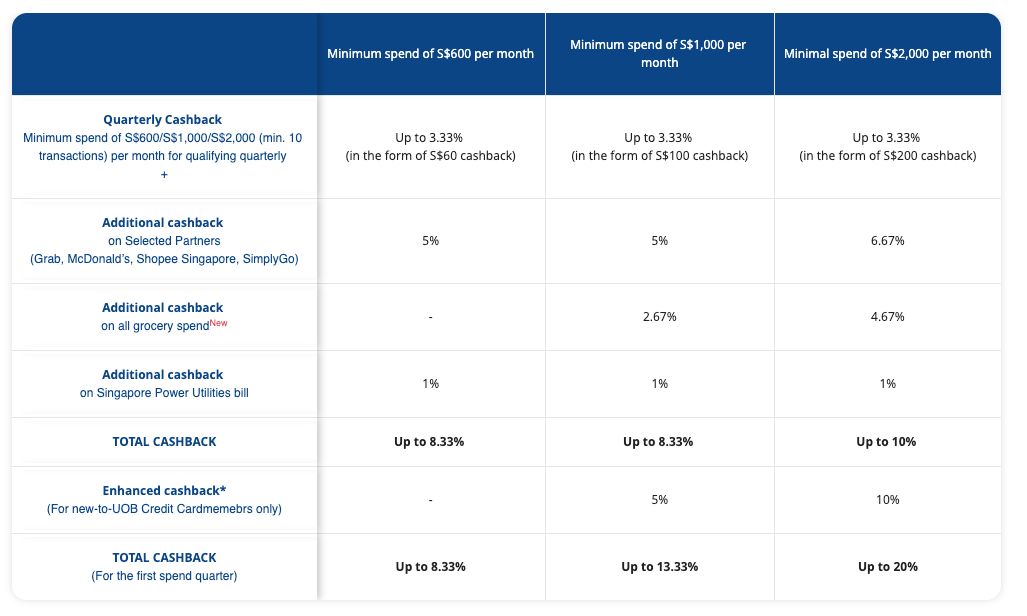
For households that regularly spend on essentials such as groceries, dining, transport and online shopping, it’s a great primary cashback card. See below illustration examples to determine the amount of cashback that Cardmembers can earn based on the minimum spend of S$600, S$1,000 and S$2,000 a month.
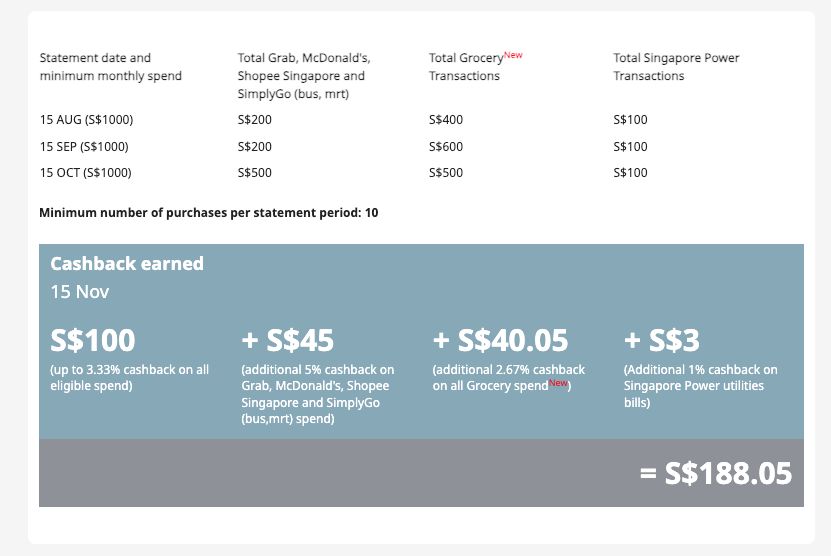
For instance, a household spending S$1,000 each month across categories such as Grab, McDonald’s, Shopee Singapore, SimplyGo (bus and MRT rides), groceries and Singapore Power payments could earn up to S$188.05 in cashback every quarter. This works out to an effective cashback rate of 6.26% on their total quarterly spend of S$3,000 (S$188.05 ÷ S$3,000).
Where Cashback Leakage Often Happens
However, like many category cashback cards, the amount of cashback cardholders can earn depends on the card’s cashback caps, eligible spending categories and qualifying transaction types.
For example, expenses such as insurance premiums, education-related payments or other recurring transactions may not always fall within cashback categories.
This creates what we can think of as cashback leakage, which refers to spending that could potentially be earning cashback, but does not because we don’t have the right cashback card for it.
How The UOB Absolute Cashback Card Complements The UOB One Credit Card
While the UOB One Credit Card can be used to maximise cashback in categories where it performs best, the UOB Absolute Cashback Card helps cover a broader range of everyday transactions, including recurring payments or general expenses like insurance and medical bills.
This gives Cardmembers a more complete cashback strategy. Instead of relying on a single card to reward every type of spending equally, they can use the UOB Absolute Cashback Card to enjoy 1.7% limitless cashback on all spend, with no minimum spend and no cashback cap. It also earns 0.3% cashback on selected local transactions typically excluded from rewards including including charity donations, education, healthcare, professional services, and mobile wallet top-ups like Grab. This makes it useful for recurring payments or one-off bigger expenses like travel bookings that may not always fall within the UOB One Card’s higher cashback categories.
For example, a household that spends S$2,000 a month may allocate S$1,000 on groceries, dining, transport and selected merchants to the UOB One Credit Card each month, while charging the remaining S$1,000 on insurance premiums, subscriptions and other expenses to the UOB Absolute Cashback Card.
Over three months, this could translate to around S$188.05 cashback from the UOB One Credit Card and S$51 (S$17/month) from the UOB Absolute Cashback Card, giving them total quarterly cashback of S$239.05.
| Spend Allocation | Card Used | Quarterly Spend (3 Months) | Estimated Cashback Earned |
| Groceries, dining, transport and selected merchants | UOB One Credit Card | S$3,000 (S$1,000/month) | S$188.05 |
| Insurance premiums, subscriptions and general expenses | UOB Absolute Cashback Card | S$3,000 (S$1,000/month) | S$51.00 |
| Total | S$6,000 (S$2,000/month) | S$239.05 |
By allocating spends this way, the household is able to optimise cashback across a broader portion of their monthly expenses, rather than concentrating everything onto a single card that may not give cashback on all transactions.
Most importantly, they do not have to spend more or change their lifestyle. They are simply matching each existing expense to the card that maximises the cashback more effectively.
Making Everyday Spending Work Smarter
At a time when many Singaporean households are paying closer attention to rising everyday costs, small financial optimisations can make a significant difference over time. If you can earn S$50 more cashback a month, this adds up to S$600 a year.
Using two cashback cards strategically is not about getting people to spend more, it’s about making smarter use of the spending we are already doing.
By pairing the UOB One Credit Card with the UOB Absolute Cashback Card, Cardmembers can potentially reduce cashback leakage and earn cashback across a wider range of expenses. For households looking to maximise both cashback and savings returns, it is a strategy worth considering.
Click here to find out more about UOB Credit Cards for cashback. Sign up for yours today.
Sign Up Promotion
Get S$100 Samsung e-voucher when you apply and spend on selected UOB Credit Cards. Plus, enjoy 10% off at Samsung online store.
Must be New-to-UOB Cards. Spend a minimum of S$1,000 in eligible spend within the first month from card approval date.
Valid from now to 30 Sep 2026. Visit UOB Cards website for more details and to sign up.
Subject to qualifying criteria, terms and conditions apply to all listed benefits.
*‘Highest Cashback’ is based on S$2,600 annual cashback cap with monthly S$2,000 spend on UOB One Credit Card compared to major banks’ cashback cards in Singapore as at 15 Apr 2026.


Street Smart
Singapore Gym Membership Price Guide (2026 Edition)


