
For many millennials in Singapore, growing up in the 1990s feels like a lifetime ago. That was a decade of rapid technological advancement. Cable television was introduced, bringing the internet from the dial-up era to the early days of home broadband. Considered a luxury just thirty years ago, high-speed internet is now an everyday expense both at home and on our mobile devices. Here are several other everyday expenses that we take for granted in Singapore today that were not as common just thirty years ago.
#1 Air-Conditioning
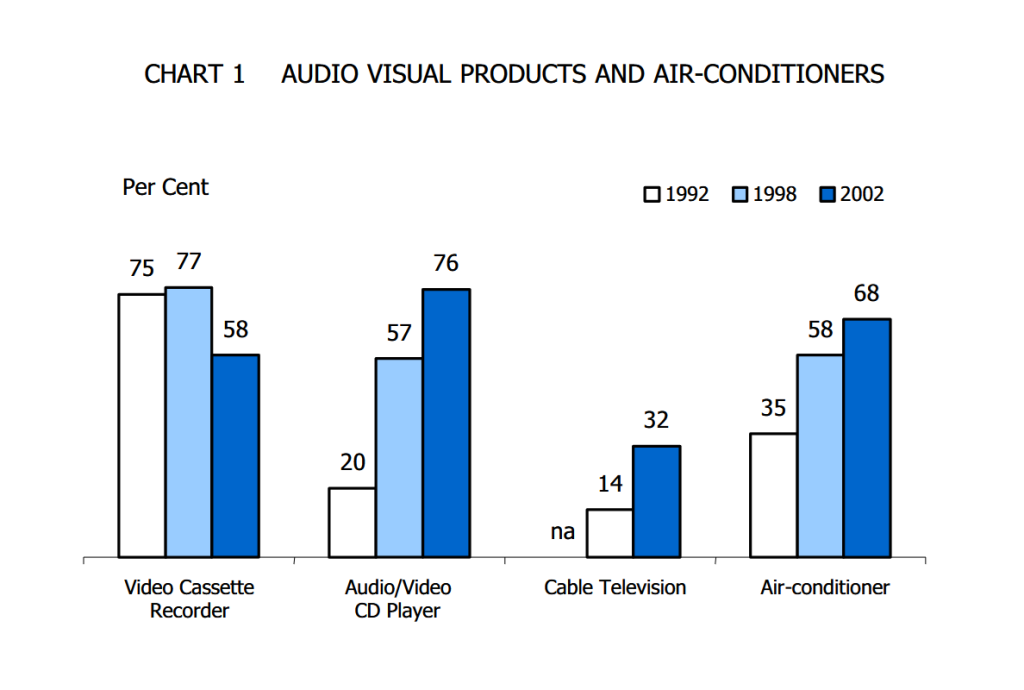
According to the Singapore Department of Statistics (SingStat), the percentage of households that installed air-conditioning rose from just 35.3% in 1993 to 58.3% in 1998. As of 2023, 81.9% of households have air-con units installed.
A 2003 newsletter attributed this rapid rise in households with air-conditioning to “increasing affluence and rising standard of living”.
Source: Singapore Department of Statistics
In contrast, devices like washing machines and televisions were already fixtures in Singapore households by the 1990s. In 1993, 80.5% of households had washing machines, while 97.5% of households had television sets.
Read Also: How Much Does It Cost To Run Your Air Conditioner Every Night?
#2 Personal Computers
While personal computers are common today, with 82.5% of households having at least one desktop or laptop, they weren’t as common in the 1990s. Only 20.2% of households had a computer in 1993, and while this proportion more than doubled by 1998 to 47.9%, it still meant that less than half of households in Singapore had a PC or a Mac at home.
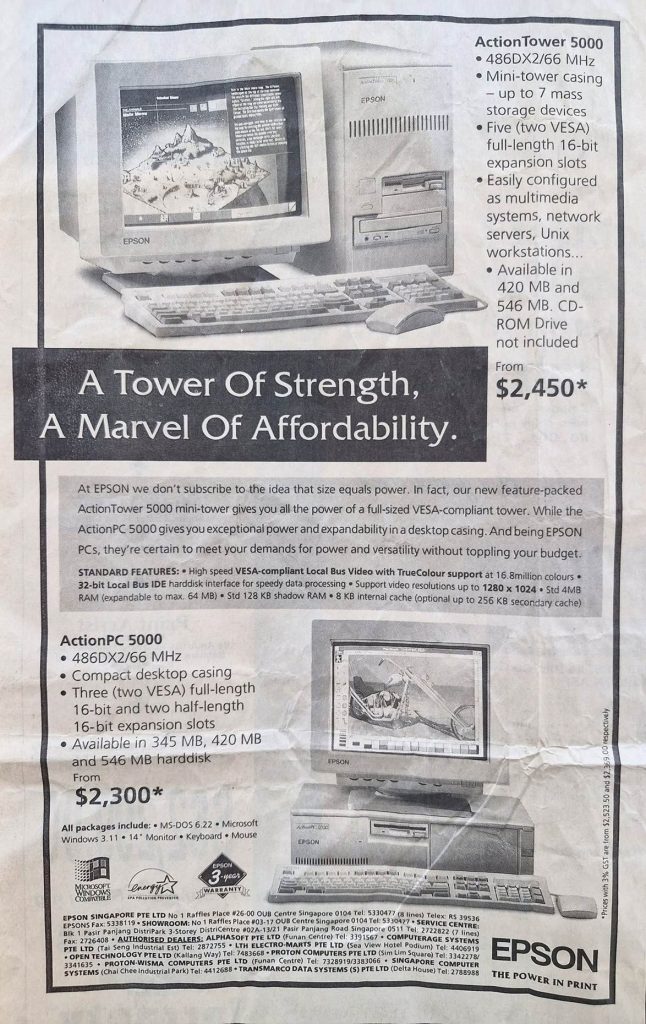
The main reason for this was the high price of these devices. A 1994 Straits Times advertisement for a 486 from Epson (a top-of-the-range device for the era) cost at least $2,300. That was more than half the median monthly household income in Singapore in 1995 ($3,135).
Source: Heritage SG Memories/Facebook
Presumably, this was because without internet access, PCs and Macs were little more than crude word processors, graphic design tools, or for playing video games.
#3 Internet Subscription And Internet Access
Public internet access in Singapore began in the mid-1990s, with community centres and libraries first providing computers that could go online. Back then, several households with internet access would have started with dial-up plans, and more affluent households would have moved to high-speed broadband or a cable internet connection once it became available in the late 90s.
In 1998, only 23.5% of households in Singapore had an internet subscription, but just 5 years later, this proportion more than doubled to 55.3% in 2003. The stiff competition between internet providers SingNet, Pacific Internet, and CyberWay (which launched in 1996) helped bring internet subscription costs down.
#4 Mobile Phones
Mobile phones are the quintessential everyday expense today. According to SingStat, more households have at least one mobile phone (99.1%) than a washing machine (96.4%) in 2023!
Yet in the 1990s, mobile phones were seen as luxuries. Bulky, brick-shaped mobile phones produced by Motorola and Nokia had been available since the 1980s, but they sold for over $2,000 in the 1990s.
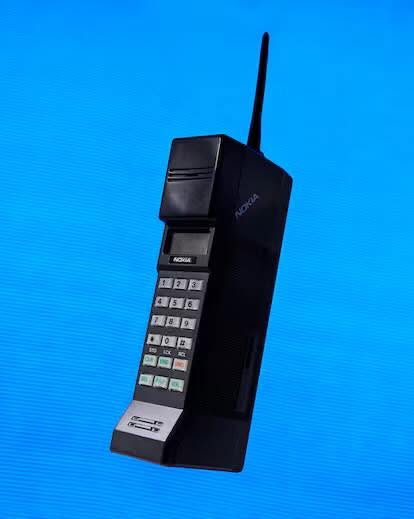
Source: Heritage SG Memories/Facebook
These were considered luxuries and only 6.5% of households had one in 1993. By the end of the decade, Nokia had started making smaller, cheaper phones such as the Nokia 3110 in 1997 and the Nokia 3210 in 1999. By 2003, 88.8% of Singaporean households owned a mobile phone.
#5 Mobile Plans With Data Roaming
While mobile phones were commonplace by the early 2000s, data roaming add-ons were still considered a luxury, especially for overseas travel. Back then, it was often more economical to buy a temporary SIM card in the countries we travelled to than to pay data roaming fees. This practice was later replaced by renting portable Wi-Fi dongles, which often cost about the same but were much more convenient.
Today, mobile plans conveniently bundle a significant amount of overseas data at very competitive prices.
Read Also: Guide To Overseas Data Roaming Plans
#6 Overseas Travel
Another luxury back in the 1990s was overseas travel. Before the widespread use of the internet, families often relied on travel agents and tour packages when travelling overseas. These packages were often costly, especially to farther destinations like the US and Europe.
Today, overseas travel, especially to neighbouring countries, is not only a regular expense but can also be an opportunity to save, especially when buying groceries or cosmetics, which are much cheaper overseas than in Singapore.
#7 Tuition And Education In General
Finally, households in Singapore now spend an average of $404.20 a month on education (as of 2023). This is about 5.7% of the total household expenditure of $7,118.70.
In 1993, however, households spent only $116.10 a month on education, or 3.8% of total household expenditure of $3,033.40.
This shows that education costs, as a proportion of household expenditure, have increased over the past 30 years. Tuition was considered a luxury 30 years ago.
We see this in the rise of the tuition industry: parents now spend a median of $500 monthly on private tuition in 2026, according to a study by the Institute of Policy Studies.
Read Also: From $318 To $677: Why Singaporeans Are Spending More On Tuition?
Advertiser Message


Branded Content
Why Your Investing Journey Works Better With A Buddy


