

Imagine the market drops just as you retire. While you were earning a salary, you could leave your investments alone or buy more at lower prices. Now, you might have to sell those investments to pay your bills.
That’s what changes when you start living off your savings. You still want your investments to grow, but you also need money for groceries and other bills today. And the money you don’t spend today might need to last another 20 or 30 years.
Why A Market Drop Early In Retirement Can Hurt More
While you’re working and investing regularly, a market drop means your next contribution can buy more units at lower prices. If those investments recover, you benefit from having bought at those prices.
Once you retire, you may have to sell some of your investments during a downturn to cover living expenses. The order of your good and bad years matters because selling during an early downturn leaves fewer units to benefit from a recovery, potentially shortening how long your savings last. This is known as sequence of returns risk.
Say you retire with $1,000,000. If your portfolio drops 30% within the first two years, it falls to a little more than $600,000. That smaller balance still has to fund years of withdrawals and, as the illustration below shows, will run out within 18 years. If the same drop comes in Year 10 and 11 after several good years, you would have a larger balance to absorb it and fewer years of withdrawals ahead and would have enough money to last more than 18 years.
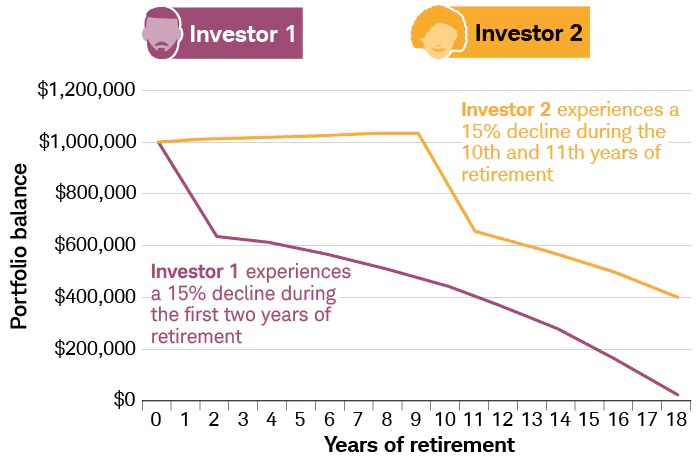
Source: Schwab
How Long Does Your Retirement Income Need To Last?
Longevity risk is the risk of outliving your savings. According to SingStat, Singapore residents aged 65 in 2025 could expect to live another 21.6 years on average. Planning only to that average could leave you short if you live into your 90s. You may also need to spend more on healthcare as you get older.
Why Your Cash Savings May Buy Less Over Time
Moving more of your savings into cash when you retire can feel reassuring. But if your savings earn less than inflation, they lose purchasing power even as your account balance grows.
If your savings earn 2% a year while prices rise by 3%, they would lose about 25% of their purchasing power over 30 years, assuming those rates persist and you make no withdrawals. Cash can cover near-term expenses, but holding too much for decades carries its own risk.
How CPF LIFE, A Cash Buffer And Investments Can Work Together
CPF LIFE pays a monthly income for as long as you live. How much you receive depends in part on your retirement account balance when you join CPF LIFE and when you start your payouts. If you’ve set aside the Enhanced Retirement Sum, compare your estimated payout with what you expect to spend on essentials. The Escalating Plan starts with lower payouts than the Standard Plan and increases them by 2% a year. That can help with rising costs, though your own expenses may rise faster.
Read Also: Retirement Sum Topping-Up Scheme (RSTU): Step-By-Step Guide To Topping Up Your CPF With Cash
A cash buffer can cover the gap between your regular income and what you spend. Holding that money in a savings account or fixed deposits can reduce the need to sell investments during a downturn.
If you retire at 65, the money you might need at 90 could stay invested for another 25 years. A mix of shares and bonds gives it a chance to grow, while CPF LIFE and your cash buffer help cover nearer-term bills.
Plan Your Withdrawals Before You Retire
Before you retire, work out how much of your monthly spending CPF LIFE and any other regular income could cover. Whatever’s left is the amount your savings need to cover each month. Once you know that number, it’s easier to decide how much cash to keep on hand and how much you can leave invested.
Read Also: Complete Guide To CPF Retirement Account
Advertiser Message


