
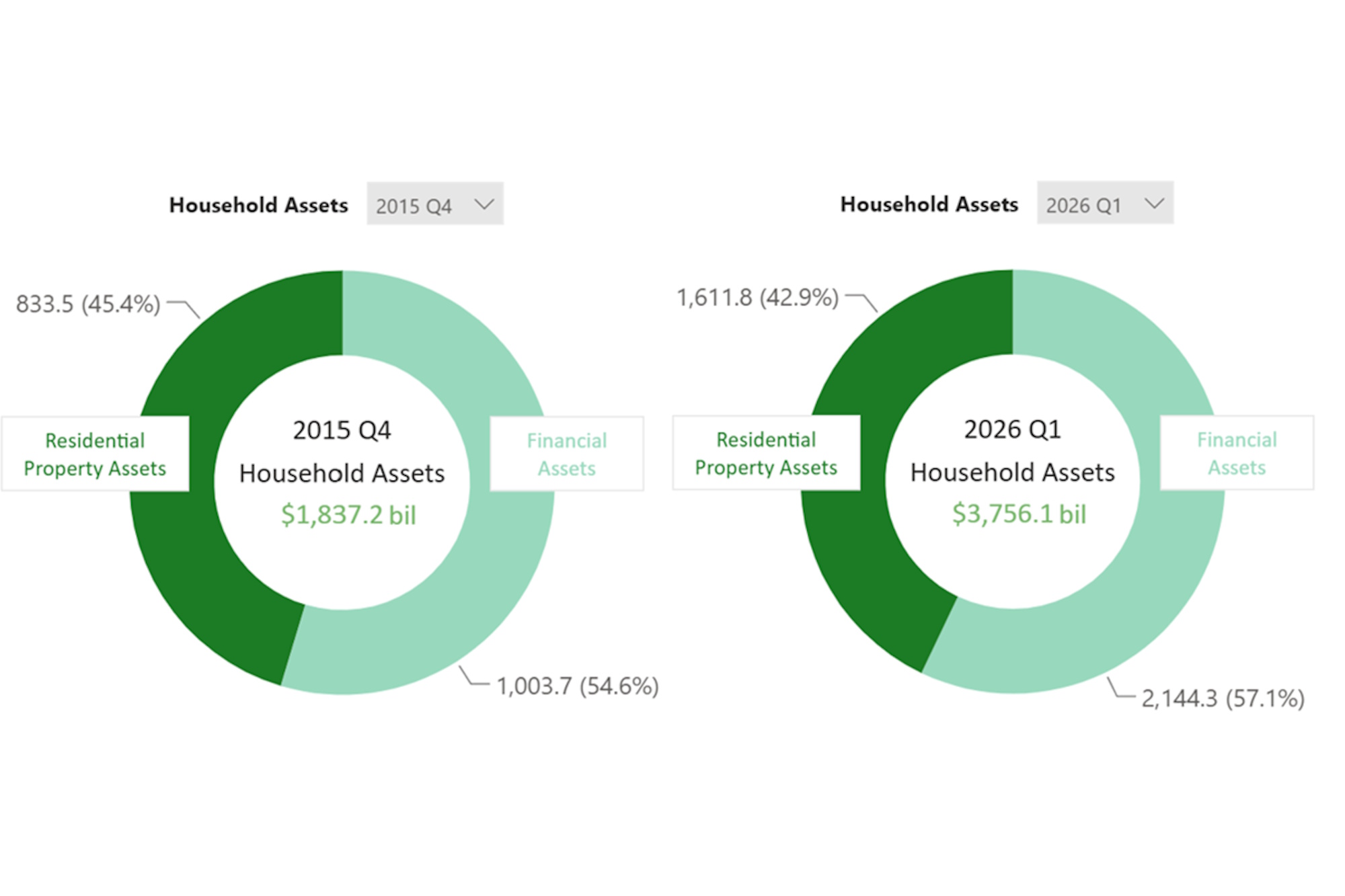
Over the past decade, Singaporean households have seen their financial assets more than double, crossing the $1 trillion mark in Q4 2015 and rising to $2.1 trillion by Q1 2026, according to the latest Household Sector Balance Sheet data released by the Department of Statistics (SingStat).
Source: SingStat
What’s notable about this growth is that it has outpaced the growth of residential property assets. Over the same period, residential property assets increased from $0.8 trillion to $1.6 trillion, just shy of doubling. Another way to look at this is that financial assets now make up a larger proportion of Singaporean household assets, almost 60%.
This growth is not just a matter of numbers. It reflects the evolving financial habits of Singaporeans.
The Drivers Of Growth
That said, property still remains the largest component of household assets. Rising HDB resale values and sustained demand for private housing have pushed asset levels higher. Even with cooling measures, housing continues to anchor household wealth, accounting for more than half of total household assets.
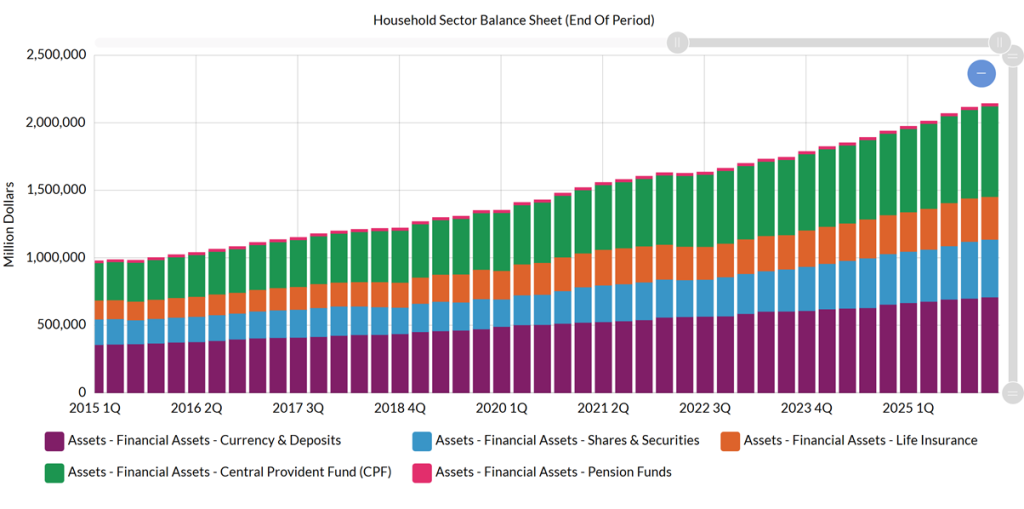
The remaining financial assets, as tracked by SingStat, are divided into five main categories, namely currency & deposits, Central Provident Fund (CPF), shares & securities, life insurance, and pension funds. The latter was included back in 2012 and comprises government pension schemes such as the Singapore Armed Forces’ Savings and Employee Retirement and Premium Fund (SAVER-Premium Fund) and the Ministry of Home Affairs’ INVEST Fund.
Source: SingStat
Over the past decade, Singaporeans have become more active investors. Equity holdings, unit trusts, and insurance-linked products have grown, reflecting both greater financial literacy and the search for returns in a predominantly low-interest environment.
Source: SingStat
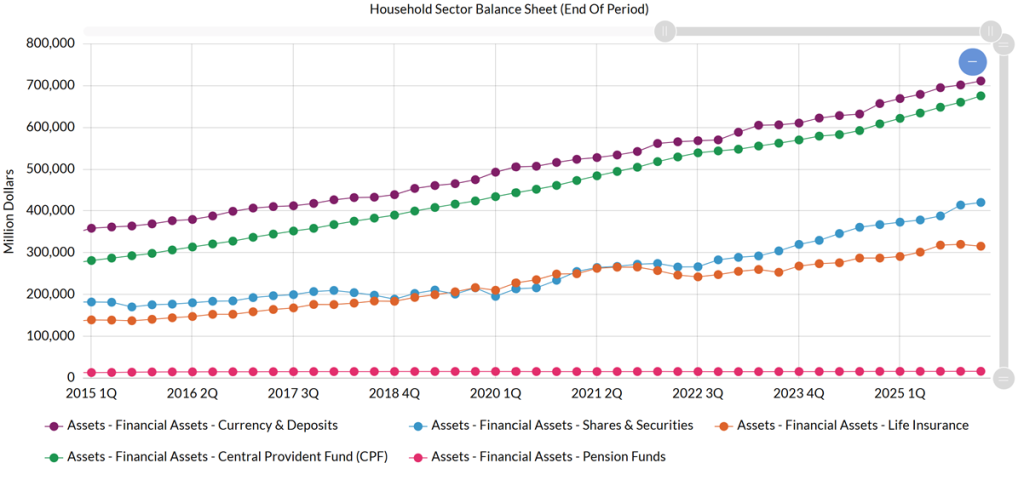
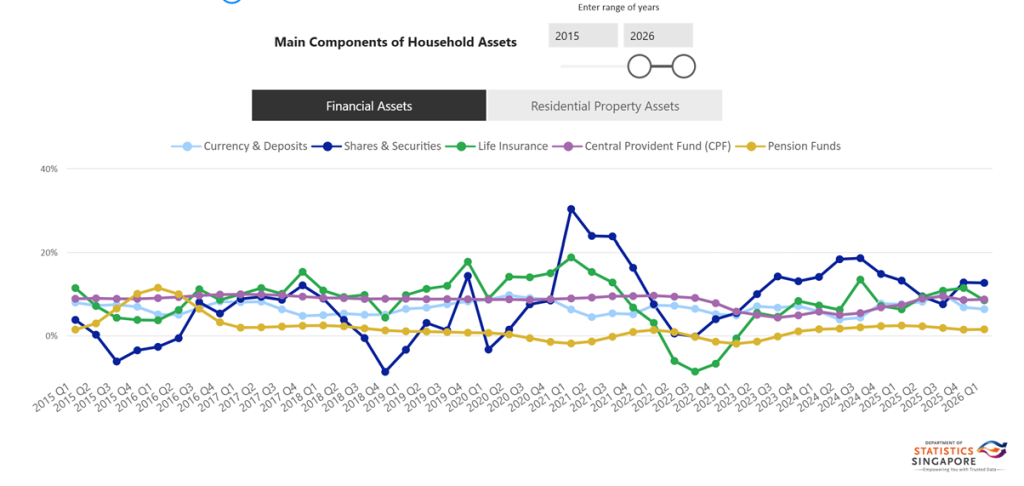
Notably, however, growth in shares & securities and life insurance has been inherently volatile, while growth in currency and deposits remains fairly stable.
Currency & Deposits Remain The Bedrock Of Singaporean Liquidity
For many households, the most tangible form of wealth is cash in the bank. Currency and deposits have steadily grown over the past decade from $370 billion to $712 billion, reflecting both rising incomes and a cultural preference for financial prudence. Currency and deposits made up about 37% of financial assets in Q4 2015, and about 33% of financial assets in Q1 2026.
Singaporeans are known for their high savings rate, and this is evident in the expansion of bank deposits, which now account for hundreds of billions in household assets.
The growth in deposits has been shaped by low interest rates in the 2010s, which encouraged households to hold liquid savings rather than chase risky returns. More recently, higher interest rates have made deposits attractive again, with banks offering competitive savings products. This liquidity provides households with a buffer against economic shocks, ensuring resilience during downturns such as the COVID-19 pandemic.
Shares & Securities Demonstrate A Growing Appetite For Investment
While deposits provide safety, shares and securities represent the pursuit of growth. Over the past decade, Singaporeans have become more active investors, with household holdings in equities and unit trusts expanding significantly, from $176B to $421B. Shares and securities made up slightly over 17% of financial assets in Q4 2025, and about 19.6% of financial assets in Q1 2026.
This reflects both greater financial literacy and the rise of digital platforms that make investing more accessible.
The surge in securities holdings also mirrors global market trends. The bull runs of the 2010s and early 2020s boosted household portfolios, while diversification into overseas markets allowed Singaporeans to tap into global growth stories.
Life Insurance Allows Protection And Wealth Accumulation
Life insurance has long been seen as a tool for protection, but in Singapore it also plays a role in wealth accumulation. Household holdings in life insurance policies have grown steadily over the past 10 years, from $140B to $317B. In terms of proportion, however, it remained around 14% of household financial assets.
This growth highlights a broader trend that Singaporeans are increasingly aware of the need to safeguard against uncertainties while building long-term wealth.
CPF Balances Serve As The Pillar Of Retirement Security
No discussion of household wealth in Singapore is complete without the Central Provident Fund (CPF). Over the past decade, CPF balances have expanded dramatically, driven by mandatory contributions, government top-ups, and compounding interest. Throughout the decade, CPF holdings remain one of the largest components of household financial assets, growing from $299 billion to $676 billion today. In terms of proportion, it remains about 30% of financial assets.
The steady growth of CPF balances underscores how effective it is at helping households accumulate wealth even if they are not active investors.
Pension Funds: A Small But Steady Contributor
Compared to CPF, pension funds represent a smaller share of household assets, but they remain important for specific groups, such as civil servants and employees in legacy schemes. Pension fund balances have grown modestly over the past decade, reflecting both contributions and investment returns. While not as prominent as CPF, they add another layer of security to household wealth, particularly for older generations.
A Small Note On Household Liabilities
Of course, household assets do not exist in isolation. Household liabilities, primarily housing loans, have also expanded, rising in tandem with property values. In fact, household liabilities outpaced asset growth in Q4 2025 for the first time since 2019.
As of Q1 2026, liabilities stand at around $415 billion, a reminder that wealth accumulation often comes with debt obligations. Yet the overall picture remains positive: assets far outweigh liabilities, leaving households with a net worth exceeding $3.3 trillion.
Advertiser Message
Thinking Of Switching Brokers Or Consolidating Your Holdings?
Tiger Brokers is currently running a transfer-in campaign where eligible clients can receive an iPhone 17 Pro Max* when they transfer in their assets.
For SGX investors, there is also a CDP Transfer promotion with 0* commissions on Singapore stocks.
Find out more here. *T&Cs apply.




Lifestyle
15 Of The Cheapest EV Cars In Singapore


Budgeting 101
7 Ways Being Frugal Is Different From Being Cheap

Street Smart
Singapore Gym Membership Price Guide (2026 Edition)


