
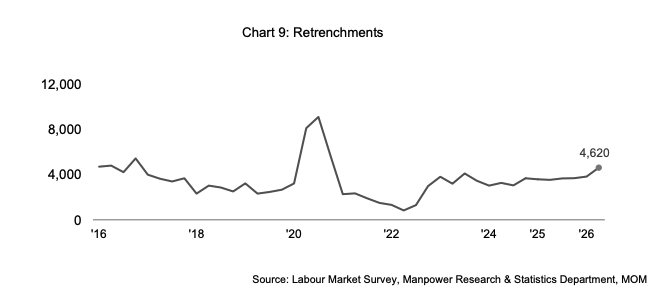
According to the Labour Market 2Q2026 Report, retrenchments in Singapore rose again, with 4,620 workers retrenched in the second quarter of 2026, up from 3,830 in the previous quarter.
This marks the fourth consecutive quarterly increase and the highest number of retrenchments since the fourth quarter of 2020, when Singapore was still grappling with COVID-19’s economic impact.
Retrenchments are a normal part of the economic cycle. Even when the economy is growing, companies may restructure their operations, reduce headcount or discontinue certain business activities. This is not necessarily a large concern if displaced workers can find new employment relatively quickly, particularly when other industries are expanding and creating jobs.
However, while Singapore’s overall unemployment rate remains low at 1.9%, several indicators in MOM’s latest Labour Market Report suggest that workers, in particular PMETs, should be concerned.
Beyond the rising number of retrenchments, fewer retrenched workers are finding employment within six months, job vacancies are declining, and hiring activity has slowed. These developments suggest that losing a job today could be harder than headline unemployment figures might indicate.
Finding A New Job After Retrenchment Is Becoming More Challenging
Retrenchment is less of a concern when workers can find another job relatively quickly. However, MOM’s latest figures suggest that re-entering the workforce has now become more challenging.
The proportion of retrenched residents who returned to employment within six months fell from 60.7% in 1Q 2026 to 54.9% in 2Q 2026. This means that almost half of workers who are retrenched do not return to employment six months after losing their jobs.
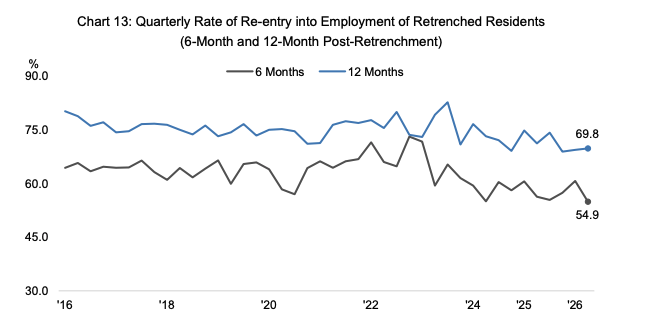
The situation is particularly concerning for Professionals, Managers, Executives and Technicians (PMETs). Retrenchment among resident PMETs rose from 2.6 to 3.2 per 1,000 employees, the largest increase among occupational groups. Degree holders also recorded the highest retrenchment among educational groups at 3.1 per 1,000 employees.
Finding another job has become more challenging for these workers, with the six-month re-entry rate for PMETs declining from 59.6% to 54.1%, while that for degree holders fell from 58.3% to just 49.9%.
Not surprisingly, older workers face an even greater challenge. Residents in their 50s recorded the highest retrenchment incidence at 3.6 per 1,000 employees, up from 3.1 in the previous quarter. Among retrenched residents aged 50 to 59, only 41.9% had returned to employment within six months, down from 51.8%.
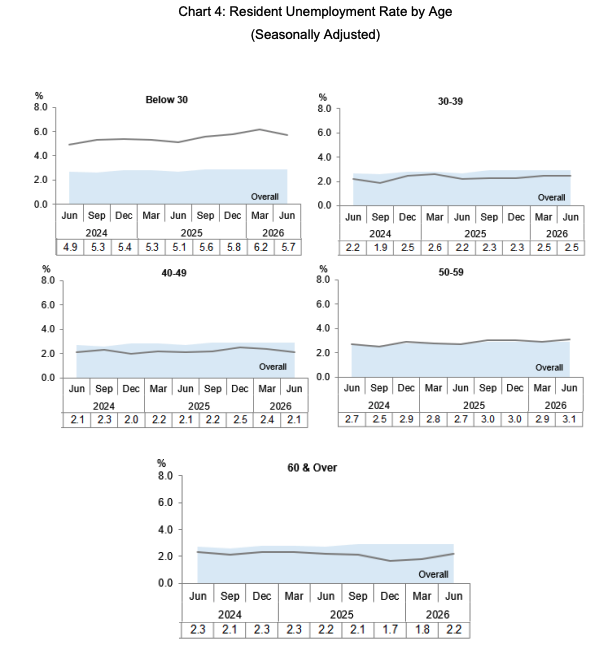
However, younger workers should not assume they are unaffected. While residents below 30 recorded the lowest retrenchment and highest six-month re-entry rate, their unemployment rate remained the highest across age groups at 5.7% in June 2026. This improved from 6.2% in March but remained above the 5.1% recorded a year earlier.
More Jobs Are Being Created, But For Who?
Rising retrenchments would be less concerning if the economy were creating enough new jobs to absorb displaced workers.
On the surface, Singapore’s employment figures appear encouraging. Total employment grew by 11,400 in 2Q 2026, higher than the increases of 9,400 in the previous quarter and 10,400 a year ago. However, a closer look shows that resident employment growth slowed from 5,400 to just 2,200, while non-resident employment increased to 9,200 from 4,100 in the previous quarter. This means that the majority of new jobs created are going to non-residents.

The decline in job vacancies adds to the concerns for anyone looking to find a job.
Total vacancies fell from 73,300 in March 2026 to 68,600 in June 2026, driven mainly by PMET positions. Financial Services and Information & Communications, among the sectors with higher retrenchments, also saw the largest declines in vacancies. Financial Services vacancies fell from 5,800 to 4,500, while Information & Communications vacancies declined from 5,300 to 4,400.
Slower Hiring Makes Switching Jobs More Challenging
For workers considering a job switch, the latest labour market figures suggest that finding a new job may take longer. The average monthly recruitment rate fell from 1.6% in 1Q 2026 to 1.4% in 2Q 2026, while the resignation rate is at 1.0%.
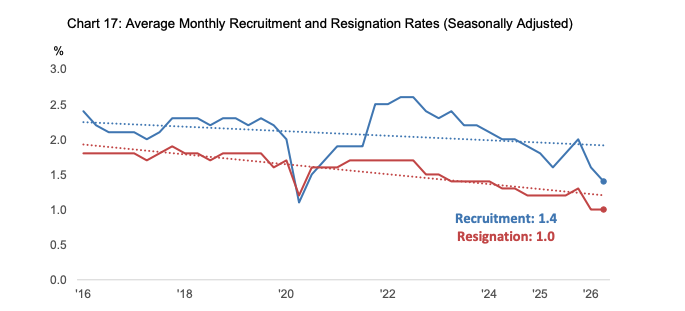
This gradual decline in labour turnover over the past decade suggests that as employers become more cautious about hiring, workers are also less inclined to leave their existing jobs.
For those thinking of resigning without another job lined up, it may be worth considering whether we have sufficient savings to support a potentially longer job search.
Strong GDP Growth Does Not Necessarily Mean Better Job Prospects
Perhaps the most surprising aspect of Singapore’s labour market is that these developments are happening even as the economy continues to perform well. Singapore’s GDP grew by 5.9% year-on-year in 2Q 2026, following a 6.3% expansion in the previous quarter. Yet during the same period, retrenchments increased, resident employment growth slowed, and fewer retrenched workers returned to employment within six months.
As we have discussed in a previous DollarsAndSense article, strong GDP growth does not necessarily translate into better employment opportunities or even higher salaries for workers. Economic growth can be driven by industries that require fewer employees, or by sectors creating jobs that do not match retrenched workers’ skills and experience.
This does not mean Singapore’s labour market is in poor shape. Unemployment remains low, and businesses are still creating jobs. However, for workers, particularly PMETs, the latest figures remind us that a growing economy no longer guarantees job security.
All screenshots are from the Labour Market 2Q2026 Report
Photo Credit: iStock/3yephotography


Family Planning
Cost Guide To International School Fees In Singapore


