

Enjoying a higher salary is always a good thing. But there is an obvious caveat: it only matters if you actually have a job in the first place. If you are unemployed, rising wages do not mean very much and may, in fact, work against you.
The latest graduate employment survey released by the Ministry of Education shows that the median gross monthly salary for fresh graduates from Singapore’s six autonomous universities is now $4,500. This is similar to the figure in 2024 and higher than the $4,295 recorded in 2023.
For someone just entering the workforce, it is also a very good starting pay. To put this into perspective, the median monthly salary in Singapore is only slightly higher at about $4,935, or $5,775 after including employer CPF contributions.
Fresh graduates who secure full-time permanent jobs are also seeing their median salaries increase.
However, there is an important catch. These higher starting salaries only apply if fresh graduates manage to find a job in the first place.
According to the survey, 83.4% of graduates actively seeking work were employed within six months of completing their final exams, down from 87.1% in 2024. It is also worth noting that being “employed” does not necessarily mean securing a full-time, permanent role, which usually accounts for a smaller proportion of graduates.
In fact, the overall employment rate for fresh graduates has been gradually declining since 2022, suggesting that while those who find jobs may be earning more, securing one has become harder.
Why Higher Wages Do Not Always Equate To Better Employment Opportunities?
Traditionally, rising wages are often seen as a sign that employment conditions are improving. When employers have difficulty finding workers, they typically need to offer higher pay to attract and retain talent. This tends to happen when the labour market is tight, unemployment is low, and workers have stronger bargaining power.
At first glance, the latest data from the Graduate Employment Survey seems to support this idea. When we look at the median gross monthly salary for fresh graduates who secured full-time permanent employment in 2025, we see that many earn more than graduates from earlier cohorts.
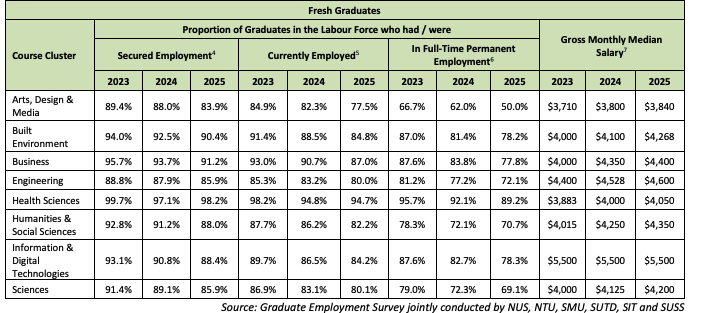
Source: Graduate Employment Survey 2025
However, a closer look suggests that higher salaries may be coming with an important trade-off.
Take the Arts, Design and Media course cluster as an example. Graduates who secured full-time permanent employment in 2025 earned a median salary of $3,840, slightly higher than the $3,710 recorded for the 2023 cohort. While the pay has improved, the chances of securing such a role have fallen sharply. In 2025, only 50.0% of graduates found full-time permanent employment, compared with 66.7% in 2023.
We see a similar pattern among business graduates. Those who secured full-time permanent roles in 2025 earned a median salary of $4,400, about 10% higher than the $4,000 earned by the 2023 cohort. Yet the share of graduates landing full-time permanent jobs has declined from 87.6% in 2023 to 77.8% in 2025.
In other words, while the graduates who manage to secure full-time permanent jobs are earning more, a smaller proportion of graduates are actually getting these roles.
Why Are Salaries Rising Even As Employment Rates Fall?
There are several possible reasons for this seemingly contradictory trend.
One explanation is simply rising costs. As the cost of living in Singapore rises due to inflation, salary expectations naturally increase as well. Offering slightly higher starting salaries can therefore be a way for companies to remain competitive in attracting good talent.
However, higher pay also means employers may become more selective in their hiring. This is especially true for fresh graduates. Unlike experienced hires, graduates typically have limited work history for employers to evaluate. Companies often rely on factors such as academic results, internships and interviews to assess potential. If the cost of hiring a graduate increases, employers may simply decide to hire fewer candidates but be more selective, choosing only those they feel are the strongest fit.
Another possibility is that graduates themselves are becoming more selective.
With starting salaries trending higher in recent years, some graduates may hold out for better offers rather than accepting lower-paying full-time roles. Jobs that offer salaries below their expectations may be rejected.
When this happens, it can create an interesting statistical effect. Lower-paying job offers that are rejected do not show up in the final salary data, which can push the median salary higher. At the same time, because some graduates choose not to accept certain offers, the overall employment rate may fall, even though jobs were technically available.
In other words, rising salary expectations on both sides of the market can lead to a situation where the graduates who do secure jobs earn more, but a smaller share of graduates end up employed.
What Matters More Than Starting Salary
Looking beyond salaries, another concerning trend is that employment rates have declined across the board. This does not only apply to full-time permanent roles. Employment rates for contract and part-time jobs have also fallen.
In other words, the challenge may not simply be about securing a “good” job. For some graduates, finding a job at all may be becoming more difficult.
There could be several reasons behind this. Employers may be taking a more cautious approach to hiring if they feel uncertain about the economic outlook. When businesses are unsure about future demand, they often slow hiring or delay expanding their workforce.
At the same time, there may also be longer-term structural shifts in the job market. As companies increasingly adopt technologies such as artificial intelligence and automation, some entry-level tasks may no longer require as many workers as before. This could mean fewer new roles being created for graduates entering the workforce.
For fresh graduates, earning a strong starting salary is certainly important. However, what may matter even more is simply having the opportunity to start working, learn on the job, and build experience.
After all, the first job is often less about maximising pay and more about gaining the skills, exposure, and track record that will open doors to better opportunities later in one’s career.


