

Remember the days when “quiet quitting” became a catchphrase for employees doing the bare minimum that kept them in their jobs? Well, now there’s a lesser-discussed flip side that matters just as much for your career: quiet cutting.
Quiet cutting isn’t a formal retrenchment per se. There’s no town hall announcement, farewell email, or severance package from your company. Instead, they simply reshape your job in ways that make you less relevant, less visible and easier to manage out over time.
In a Singapore context, this is worth paying attention to because our job market here can look “fine” on the surface, even when certain teams are quietly being reorganised. For example, the Ministry of Manpower (MOM) reported that 14,400 employees were retrenched in 2025, a slight increase from 2024. Should this matter in the grand scheme of things?
It does, but the bigger story is what many firms do before they reach retrenchments: they restructure internally and reallocate people in ways that don’t show up in the stats we see. Quiet cutting is often that in-between stage. So, here’s a deeper look at how quiet cutting can impact your career.
What Quiet Cutting Actually Looks Like (And Why It’s So Hard To Prove)
Quiet cutting usually shows up as a change in your trajectory, not a change in your employment status.
You might still have the same title and pay, but the role is hollowing out. Your responsibilities are trimmed, assignments may not come your way, and your scope of work shrinks (alongside your visibility).
Sometimes, it’s the opposite, though. Your job becomes working on “special projects” with unclear outcomes, or you’re moved into work that doesn’t match your strengths, making it harder to perform well. This is why it can feel like you’re being gaslighted, because nothing dramatic has happened, but you can definitely sense the air going out of the balloon of your career.
And because it’s subtle, quiet cutting is also easier for companies to execute. It avoids the reputational risk of layoffs, reduces immediate costs, and gives leadership optionality. If business conditions improve, they can just say they “redeployed talent.” If conditions worsen, they can later justify a formal cut by citing performance issues or redundancy.
Why Do Employers Quiet Cut?
There are several reasons quiet cutting has become more common. First, it’s a way to manage costs without a clean break. When a company carries out official retrenchments, they’re typically both expensive and disruptive. A sense of fear is created across the organisation, which can harm productivity and retention.
Second, it’s a way to manage performance without having hard conversations with underperformers. Instead of confronting misalignment early, some managers simply slowly reduce scope or move someone sideways, hoping the person eventually quits.
Third, it’s an outcome of restructuring. In Singapore, many teams have had to adjust to shifting demand, tech investment cycles, and regional business changes. MOM’s labour market updates show job vacancies moving around as conditions change, with September 2025’s 69,200 vacancies coming down from the 76,900 vacancies as of June 2025.
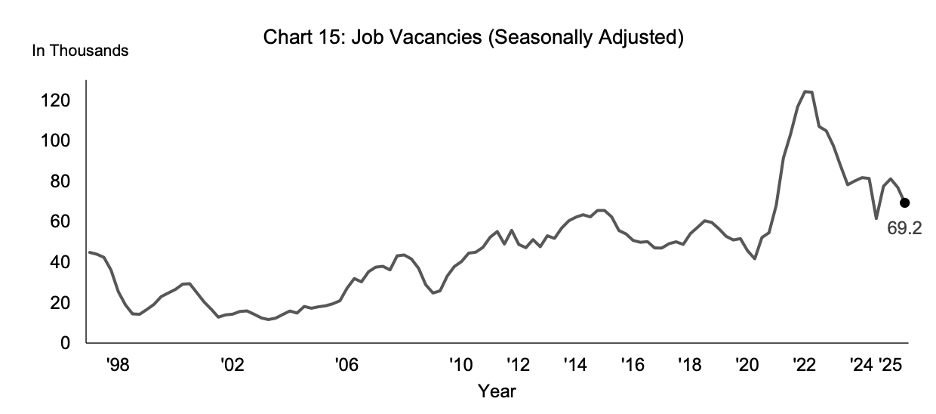
Sources: Labour Market Survey, Manpower Research & Statistics Department, MOM, as of December 2025
Even when vacancies exist, they may not match your function, seniority, or pay expectations. That mismatch is where quiet cutting can thrive: companies try to make do with internal reshuffles rather than add headcount. It’s more a case of squeezing higher productivity out of existing employees. The uncomfortable truth is that quiet cutting is often framed internally as being “practical” but the real question is whether it’s building you up or quietly pushing you out.
The Career Damage Isn’t Just Emotional
The biggest risk with quiet cutting is that it steals time from your career without you noticing. A few months of lower visibility can easily become a year without meaningful achievements. A weaker performance cycle makes it harder to get promoted, harder to negotiate pay, and easier to label as “not progressing.”
And once you’re seen as someone with limited momentum, your next career move gets harder. Recruiters and hiring managers don’t just look at your job title, but they increasingly want evidence of outcomes or noticeable “visibility”. If your role has quietly been stripped down, you may find yourself struggling to explain what you’ve actually been doing.
It also affects morale, which in turn impacts performance. Globally, engagement has been slipping. Gallup reported that global employee engagement fell from 23% to 21% in 2024, and linked the decline to significant productivity losses. If you’re being quietly cut, your engagement will almost certainly drop along with your output. Then the evidence piles up against you, even when the root cause was structural.
Read More: Employment, Unemployment And Retrenchment: Here’s What The Statistics Mean In Singapore
What You Can Do If You Suspect You’re Being Quiet Cut
You don’t need to panic at the first sign of change, but you do want to be aware and respond like someone protecting their career runway. Start by gaining clarity in a calm, practical way. Ask your manager what success looks like for the next quarter and what outcomes you will be measured on.
At the same time, document your impact professionally. Think of it as a “paper trail” of your own achievements. Track what you delivered at work, what improved, what you saved, and what the outcomes were. Quiet cutting works best when your work is invisible, so your job is to make it as visible as possible.
Then have an honest conversation with yourself: Is this simply a temporary phase, or a directional change? This is also where Singapore’s reality matters, as the market here is small and the industry is concentrated. Waiting too long can leave you job searching from a weaker position. Quiet cutting often leads people to make reactive decisions, whereas the ideal approach is to stay proactive.
Be Strategic Amid Quiet Cutting
Overall, the goal for you isn’t to turn every change into a conspiracy theory at work but rather to recognise that in today’s day and age, careers don’t usually collapse overnight. Quiet cutting is dangerous because it can feel “manageable” in the moment (i.e., you have a job and income), yet your long-term career capital might be shrinking without you realising.
If you spot it early, you still have options to rectify it. In a world where businesses are constantly reorganising, protecting your career trajectory is part of being a professional. Quiet cutting isn’t always personal, but the impact on your career can be very real, and it can also be very hard to reverse if you ignore it for too long.


Street Smart
Singapore Gym Membership Price Guide (2026 Edition)


