
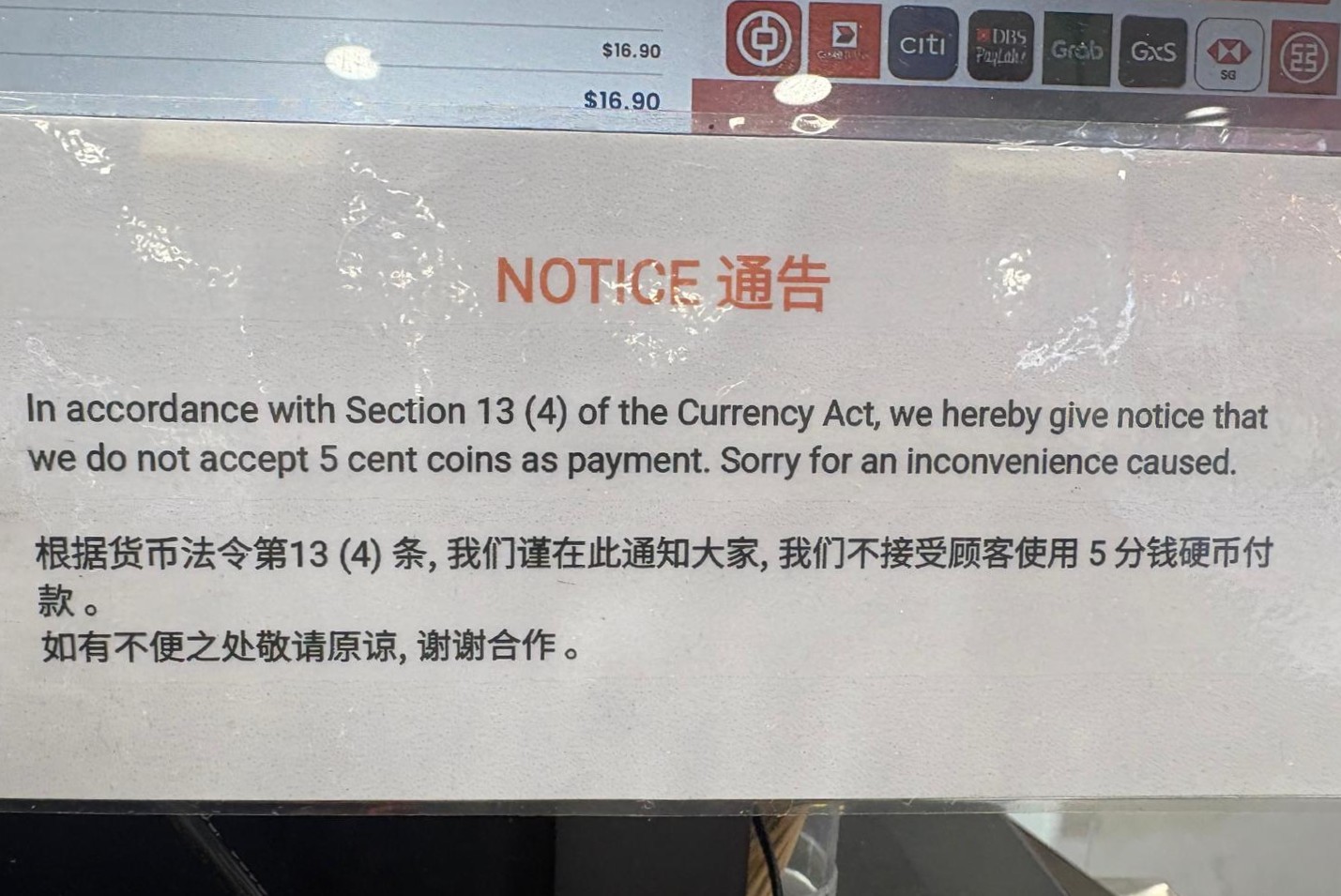
You may have encountered shops in Singapore displaying signs stating that they do not accept 5-cent coins. But if these coins are legal tender, shouldn’t shops be required to accept them?
While 5-cent coins remain legal tender in Singapore, businesses are allowed to refuse them under certain circumstances. Here’s what consumers should know about their rights when paying with coins.
Are Shops Legally Required To Accept 5-Cent Coins?
Under Singapore’s Currency Act 1967, currency notes and coins issued by the Monetary Authority of Singapore (MAS) are legal tender. However, retailers are not required to accept an unlimited number of coins.
The legal tender limit is 20 coins per denomination per transaction, regardless of the coin’s value.
| Coin denomination | Legal tender limit | Maximum value |
| 5 cents | 20 coins | $1 |
| 10 cents | 20 coins | $2 |
| 20 cents | 20 coins | $4 |
| 50 cents | 20 coins | $10 |
| $1 | 20 coins | $20 |
For example, you can use twenty 5-cent coins to pay for a $1 item. However, a retailer is not legally obliged to accept forty 5-cent coins for a $2 purchase.
The limit applies separately to each denomination, so you can use twenty 5-cent coins and twenty 10-cent coins in the same transaction. Retailers can also choose to accept more than 20 coins of a particular denomination if they wish.
Can Shops Refuse Your 5-Cent Coins Even If You Are Within The Legal Tender Limit?
Yes. Under the Currency Act, retailers can refuse certain denominations of currency notes or coins, or limit the quantity they accept, provided they give customers written notice.
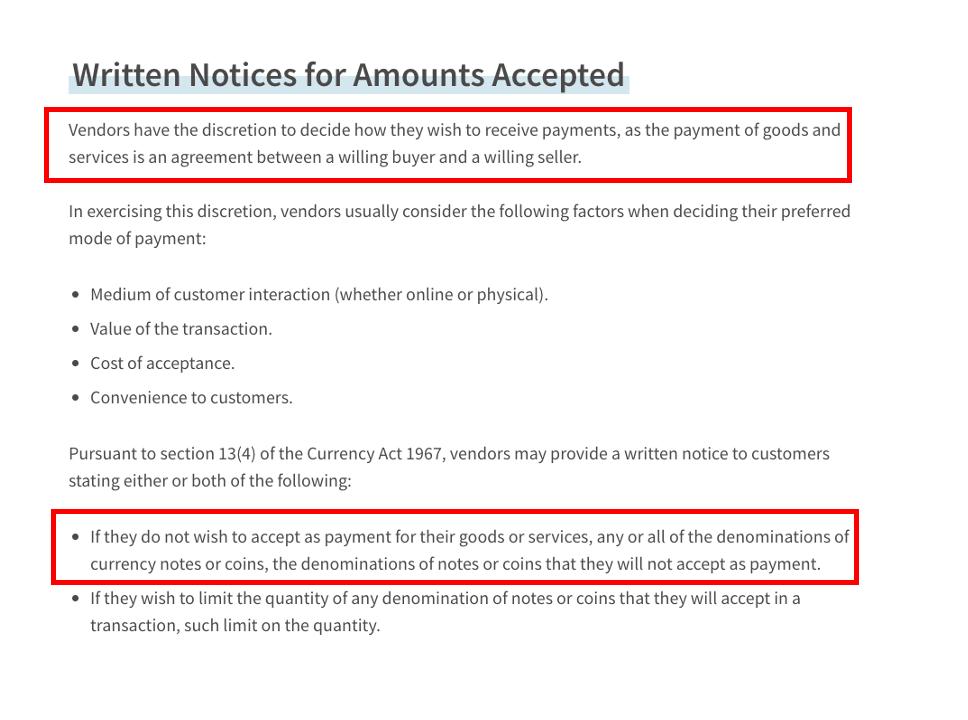
This explains why some shops display signs stating that they do not accept 5-cent coins or will only accept a certain number per transaction.
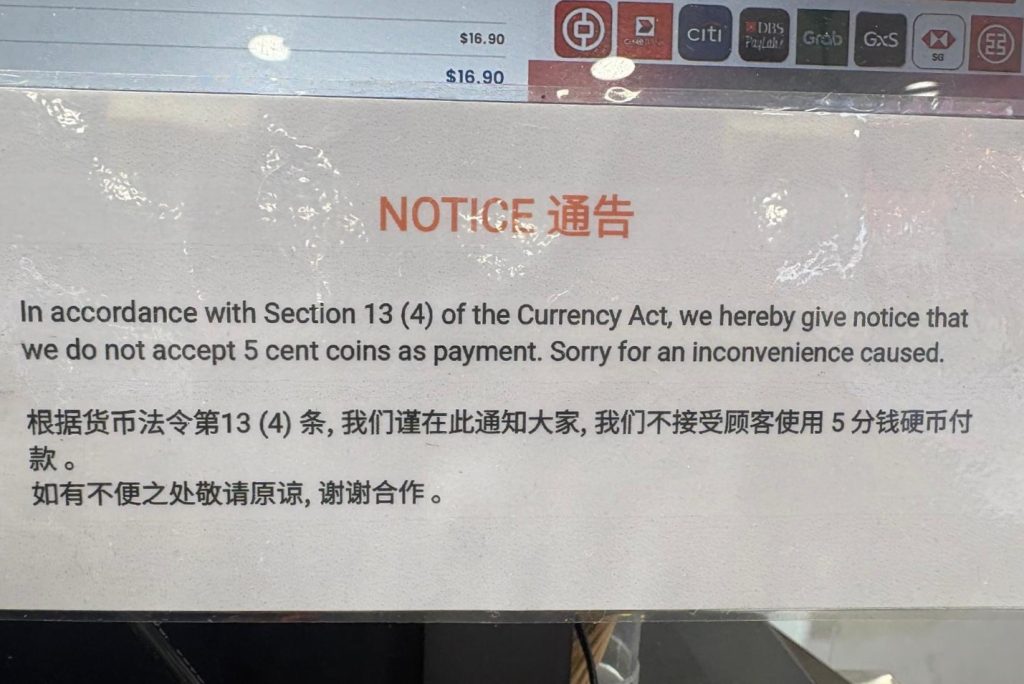
Retailers may introduce these restrictions because handling small coins takes additional time when counting cash and preparing change. This is similar to how some shops will put a notice saying they do not accept cash as a form of payment, as they may prefer cashless payments or want to reduce the amount of loose change they handle.
Whatever the reason, shops can establish their payment terms by providing the required written notice. The fact that 5-cent coins are legal tender does not mean retailers must accept them in every transaction.
What If A Shop Refuses Your 5-Cent Coins Without Displaying A Notice?
If a retailer has not provided written notice restricting the acceptance of certain denominations, customers are generally entitled to use legal tender within the statutory limits to settle an existing debt.
For example, if you have finished a haircut and need to pay the agreed amount, the barber generally cannot refuse your 5-cent coins if no written notice was provided and you are within the legal tender limit.
For consumers, it is worth checking for payment notices before making a purchase, particularly if you intend to pay with a large quantity of coins.
Will Singapore Eventually Phase Out 5-Cent Coins?
With more retailers refusing 5-cent coins and consumers increasingly using cashless payments, it is worth asking whether Singapore still needs its smallest coin.
In a parliamentary written answer on 24 February 2026, Deputy Prime Minister Gan Kim Yong revealed that MAS had not minted any new 5-cent coins in the preceding five years and had no plans to mint more at that stage.
There are also practical reasons to retain the denomination. Many retailers continue to price products in 5-cent increments, while supermarkets charge 5 cents or 10 cents for disposable bags. Removing 5-cent coins could encourage businesses to round up their prices, potentially increasing costs for consumers.
MAS also estimated that producing a 5-cent coin still costs less than its face value. It will continue monitoring demand to assess whether the denomination remains relevant in the longer term.
Read Also: 4 Money Habits Every Child Needs In A Cashless World
Can Shops Round Their Bills To The Nearest 5 Cents?
Singapore stopped issuing 1-cent coins in 2002. Since then, businesses have been able to round their bills to facilitate cash payments.
According to IRAS, businesses may round their total bills, including GST, to the nearest 5 cents. Whether they round up or down is a business decision, but the chosen approach must be applied consistently.
This is separate from refusing 5-cent coins. A retailer that rounds its bills to the nearest 5 cents may still accept the coins as payment.
Your 5-Cent Coins Are Still Legal Tender, But Shops Can Refuse Them
Singapore’s 5-cent coins remain legal tender, and MAS has no announced plans to withdraw them from circulation. However, retailers can refuse them or impose limits on how many they accept, provided they give customers the required written notice.
If you have accumulated a collection of 5-cent coins, you can still spend them at retailers that accept them, subject to the legal tender limit of 20 coins per denomination per transaction.
Read Also: Why Saving Money Gives You More Options In Life
Advertiser Message
Thinking Of Switching Brokers Or Consolidating Your Holdings?
Tiger Brokers is currently running a transfer-in campaign where eligible clients can receive an iPhone 17 Pro Max* when they transfer in their assets.
For SGX investors, there is also a CDP Transfer promotion with 0* commissions on Singapore stocks.
Find out more here. *T&Cs apply.


Family Planning
Cost Guide To International School Fees In Singapore


