

On 29th July, the government announced a second support package for Singaporean households. According to Second Minister for Finance Mr Jeffrey Siow, this follows the ongoing “fragile” situation in the Middle East, which has led to elevated global energy prices. Despite this, the Singapore economy has seen healthy growth in the first half of 2026. The second support package includes enhanced U-Save rebates in October 2026 and January 2027, as well as a new $300 tranche of CDC vouchers to be disbursed in January 2027.
Read Also: When Will Singaporeans Receive Their Budget 2026 Payouts? Key Dates To Know
The Household Size Question
Notably, while the elements of this second support package benefit households directly, they don’t take into account the number of household members. This means that the amount of CDC vouchers and U-Save rebates disbursed are the same, regardless of how big the household is.
Last week, Member of Parliament Mr Saktiandi Supaat raised a Parliamentary Question on this issue. Specifically, he asked, “whether larger households receive proportionately less support per household member”. The Parliamentary Reply by Mr Siow revealed that in 2025, large households with six or more members received an average of $8,700 in total government transfers per member, compared to the average of $8,400 per member across all households.
Key Household Income Trends
It’s unclear how the $8,700 and $8,400 values were derived. Prior to this Parliamentary Reply, the only available data regarding government transfers per household member comes from the Key Household Income Trends, 2025 report published by SingStat earlier this year in February.
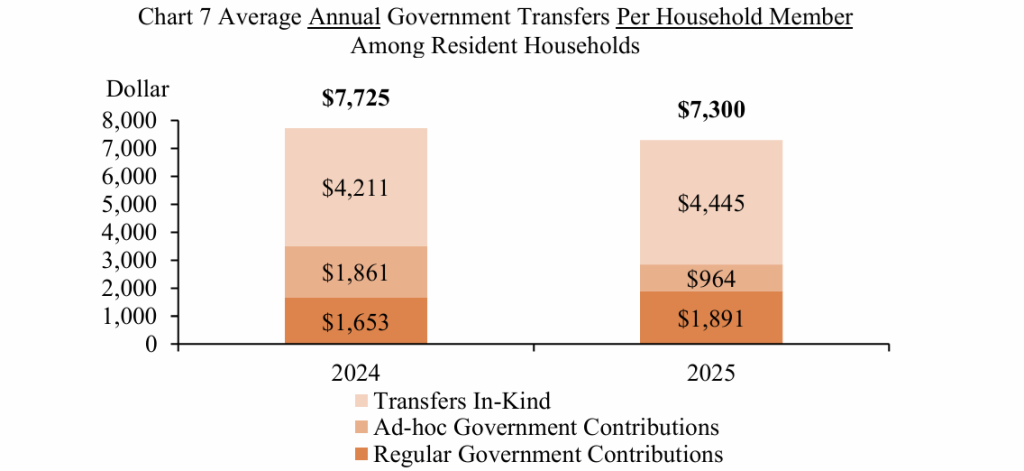
Source: SingStat
The report indicates that the average annual government transfers per household member among resident households was $7,300 in 2025. Government transfers can be in cash or in-kind and are classified into three categories:
#1 Regular Government Contributions, which refer to recurring cash disbursements, top-ups and rebates, including Workfare Income Supplement, GST Vouchers, and Pioneer Generation MediSave Top-ups
#2 Ad-hoc Government Contributions, which refer to one-off disbursements, including CDC Vouchers, Post-Secondary Education Account Top-ups, and One-off Retirement Savings Bonus under the Majulah Package
#3 Transfers In-Kind, which refer to subsidised services and goods, including education subsidies and centre-based infant and child care subsidies.
The Connection Between Household Size And Dwelling Type
According to SingStat, 91,000 households, or about 6.1% of total resident households in Singapore, have six or more members.
The Key Household Income Trends, 2025 report also revealed the average annual government transfers per household member among resident households by type of dwelling.
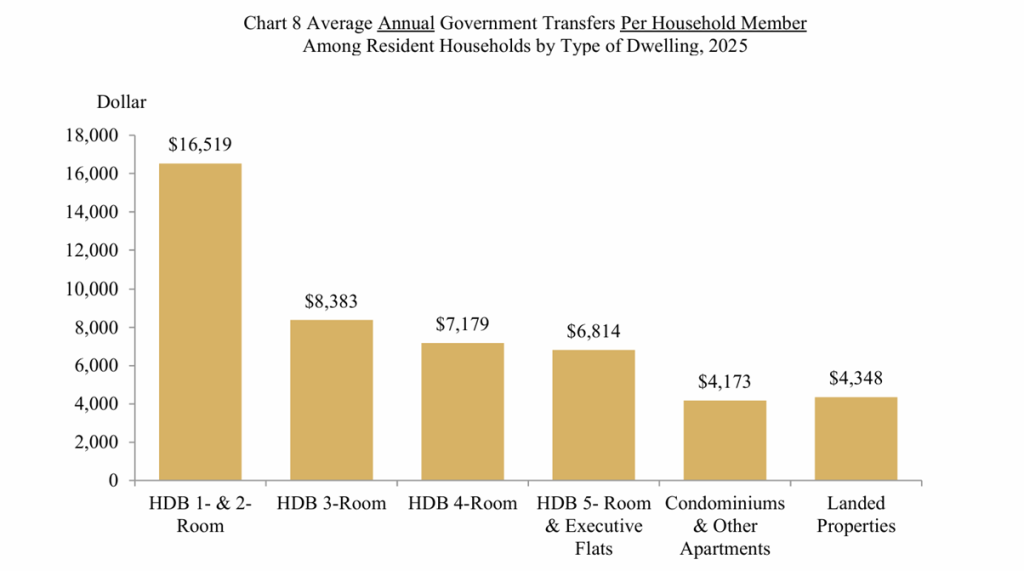
Source: SingStat
While there is no publicly available data for the type of dwelling that these large families live in, we do know that in 2025, the highest average household size is found in HDB 5-Room and Executive Flats (3.48 persons) and Landed Properties (4.13 persons). It would therefore be fair to assume that many households with 6 or more members would live in either of these two types of dwellings.
HDB 5-Room flats and Executive Flats receive the smallest amount of U-Save rebates. Landed properties don’t even receive them at all, as U-Save rebates are only available for Singaporean households living in HDB flats.
Household-Based Versus Individual-Based Schemes
In other words, households with six or more members are less likely to receive government transfers from household-based schemes. Instead, they would need to rely on schemes provided on an individual basis.
Minister Siow mentioned several of these schemes in his Parliamentary Reply, including the GST Voucher-Cash, Assurance Package Cash, and Cost-of-Living Special Payment.
The 2026 GST Voucher-Cash is given to Singaporeans aged 21 and above, with assessable income earned in 2024 not exceeding $39,000. It was disbursed earlier this August.
The 2026 Assurance Package Cash is given to Singaporeans aged 21 and above, with $100 to $250 disbursed in December based on your assessable income earned in 2024. Both the GST Voucher-Cash and Assurance Package Cash had the assessable income thresholds increased from $34,000 to $39,000 to “keep pace with rising incomes” according to Minister Siow.
The Cost-of-Living Special Payment is given to Singaporeans aged 21 and above, with assessable incomes of $100,000 and below. It will be disbursed in September, and the amount will be based on your assessable income earned in 2024, as well as the annual value of your place of residence.
Additional Large Family Benefits
Though Minister Siow did not go into further detail, it can be assumed that many households with six or more members are “large families”. These will receive various benefits and support given to those with three or more children. These include an increased CDA First Step Grant, a Large Family Medisave Grant, and Large Family LifeSG Credits.
Read Also: Guide To All The Benefits For The Large Families Scheme


