

Increasing interest rates would be a cause of concern for many Singapore homeowners. Earlier this month, the US Federal Reserve raised interest rates by 25 basis points to between 3.75% and 4% – the first increase since 2023.
Since many homeowners would have taken a home loan to purchase their properties, an increase in interest rate would lead to higher borrowing costs and monthly mortgage repayments. For homeowners with an existing home loan, a good question to ask ourselves at this point is that if interest rates are expected to further increase in the near future, should we refinance our home mortgage as soon as possible?
The conventional wisdom is that refinancing our mortgage means finding the lowest possible rates. However, while it’s important to secure good rates, interest rate is not the only variable we need to look out for.
Your Refinancing Goals Matter
One of the things we should think about is our refinancing goals. For example, while some homebuyers may want to lower monthly repayments, others may prefer to be debt-free as soon as possible. Some homeowners may even want to refinance the loan of their private property to get cash for a major expense (i.e. take a home equity loan).
The home loan we choose should be aligned with our refinancing goals. If we are unsure of how to get started, we can use Cashew’s AI tool, The Mortgage Recommender which is designed specially to help homeowners make the best refinancing decision, at the right time.
We could input our loan requirements or better still, upload our home offer letter and let Cashew’s AI tool do the deciphering and give us tailored recommendations.
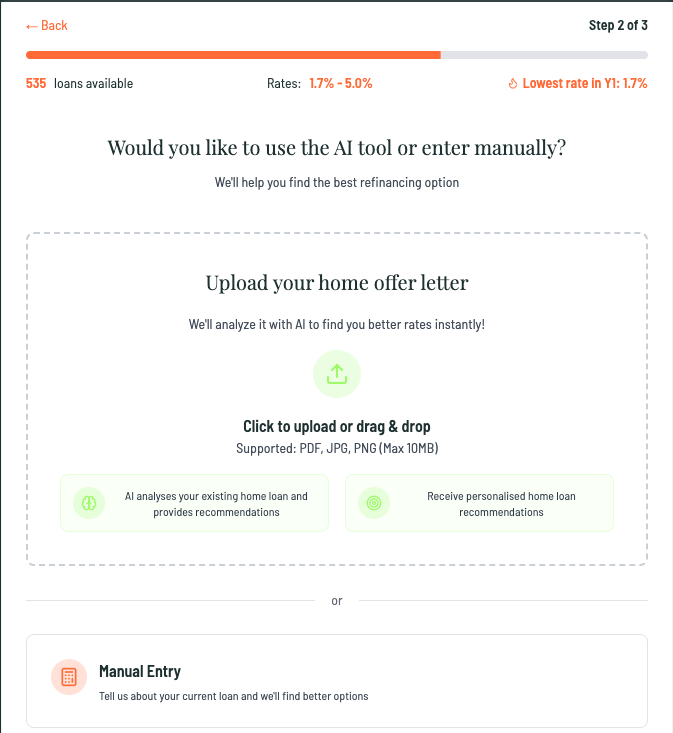
This could be useful even if we’re still considering our options between refinancing or repricing.
Refinancing Or Repricing?
Refinancing and repricing are sometimes used interchangeably, and they both serve the same purpose – optimising our home loan’s interest rates. But the two are not the same.
Refinancing refers to switching our existing home mortgage to another bank, while repricing refers to taking a new home loan package with our current bank.
We can think of this as similar to our telco plans. Many of us would regularly change telco plans every two years to find a better plan. While we can choose a new plan from our existing telco (i.e. repricing), we would enjoy far more options and possibly get a much better deal if we choose between the plans offered by different telcos in Singapore (i.e. refinancing). The same logic applies to finding our best home loan package.
This isn’t to say that refinancing will always be better. At times, the best home loan we can find in the market may already be with our existing bank. There may also be situations, such as clawback period, a job loss or a smaller outstanding loan amount, that make it harder to qualify for refinancing. In such cases, repricing could be the only practical option. What’s important is to compare offers across various banks and choose the best one the fits our needs.
Read Also: 3 Ways The Fed Raising Interest Rates Could Affect Our Money In Singapore
Factors That Determine The Ideal Home Loan Package For Us
Besides identifying our refinancing goals and searching for the lowest possible interest rates, there are some other factors we need to consider when choosing a home loan package.
One such consideration is whether we prefer a fixed or floating interest rate. Fixed rates give us the assurance of knowing the interest rate that we will get for a specific period. Floating rates use an interest rate benchmark (e.g. SORA) to determine the rates we pay on our home mortgage. Other benchmarks may include bank board rates and fixed deposit-pegged rates (e.g. DBS’s FHR).
We should also consider the lock-in period for our home loan package. This matters if we have the intention to sell our home or make a partial prepayment to reduce our principal loan amount in the near term. In such cases, it makes sense to choose a package that allows partial prepayment during the lock-in period, or one that offers a waiver in the event of a property sale, so that we can avoid early redemption penalties.
Typically, fixed rate packages have slightly higher rates than floating rate packages as the banks need to factor in a buffer for the possibility of rates rising in the future. The longer the fixed rate period, the wider the spread is likely to be compared to prevailing market rates.
If we’re new to home financing or prefer to have a professional’s advice, we can consider speaking to our friends over at Redbrick. Their professional mortgage brokers will not only offer personalised recommendations based on our eligibility, specific requirements and refinancing fees, but also explain the finer details of each loan package during a free, non-obligatory consultation.
Being able to tap on professional advice can help us make a more informed decision, rather than relying solely on our own judgement or comparing packages based on interest rates alone.
Talking about refinancing eligibility, one important thing worth noting is that it typically takes some time for the refinancing process to be finalised. Besides having to submit the necessary documents for refinancing, we may also need to serve a notice period (usually about two months) for a loan redemption. This is in addition to the time needed for our new loan application to be approved, which can take around one week to one month, depending on the bank and our circumstances.
Thus, timing the refinancing process correctly is important to ensure we don’t pay higher interest rates unnecessarily beyond what is required had we refinanced the loan immediately upon expiry.
That’s where having a professional mortgage broker could be helpful, as they can guide us through the timelines and paperwork to ensure everything is completed in a timely and convenient manner.
For those of us who are eligible to refinance our home loan or will be qualified to do so soon, it might be sensible to refinance as quickly as possible to lock in the rates we want before interest rates increase further.
If we have a more straightforward refinancing process, Cashew is an option we can consider. It allows us to compare rates across major banks in Singapore based on our requirements, and submit our loan application conveniently online.
Regardless of the type of service we use, the key is to review our home loan regularly and not wait until we are already paying higher thereafter rates after our package has lapsed. The best home loan package is not necessarily the one with the lowest advertised rate, but the one that suits our loan quantum, repayment plans, preferred features and current market conditions. By comparing our options early, whether through our bank, a mortgage broker or an online platform, we can make a more informed decision and avoid overpaying unnecessarily.
Read Also: Why Knowing All About Home Loan Rates Still Cost Me More Than An HDB Loan
This article contains affiliate links. DollarsAndSense may receive a share of the revenue from your sign-ups. You can refer to our editorial policy here.


Lifestyle
15 Of The Cheapest EV Cars In Singapore


Budgeting 101
7 Ways Being Frugal Is Different From Being Cheap


Street Smart
Singapore Gym Membership Price Guide (2026 Edition)


Street Smart
Singapore Gym Membership Price Guide (2026 Edition)

Bonds and Fixed Income
Complete Guide To Buying Singapore Savings Bonds (SSB) [2026 Edition]


