
The term “HENRY”, short for High Earner, Not Rich Yet, was coined in a 2003 Fortune Magazine article written by Shawn Tully. It describes professionals who earn six-figure annual salaries yet feel financially constrained by lifestyle costs, debt, and the pressure to keep up with peers. While there is no official definition here in Singapore, it’s largely accepted that simply earning about S$15,000 a month still means being squeezed by property prices, childcare costs, and the rising expectations of what it means to be “comfortable” in Singapore.
A decade ago, earning S$10,000 a month placed someone firmly in the top tier of income earners. Today, with wage growth in finance, tech, and biomedical sectors, that figure is increasingly common among mid-career professionals. Yet many of them still identify as HENRYs, underscoring how the definition has shifted.
Read Also: The Rise of HENRYs: Why High Earners Still Don’t Feel Rich In Singapore
Rising Income Thresholds
According to the Ministry of Manpower (MOM), the median gross monthly income for full-time employed residents in 2025 was around S$5,775. That means someone earning S$15,000 a month is just above two times the median. But in practice, this income no longer guarantees a sense of wealth. The benchmark for “high earners” has risen, and so too have the costs that erode disposable income.
According to the latest statistics from MOM, real income growth among full-time employed resident degree holders has slowed due to higher inflation. This is especially concerning since median income is growing faster in nominal terms.

Source: Labour Force In Singapore 2025, MOM
In other words, median incomes have grown by about 4% per year since 2020, compared to about 1.5% per year between 2015 and 2020. However, once you factor in inflation, real income growth has only grown 0.7% per year between 2020 and 2025, compared to 1.3% per year between 2015 and 2020.
Private sector salaries in banking and technology often exceed S$200,000 annually, but professionals in these brackets increasingly report feeling financially stretched. The HENRY label now applies to those earning well above traditional thresholds, reflecting how quickly the cost of living has outpaced income growth.
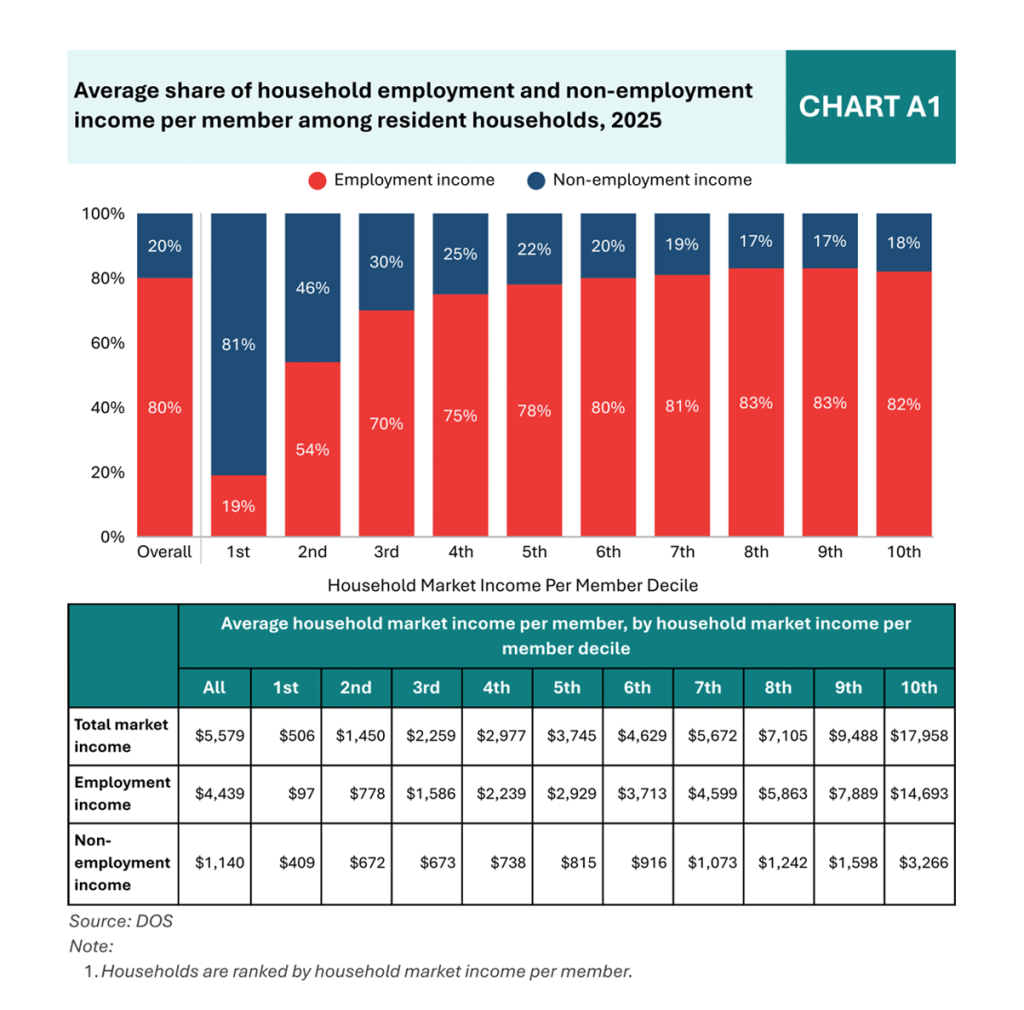
According to recent statistics released by the Ministry of Finance, there initially appears to be no difference between the top 10% of households and the top 20% in terms of the average share of household employment and non-employment income per member.
Source: Ministry of Finance
However, when you drill down into the numbers, that’s when the real difference appears – the top 10% are earning almost double what the rest of the top 20% are earning per household member.
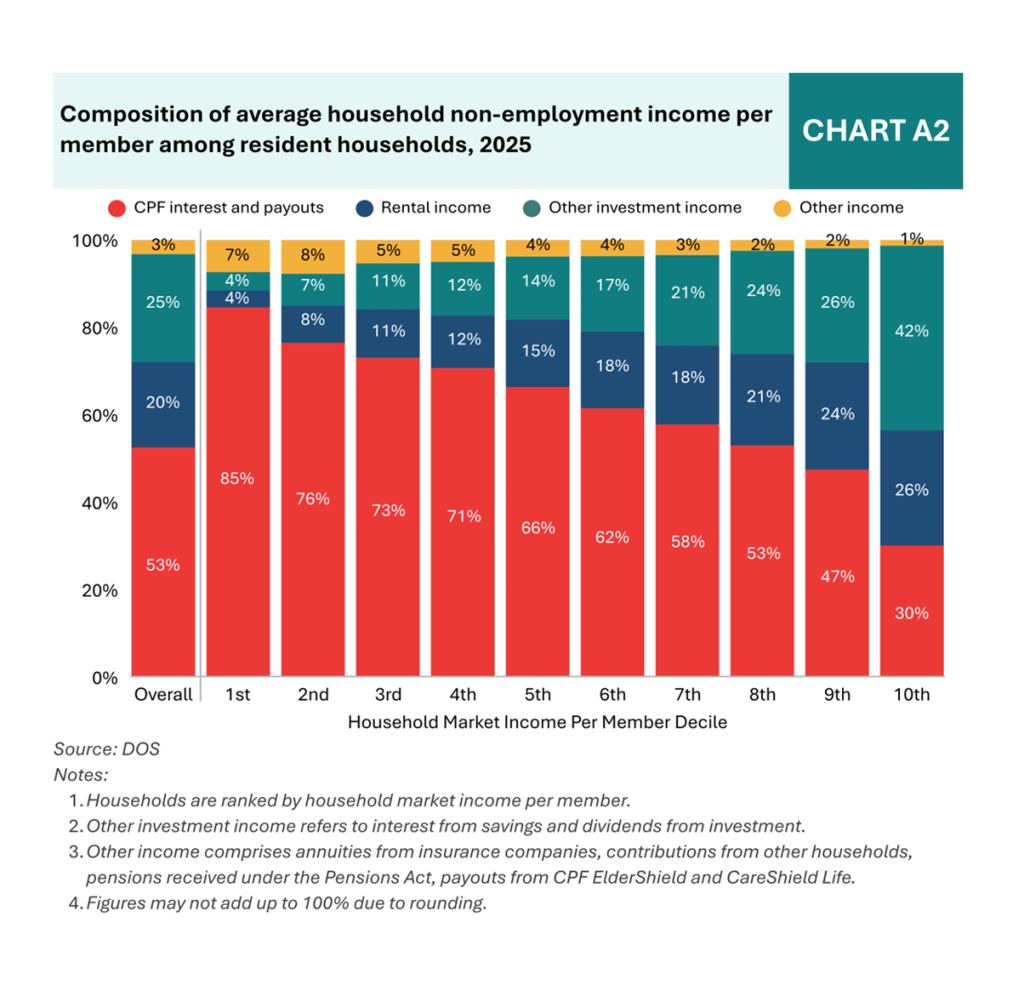
According to the same data released by the Ministry of Finance on 9th February 2026, households in the top 10% by income rely less on their CPF interest and payouts and more on “other investment income”, which refers to interest from savings and dividends from investments.
Source: Ministry of Finance
This is a stark contrast to those in the top 20%, who, like the rest of households in Singapore, still rely on CPF interest and payouts to form the largest source of non-employment income.
Property Pressures Are The Biggest Wealth Divider
Housing remains the single largest factor shaping the HENRY experience in Singapore. In 2025, the average price of a new launch condominium crossed S$2,200 per square foot, with prime districts commanding far higher premiums. Even resale HDB flats have seen record transactions above S$1.5 million. For a professional couple earning S$25,000 combined monthly income, servicing a mortgage on a S$2 million property can consume a significant portion of cash flow.
This dynamic explains why many high earners feel asset rich but cash poor. CPF contributions may help with retirement savings, but the bulk of disposable income is often tied up in property loans, leaving less room for wealth accumulation through investments.
Lifestyle Inflation And Social Expectations
Beyond housing, lifestyle inflation plays a major role. Cars in Singapore remain among the most expensive in the world, with Certificates of Entitlement (COEs) exceeding $120,000 in 2026. International school fees can run upwards of $40,000 per child annually. Add in luxury travel, dining, and the social expectation of maintaining a certain standard of living, and even six-figure earners find their budgets stretched thin.
This creates a paradox: while incomes are objectively high, the social benchmarks for being rich have shifted so dramatically that many professionals feel they are merely keeping up, not getting ahead.
Read Also: Financial Vices In Singapore: 5 Things That Cost More In Singapore Compared To Other Countries
Income VS Net Worth
The essence of being a HENRY lies in the gap between income and net worth. In Singapore, wealth accumulation is slowed as property costs dominate savings, and lifestyle spending erodes investment potential. A professional earning S$200,000 annually may have little in liquid assets after accounting for mortgage payments, school fees, and discretionary spending.
Unfortunately, it appears high income does not automatically translate into financial freedom. For many Singaporean HENRYs, the journey to feeling “rich” requires disciplined investing, careful financial planning, and resisting lifestyle creep.
At the same time, investment behaviour appears to be shifting. More HENRYs are diversifying into REITs and T-bills to hedge against market pressures. This reflects a growing awareness that wealth is not just about income but about building sustainable assets.
The New Definition of HENRY in Singapore
The Singaporean definition of HENRY has evolved. It is no longer simply about being a high-income professional with little wealth. Today’s HENRYs are those caught between rising aspirations and structural costs, earning $180,000 or more annually yet still feeling far from wealthy.
In Singapore, where property prices, lifestyle inflation, and social expectations continue to climb, the HENRY label suggests that financial security is not guaranteed by income alone. For Singapore’s professionals, the challenge is not just to earn more, but to redefine wealth in terms of freedom, resilience, and long-term stability.
Read Also: What Is The Household Income For Singapore Families? (Based On Flat Types, Household Members)


