
Singapore recorded 41,974 scam and cybercrime cases in 2025, more than double the 20,857 physical crime cases reported that year. Victims lost about $913.1 million in total.
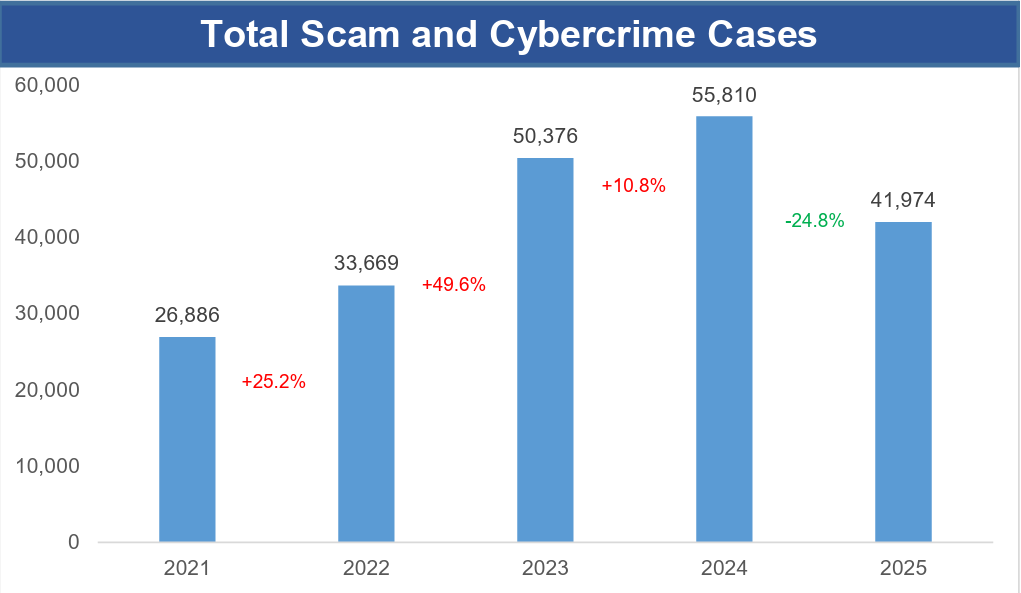
Source: Annual Scam and Cybercrime Brief 2025
In this episode of the DollarsAndSense Podcast, Feng Yi and Timothy from the editorial team examine how scammers manufacture that trust and why the tactics that work on a fresh graduate may be very different from those used on someone approaching retirement.
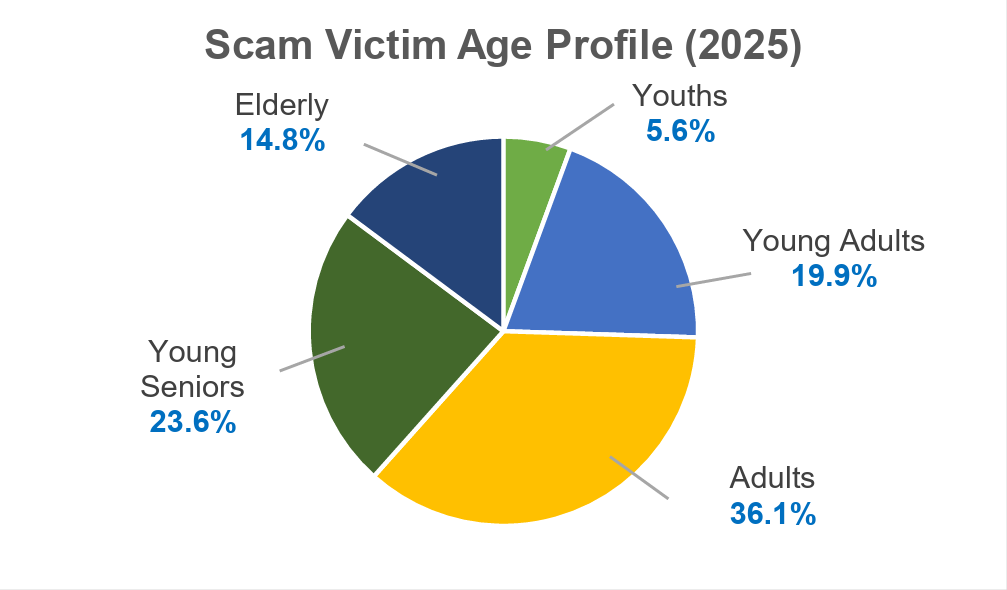
Their discussion also focuses on older Singaporeans. While the total number of scam and cybercrime cases fell from 2024 to 2025, those aged 65 and above made up a larger share of victims, rising from 8.4% to 14.8%. This makes scams involving older Singaporeans an important focus, especially as the financial losses can be particularly severe when a scam succeeds.
Watch the full DollarsAndSense Podcast episode here:
Scam And Cybercrime Cases Now Outnumber Physical Crime Cases
Feng Yi opened the discussion with the statistic that surprised both hosts: there were more than twice as many scam and cybercrime cases as physical crime cases in Singapore in 2025.
Timothy noted that the comparison changes how we should think about personal safety. Protecting ourselves today is not just about securing our homes or watching our belongings in public. It also means recognising suspicious messages, calls, advertisements and online requests before money leaves our accounts.
This risk cuts across age groups. As Feng Yi pointed out, it is no longer accurate to think that only seniors fall for scams. Young people, working adults and retirees are all targeted just through different approaches.
Source: Annual Scam and Cybercrime Brief 2025
Most Scams Do Not Begin With Someone Hacking Your Bank Account
One of the most important statistics Timothy highlighted was that 81.8% of reported scams involved self-effected transfers.
This means scammers usually did not seize direct control of the victim’s bank account. Instead, they used deception and social engineering to persuade the victim to authorise the transaction.
While better passwords and stronger cybersecurity remain important, they cannot stop every scam when the account holder has been convinced that the payment is legitimate.
A victim may believe that he is transferring money to a genuine investment platform, protecting his savings in a “safe account”, helping a family member in distress or complying with an official investigation.
As Timothy explained during the episode, scammers are increasingly attacking human decision-making rather than simply attacking technology.
Older Singaporeans May Suffer The Largest Financial Losses
The podcast paid particular attention to older Singaporeans, not because they are the only people who fall for scams, but because the financial consequences can be more severe.
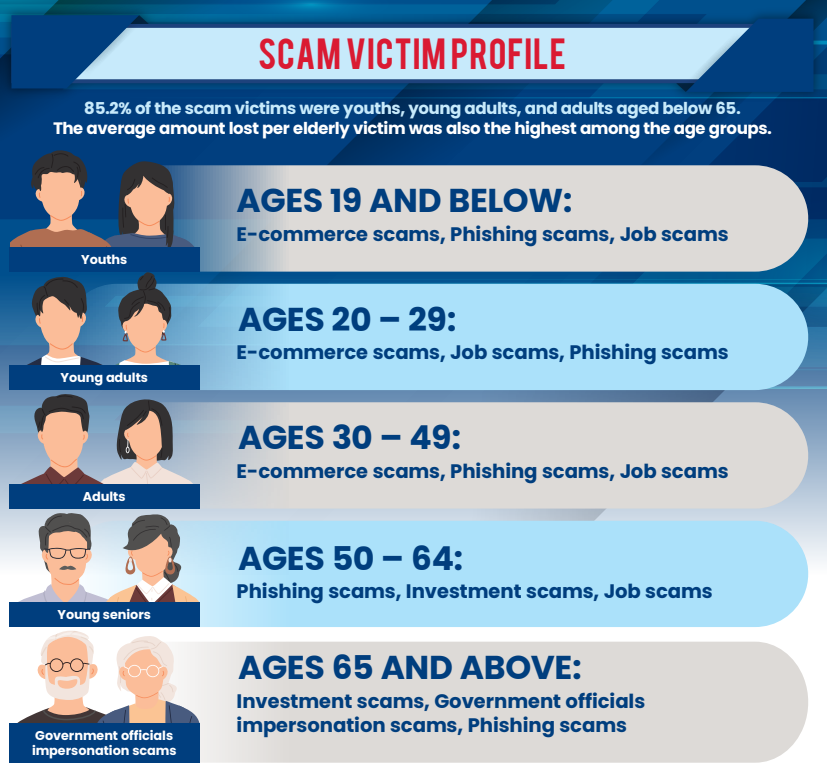
People aged 65 and above made up 14.8% of scam victims in 2025. This was an increase from 8.4% in 2024.
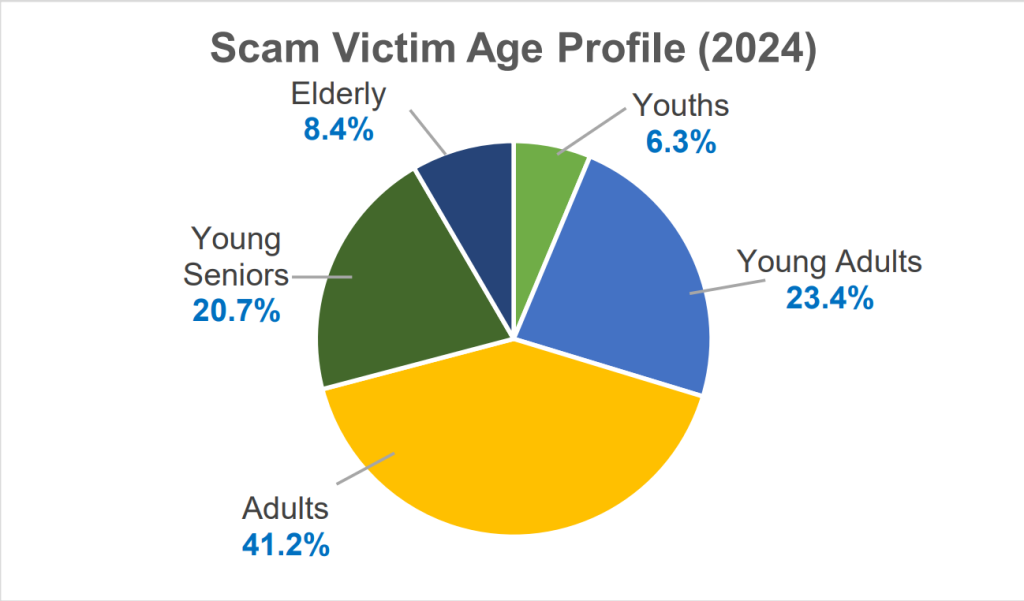
Source: Annual Scam and Cybercrime Brief 2024
Elderly victims lost an average of $37,053 each, the highest average loss across all age groups. Among elderly victims, 22.5% fell for investment scams and 21% fell for Government Officials Impersonation Scams.
Source: Singapore Police Force
Why Investment Scams Appeal To Seniors
Timothy shared that one reason for elderly victims making the highest average loss was because many older Singaporeans have spent decades accumulating savings and retirement assets.
They may also be thinking about how to make their money last through retirement. This makes offers of passive income, guaranteed returns or “low-risk” investments especially appealing.
As Feng Yi observed, it would also be too simplistic to assume that seniors fall for scams merely because they are less familiar with technology. Artificial intelligence (AI), convincing fake websites and realistic impersonation techniques are making fraudulent communications harder for people of any age to identify. At the same time, scammers use tactics such as urgency, authority, or friendliness which makes their pitch especially persuasive.
Government Impersonation Scams Exploit Authority And Urgency
These scams may begin with a caller claiming that the victim’s Singpass, CPF account or identity has been linked to a suspicious transaction or overseas crime.
The victim may then be told that he or she is under investigation and must hand over money, gold or valuables for “verification” or “safekeeping”. In other cases, the scammer may offer assistance and or support to resolve a supposed problem with the victim’s account.
Timothy noted that fear is only one of the tactics employed by scammers. Scammers can also present themselves as patient, helpful officials who are trying to protect the victim. For example, a scammer might tell an older person that there is something wrong with their CPF account, knowing they may be keen to understand and resolve the issue. Younger people, on the other hand, may be approached with fake job opportunities, while retirees may be targeted with investment offers.
Once the victim accepts the scammer’s authority, they may become more willing to follow instructions. The scammer can then escalate from asking for personal details or account information to demanding money, valuables or transfers for supposed “verification” or “safekeeping”.
Urgency is another common feature.
Victims are encouraged to transfer money or surrender valuables before they have time to pause, consult a loved one, verify the information with the Government agency, or reconsider whether the story makes sense.
CPF Savings Require Protection
As Timothy explained, scammers are not only targeting money held in an ordinary bank account. They may also be targeting savings that someone has accumulated in their CPF.
He added that CPF Board adopts a multi-pronged, security-first approach, focusing on detection, prevention, and user empowerment. They work closely with banks and government agencies to strengthen the overall scam detection ecosystem. And in recent years, several new measures have been introduced to better partner CPF members in safeguarding their CPF savings from scams.
Online Daily Withdrawal Limit For Those 55 And Above
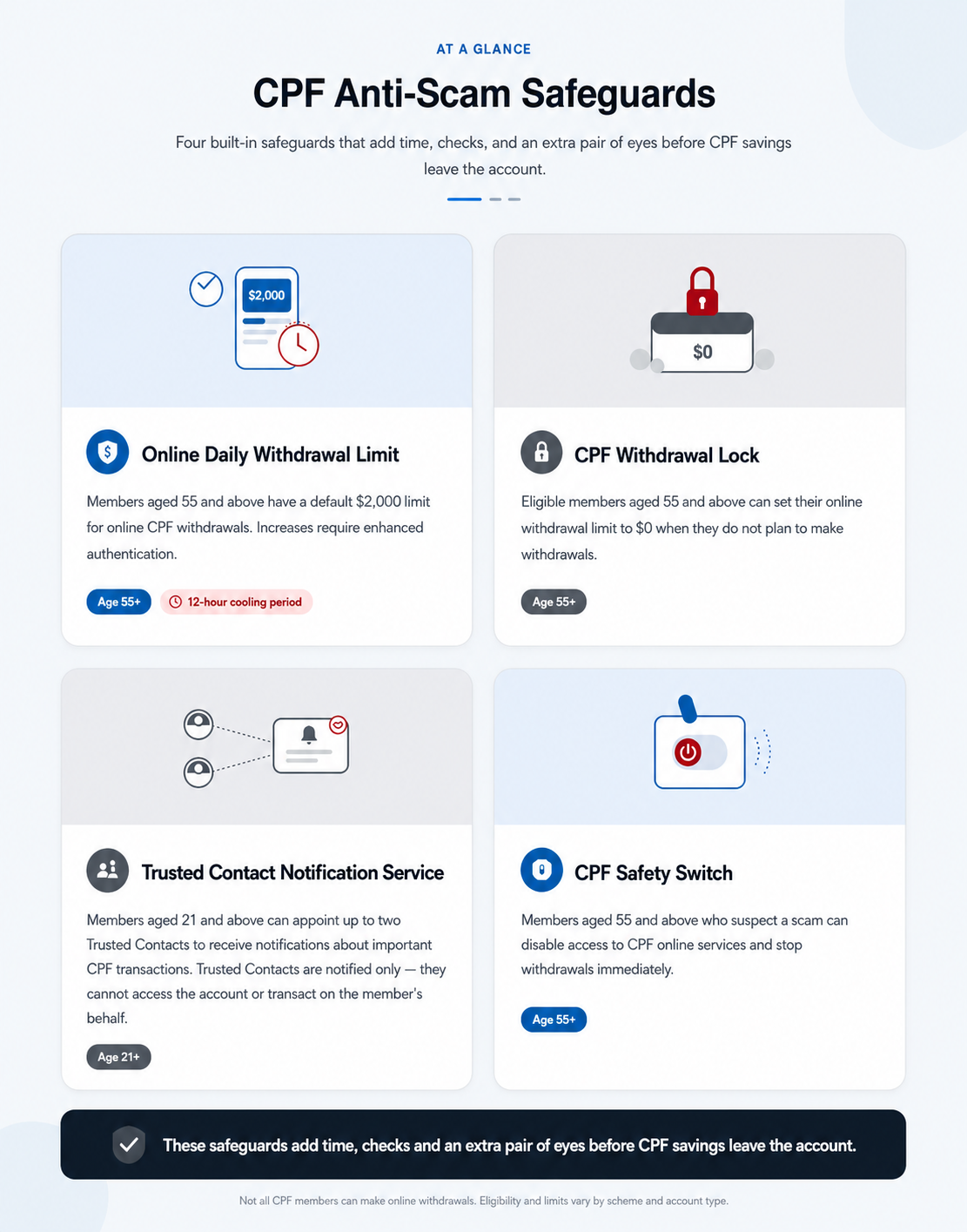
As part of CPF Board’s anti-scam measures, members aged 55 and above have a default Daily Withdrawal Limit of $2,000 for online CPF withdrawals. Members can choose to adjust this limit under Account Settings. Any increase is subject to enhanced authentication and a 12-hour cooling period, giving members time to detect and respond to unauthorised changes.
Another safeguard for CPF members aged 55 and above is the CPF Withdrawal Lock. It lets members instantly disable online withdrawals by setting their Daily Withdrawal Limit to $0. This can be useful for those who do not expect to make an online withdrawal soon. To re-enable withdrawals, members must adjust the limit, with a 12-hour cooling period and enhanced authentication where applicable.
Trusted Contact Notification Service
The Trusted Contact notification service allows members aged 21 and above to appoint up to two trusted individuals to receive copies of notifications for important CPF transactions. These Trusted Contacts cannot access the member’s CPF account or transact on the member’s behalf, but they can act as an additional pair of eyes to help spot suspicious transactions and alert the member promptly.
The CPF Safety Switch is available to members aged 55 and above who suspect that they have been scammed. Activating it disables access to CPF online services, stops in-progress withdrawals and prevents any future CPF withdrawals, giving you time to verify and safeguard your account.
The Simplest Defence Starts With You
Despite the growing sophistication of scams, Feng Yi and Timothy kept returning to one practical defence: do not act immediately.
Timothy observed that many seemingly authentic requests become much less convincing once the recipient pauses.
Instead of responding through the number, message or link provided, one can opt to contact the organisation separately using its official website, mobile application or hotline.
For CPF-related communications:
- CPF Board calls only from 6227 1188 and does not call through WhatsApp or other messaging applications.
- If you miss a call from CPF Board, you will receive a follow-up SMS or email with the official callback details.
- Official SMSes are sent from the gov.sg sender ID.
- CPF Board emails end with @cpf.gov.sg or @e.cpf.gov.sg.
- WhatsApp messages come only from CPF Board’s verified accounts with the blue verification tick.
- Members may also contact CPF Board through its Text Us service at 6031 5753.
Feng Yi also shared that she had reported a suspicious number through ScamShield after nearly falling for a scam herself. Free to download, the ScamShield app helps users check and report suspicious numbers, messages and links, while also blocking known scam calls and filtering scam SMSes. The number she reported was subsequently blocked, illustrating how reporting suspicious activity can contribute to a safer community by helping to protect others from falling victim to scams.
Building Scam Awareness Into Financial Planning
The hosts concluded the podcast by noting that scammers will continue to refine their tactics, using more convincing stories and communication methods to deceive victims.
The modus operandi in the podcast may become outdated over time. However, the emotional triggers that scammers rely on often remain consistent: authority, fear, greed, trust and urgency.
Build habits that continue working even when the scam changes. This includes enabling two-factor authentication, using strong and unique passwords, and keeping your devices and software updated so known security vulnerabilities can be fixed. Never share your Singpass credentials, passwords or one-time passwords, even with someone claiming to be from a government agency or trusted organisation.
Pause before responding. Verify unexpected requests independently. Keep withdrawal limits low when larger transactions are unnecessary. Leverage available security measures. Most importantly, involve someone you trust before making a large or unusual financial transfer.
Staying cautious is about being empowered, not fearful. Taking a few minutes to pause, check and verify can help safeguard the savings you have worked hard to build over a lifetime.
Read Also: Trusted Contacts And Safety Switch: How The Two New CPF Anti-Scam Security Measures Work


Family Planning
Cost Guide To International School Fees In Singapore


