
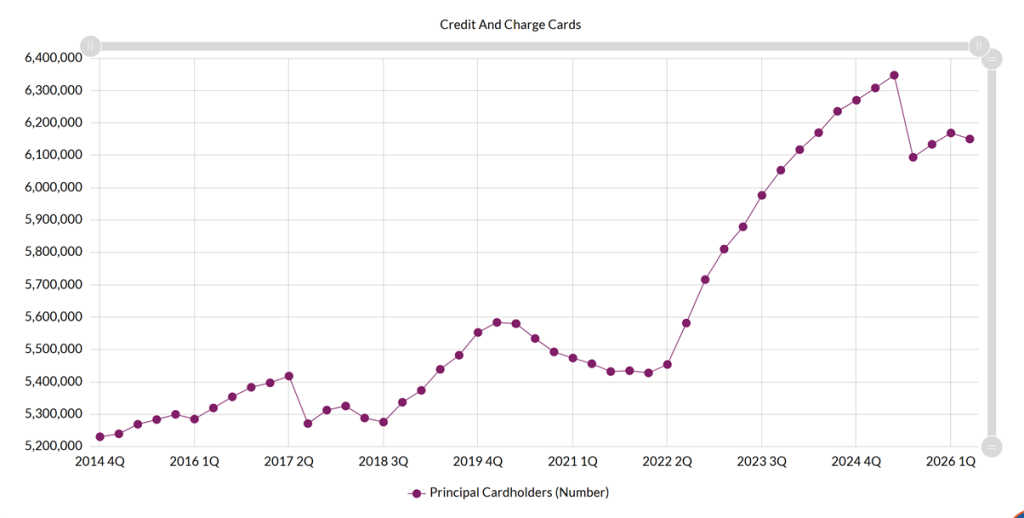
With the launch of the GXS Credit Card in August, all three of Singapore’s digital banks now offer traditional credit cards. The GXS Credit Card is the digital bank’s latest attempt to capture the attention of Singapore’s millions of principal cardholders, a figure that rose sharply since 2022 from 5.5 million to more than 6.3 million last year, before dropping to 6.1 million in Q2 2026.
This rise reflects both consumer appetite for cashless convenience and the aggressive expansion of digital banks like GXS, Trust Bank, and MariBank into the space since their 2022 launches.
Source: SingStat
GXS Credit Card Offers 1.75% Unlimited Cashback On Local Spends
In August, GXS Bank became the latest bank to offer a traditional credit card in Singapore. GXS previously launched the no-interest FlexiCard in 2024, but it had a $500 credit limit.
Unlike many unlimited-cashback cards from other banks, the GXS Credit Card is surprisingly understated. It offers 1.75% unlimited cashback on local spends (as long as you hit the relatively low $500 minimum monthly spend, excluding Grab) and is one of the most generous unlimited cashback credit cards on the market today.
But you probably wouldn’t have guessed any of that based on the name alone. Unlike other unlimited cashback cards with names like Cash Back+, Simply Cash, and INFINITY, the GXS Credit Card doesn’t need to announce what it can do. In fact, GXS Bank seems keen on taking aim at its other cashback competitors, calling out the “conditions buried in the fine print” that often “disqualify everyday transations”.
Read Also: Best Cashback Credit Cards In Singapore: Which One Suits Your Lifestyle?
Trust Bank Chooses Innovation With The Freedom Credit Card
In contrast, Trust Bank has tried something new. By rebranding its flagship Cashback Card as the Freedom credit card, it aims to stand out in a crowded field with a first-in-market credit card feature: stockback. This twist on cashback channels rebates earned directly into investment portfolios.
In simple terms, whenever you spend on your Freedom credit card, you earn “Stockback”. Every $10 worth of Stockback is automatically converted into fractional shares of the selected stock or ETF of your choice. You can select from a curated list of 50 US stocks including NVIDIA, Apple, Microsoft, and Alphabet, and ETFs including Vanguard S&P 500 ETF, iShares Core S&P 500 ETF, and State Street SPDR S&P 500 ETF. No commission and/or market fees are charged on these purchase orders, but there will be commission and exchange fees when you sell the stock or ETF.
You can earn up to $500 in Stockback per quarter. From now till 31 December 2026, you can earn a promotional 3% Stockback on both local and foreign eligible spend, and from 1 January 2027 onwards this will revert to 2% Stockback on local eligible spend and 0.5% Stockback on foreign eligible spend.
The Debt Trap Beneath the Surface
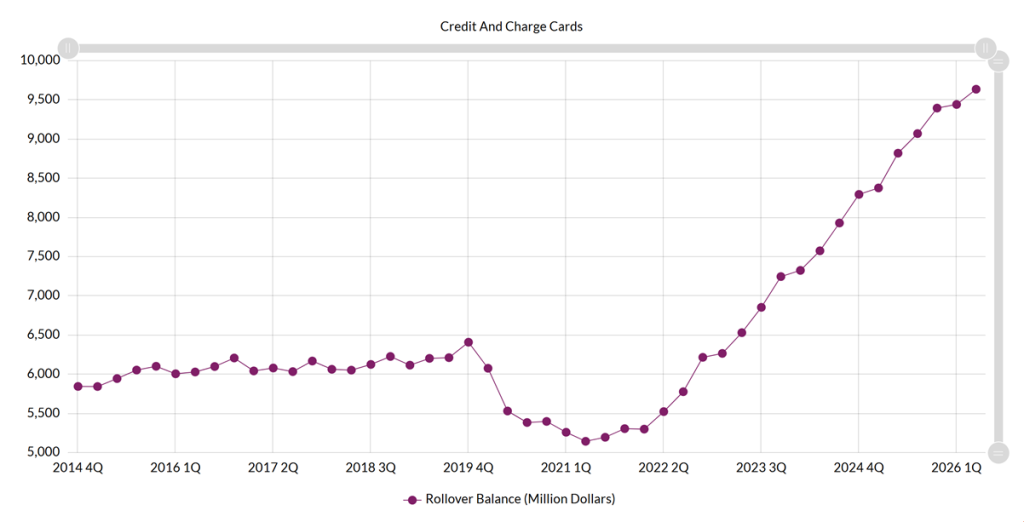
While the market has grown more diverse and competitive, the debt picture has darkened. Unpaid credit card balances have reached a ten-year high, climbing to $9.64 billion in the second quarter of 2026. This surge began in 2022 and has continued unabated.
Source: SingStat
One silver lining is that unsecured delinquency rates, that is, those who missed payments beyond 30 days, remain relatively low. According to the latest data from the Consumer Credit Index report, the unsecured credit card delinquency rate is hovering between 2% to 4%, with middle-aged Singaporeans aged 40-44 having the highest delinquency rate of 3.73%.
Unfortunately, this is not entirely reassuring. While many cardholders are able to pay the minimum due on time and avoid delinquency, these credit card balances are accruing interest at rates of between 27% to 30% annually. The result is a compounding debt trap that will eventually erode household finances if left unchecked.
Middle-aged Singaporeans, particularly those in their forties and early fifties, now carry the highest average unpaid balances, hovering around $6,800 to $7,209.
Why Credit Card Balances Keep Rising
Several factors in Singapore are likely to drive this rise in unpaid balances. On one hand, unavoidable inflation in essentials like food, utilities, and housing may have pushed households to rely more on credit cards. Meanwhile, the convenience of online shopping and mobile payments has made overspending easier, allowing lifestyle inflation to subconsciously add new layers of financial strain.
The convenience of credit cards has therefore become a double-edged sword. On one side, they integrate seamlessly into digital life, offering enticing benefits like cashback. On the other, they enable a culture of deferred payment that, when combined with high interest rates, can spiral into long-term debt.
If balances are not paid in full, the high interest rates will quickly erode any cashback gains, leaving consumers worse off than if they had simply saved or invested directly.
The Policy Challenge Ahead
Since June 2019, the Monetary Authority of Singapore (MAS) has implemented the Credit Limit Management Measure (CLMM), which restricts new loans and credit facilities for borrowers whose debt exceeds six months of income. At the same time, if you exceed the industry-wide borrowing limit for 3 consecutive months, you will not be able to charge new amounts to existing credit cards and/or other unsecured credit facilities with all financial institutions.
Singapore’s credit card story is therefore reaching a crossroads. Despite the CLMM, the record-high level of unpaid balances is an unfortunate reminder that credit cards carry the potential for significant compounding debt. The question remains whether MAS will feel the need to update the CLMM further and impose more stringent credit restrictions.
Read Also: 6 Steps To Manage Credit Card Debt In Singapore
Advertiser Message
Thinking Of Switching Brokers Or Consolidating Your Holdings?
Tiger Brokers is currently running a transfer-in campaign where eligible clients can receive an iPhone 17 Pro Max* when they transfer in their assets.
For SGX investors, there is also a CDP Transfer promotion with 0* commissions on Singapore stocks.
Find out more here. *T&Cs apply.


Family Planning
Cost Guide To International School Fees In Singapore


