

This month, on 11 June 2026, a new tranche of $500 CDC Vouchers has been disbursed to every Singaporean household. These were announced as part of Budget 2026 and were originally scheduled for January 2027. However, the tranche was brought forward to June due to the situation in the Middle East to help Singaporeans manage rising costs amid global uncertainties.
The CDC Voucher scheme has been given to all households in Singapore since December 2021, and the frequency and value of the vouchers have steadily increased each year. The CDC Vouchers complement other forms of government support, and they are the most accessible, as they are distributed without conditions and regardless of one’s income or assets.
This latest disbursement of $500 is the most generous CDC Voucher amount ever distributed. Of course, we’re excluding the $600 to $800 in SG60 Vouchers issued last year, as those were given to individuals rather than households. And because the amount was brought forward, the expiry date for these latest CDC Vouchers is 31 December 2027, giving Singaporean households about 1.5 years to spend them.
But exactly how far can these $500 CDC vouchers go? The obvious answer is that it depends on the household size, or in other words, the number of people living together. For the illustrations that follow, we’ll use the latest data from the 2023 Household Expenditure Survey (HES) as the best available approximation.
Read Also: Step By Step Guide To Redeeming Your CDC Vouchers
#1 Citizens Who Live Alone
CDC Vouchers are distributed to every Singaporean household. This means every household with at least 1 Singapore Citizen, including those who live alone.
According to the HES, households with only 1 person spend about $167 each month on food and non-alcoholic beverages. This is a broad category that includes rice and cereal products, meat, fish, coffee, tea and soft drinks, items that you would typically buy at a supermarket. Unsurprisingly, they spend much more, about $410, on food and beverage services, since it’s often less convenient to cook just for one person, unless you’re committed to weekly meal preps.
This means that the $250 of CDC vouchers that can only be used at the supermarket can go a long way, since it more than covers an entire month’s groceries, leaving about $90 to subsidise the following month’s groceries.
If they use the remaining $250 CDC vouchers at hawker centres, it will definitely subsidise their meals for the month, though it would probably all be used up within that same month.
Read Also: Guide To HDB Housing Options For Singles
#2 Households With Young Children
Because the same amount of CDC Vouchers is distributed to every Singaporean household, a married couple with young children will also receive the same $500 in CDC Vouchers.
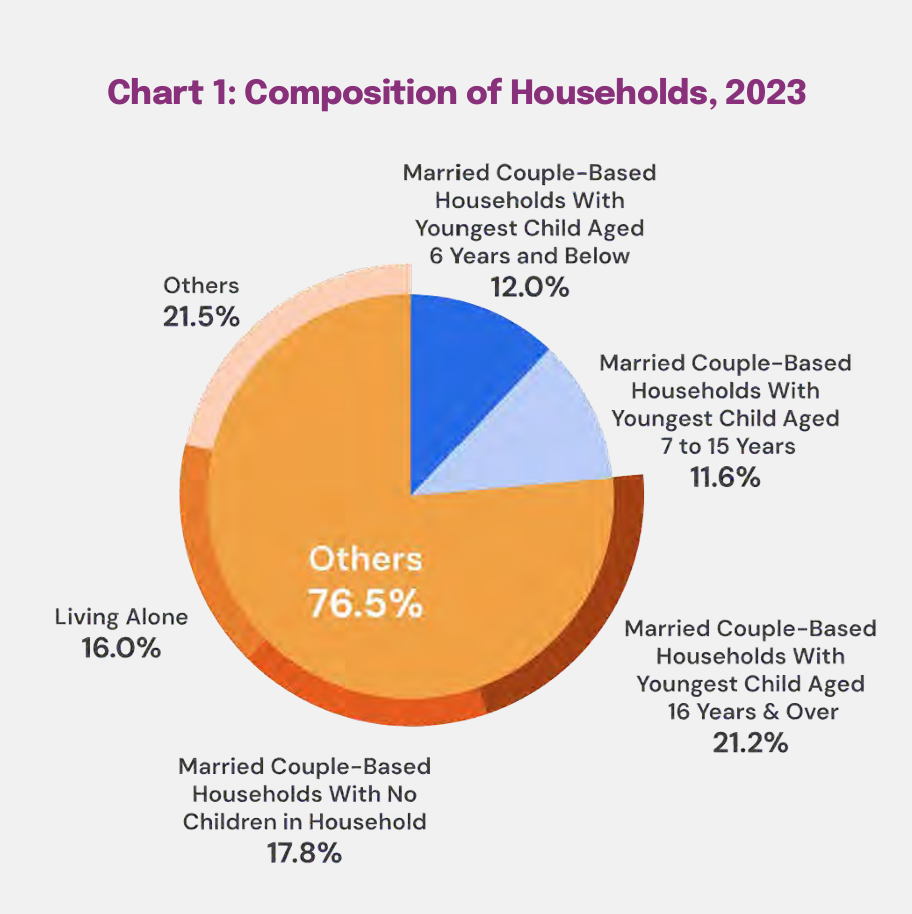
According to the 2023 HES, about 23.5% of resident households have young children aged below 16 years. The average household size between 4 and 5, which usually means two parents and two children, while a third of such households also have a domestic worker.
Source: Singapore Department of Statistics
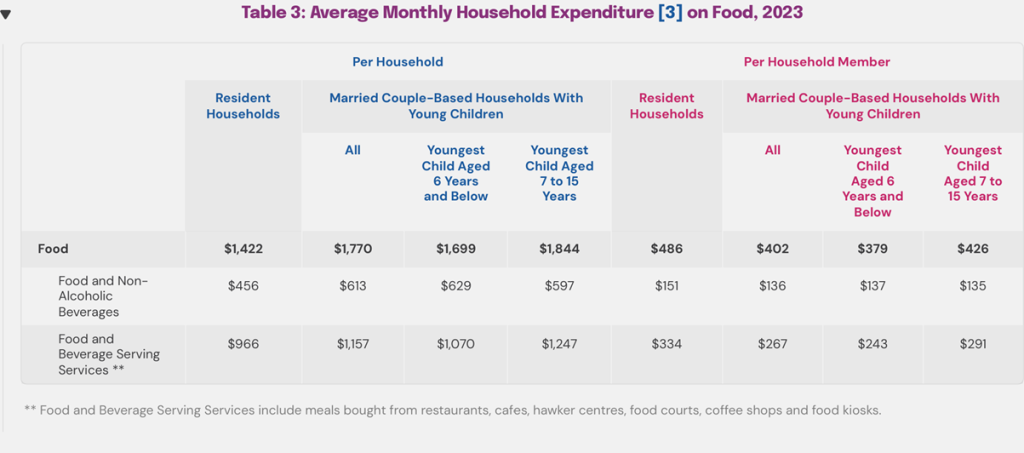
For these households, food and non-alcoholic beverages cost about $613 per month, while eating out costs up to $1,157 monthly. Notably, families with children aged 6 and below spent slightly more on groceries, while families with children aged 7 to 15 years naturally spent more when eating out.
Source: Singapore Department of Statistics
For such families, the $500 CDC Vouchers will definitely help by subsidising about a third of a month’s food spending, but objectively won’t go very far over 1.5 years.
Read Also: 10 Key Differences Between Singapore Families With Young Children And Those Without
#3 Two Or More Households Living At The Same Address
When two or more households are staying at the same address, both households can claim the $500 CDC Vouchers. If one household has already claimed the CDC vouchers, the other households can visit the nearest Community Centre to apply for their own set of $500 CDC Vouchers.
While the exact circumstances are not spelt out, the CDC Vouchers website FAQ mentions relevant documents, including tenancy agreements, which suggests that landlords and tenants count as separate households.
However, the government has made it clear that CDC Vouchers will not be issued separately to different family generations living in 3Gen households. When asked about this in Parliament, Mr Edwin Tong, speaking in his capacity as the “Minister charged with the responsibility for the People’s Association”, spelt out that they must be “unrelated Singaporean households”.
He went on to say that “the application process is simple and various types of supporting documents that show proof of a distinct household, such as a tenancy agreement and a marriage certificate, are accepted. In general, the application will be approved as long as the applicants are not from the same Singaporean household and have not previously claimed the CDC vouchers.”
Read Also: Where To Find Cheaper Groceries In June: Supermarket Price Freezes, Discounts And Deals
Advertiser Message
Thinking Of Switching Brokers Or Consolidating Your Holdings?
Tiger Brokers is currently running a transfer-in campaign where eligible clients can receive an iPhone 17 Pro Max* when they transfer in their assets.
For SGX investors, there is also a CDP Transfer promotion with 0* commissions on Singapore stocks.
Find out more here. *T&Cs apply.



Lifestyle
15 Of The Cheapest EV Cars In Singapore


Budgeting 101
7 Ways Being Frugal Is Different From Being Cheap


Street Smart
Singapore Gym Membership Price Guide (2026 Edition)


Street Smart
Singapore Gym Membership Price Guide (2026 Edition)

Bonds and Fixed Income
Complete Guide To Buying Singapore Savings Bonds (SSB) [2026 Edition]


