
Losing your job can put immediate pressure on your finances, especially if it takes several months to find a suitable new role.
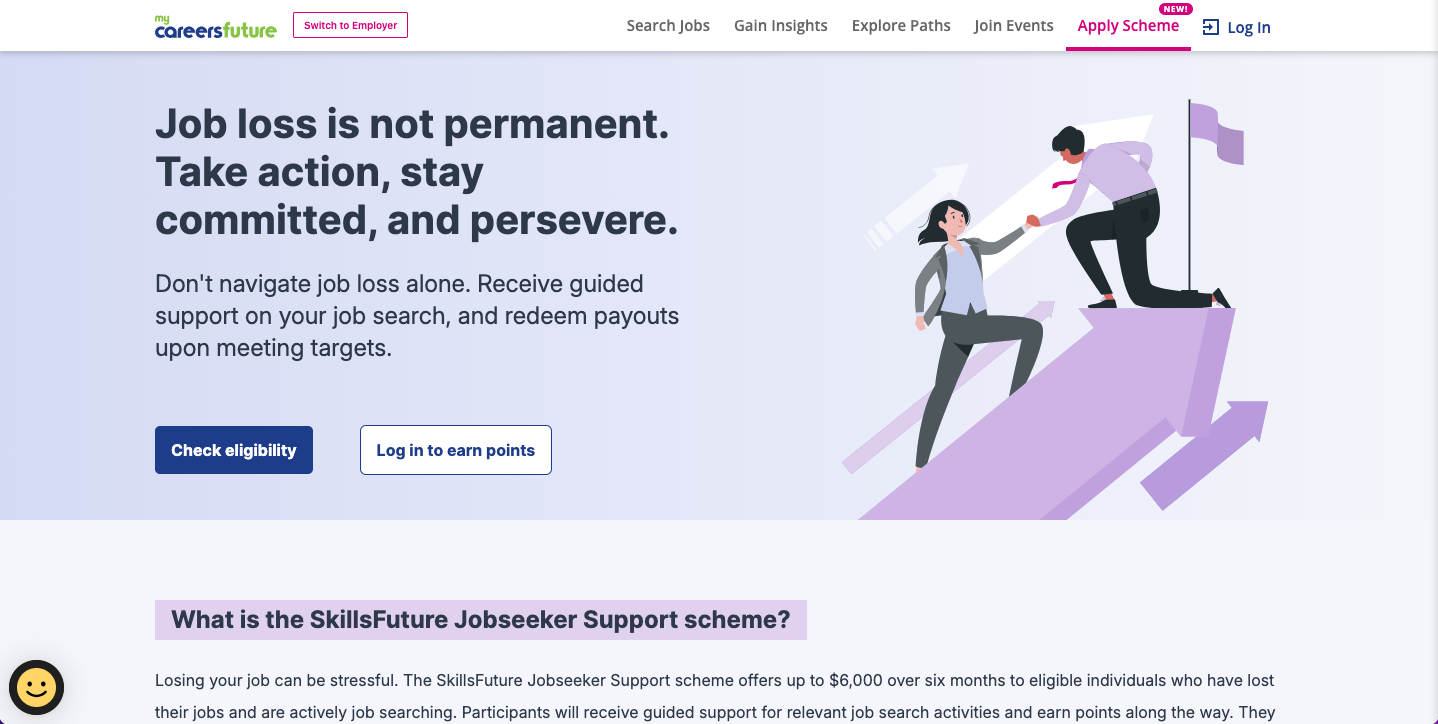
The SkillsFuture Jobseeker Support Scheme provides eligible Singapore Citizens and Permanent Residents who become involuntarily unemployed with up to $6,000 in temporary financial support over six months while they actively look for work.
Who Qualifies For The SkillsFuture Jobseeker Support Scheme?
To qualify, you must:
- Be a Singapore Citizen or Permanent Resident aged 21 and above;
- Have earned an average gross monthly income of $5,000 or less during the periods you were employed in the past 12 months, excluding employer CPF contributions;
- Have been employed in Singapore for at least six months in the past 12 months;
- Have become unemployed for an involuntary reason;
- Live in a property in Singapore with an Annual Value of $31,000 or less; and
- Not have received a Jobseeker Support payout in the past three years.
How Much Can You Receive?
Eligible jobseekers can receive up to $6,000 over six months, provided they meet the required job-search activity targets.
| Month | Maximum Payout |
| 1st Month | $1,500 |
| 2nd Month | $1,250 |
| 3rd Month | $1,000 |
| 4th Month | $750 |
| 5th Month | $750 |
| 6th Month | $750 |
| Total | $6,000 |
The payouts are front-loaded, providing more support immediately after someone loses their job before gradually declining. However, not everyone will receive the full scheduled amount. Your monthly payout is capped at your previous average gross monthly income.
For example, if your previous average gross monthly income was $1,200, you can receive at most $1,200 in the first month even though the scheme’s first-month maximum is $1,500.
You Need To Actively Look For Work To Receive The Payouts
Being eligible does not automatically entitle you to all six payouts. After your application is approved, you need to complete recognised job-search activities and accumulate sufficient points each month. These can include applying for jobs, attending career coaching and participating in other supported career activities.
Once you meet the required points target, you become eligible for that month’s payout.
If you miss your target, the points already earned can roll over into the following month. However, participation is limited to six months, so delaying your targets could ultimately mean forfeiting one of the payouts.
What Happens If You Find A New Job?
You are required to declare your employment status during the programme. Once you start a new job, you will no longer qualify for subsequent payouts.
There is some flexibility for temporary employment. Someone earning $1,500 or less a month from temporary work may continue to qualify if they meet the scheme’s other requirements.
Jobseeker Support Does Not Replace Retrenchment Benefits
Receiving Jobseeker Support does not mean you should lose any retrenchment benefits provided by your employer.
The scheme is intended to complement rather than replace retrenchment benefits. For affected workers, the two forms of support also serve slightly different purposes: retrenchment benefits may provide an immediate lump sum, while Jobseeker Support provides smaller payouts over several months.
Read Also: 6 Things Employers Should Do When Retrenching Workers In Singapore
You May Still Qualify For Other Government Support
Receiving assistance under another government programme does not automatically disqualify you from Jobseeker Support.
For example, eligible Singaporeans aged 40 and above can receive the SkillsFuture Mid-Career Training Allowance while undertaking eligible long-form training. For full-time training, the allowance can provide 50% of average income, capped at $3,000 a month. Eligible part-time long-form training can attract a flat $300 monthly allowance.
This means someone who loses their job and decides to retrain could potentially receive both career-transition and training support, subject to satisfying the requirements of each scheme.
SkillsFuture Jobseeker Support Scheme Helps, But It Does Not Replace An Emergency Fund
Receiving up to $6,000 can help extend your financial runway after retrenchment, but it is unlikely to replace your previous salary.
If you lose your job, it is useful to work out your essential monthly expenses immediately, including housing payments, insurance premiums, utilities, food and debt repayments. You can then compare these expenses against your retrenchment benefits, savings and expected Jobseeker Support payouts. This gives you a clearer idea of how long your cash reserves can last and whether you need to cut discretionary spending while looking for your next role.
Ultimately, the SkillsFuture Jobseeker Support Scheme provides some financial breathing room after an involuntary job loss while encouraging workers to actively search for their next role.
Read Also: Emergency Fund Or Investment Portfolio: Which Helps More When You Lose Your Job?


Lifestyle
15 Of The Cheapest EV Cars In Singapore


Budgeting 101
7 Ways Being Frugal Is Different From Being Cheap


Street Smart
Singapore Gym Membership Price Guide (2026 Edition)


