

This article was written in collaboration with the National Trades Union Congress (NTUC). All views expressed in this article are the independent opinion of DollarsAndSense.sg based on our research, and is purely for informational purposes and should not be relied upon as financial advice. DollarsAndSense.sg is not liable for any financial losses that may arise from any transactions and readers are encouraged to do their own due diligence. You can view our full editorial policy here.
Even in a good job, most of us can expect some workplace friction. It could be a difficult manager, a change in work responsibilities, or a tough performance conversation where the KPIs feel unrealistic.
Most of the time, these situations are part of working life and may not, on their own, develop into an employment issue.
The key question is whether the issue affects your employment rights or contractual entitlements, such as your pay, notice period, dismissal, retrenchment terms or protection from being penalised for raising a legitimate workplace concern.
This distinction is not always obvious. For Professionals, Managers, and Executives (PMEs), it is useful to recognise when a workplace situation may require more than simply “toughing it out”, and when it may be worth seeking formal advice or support.
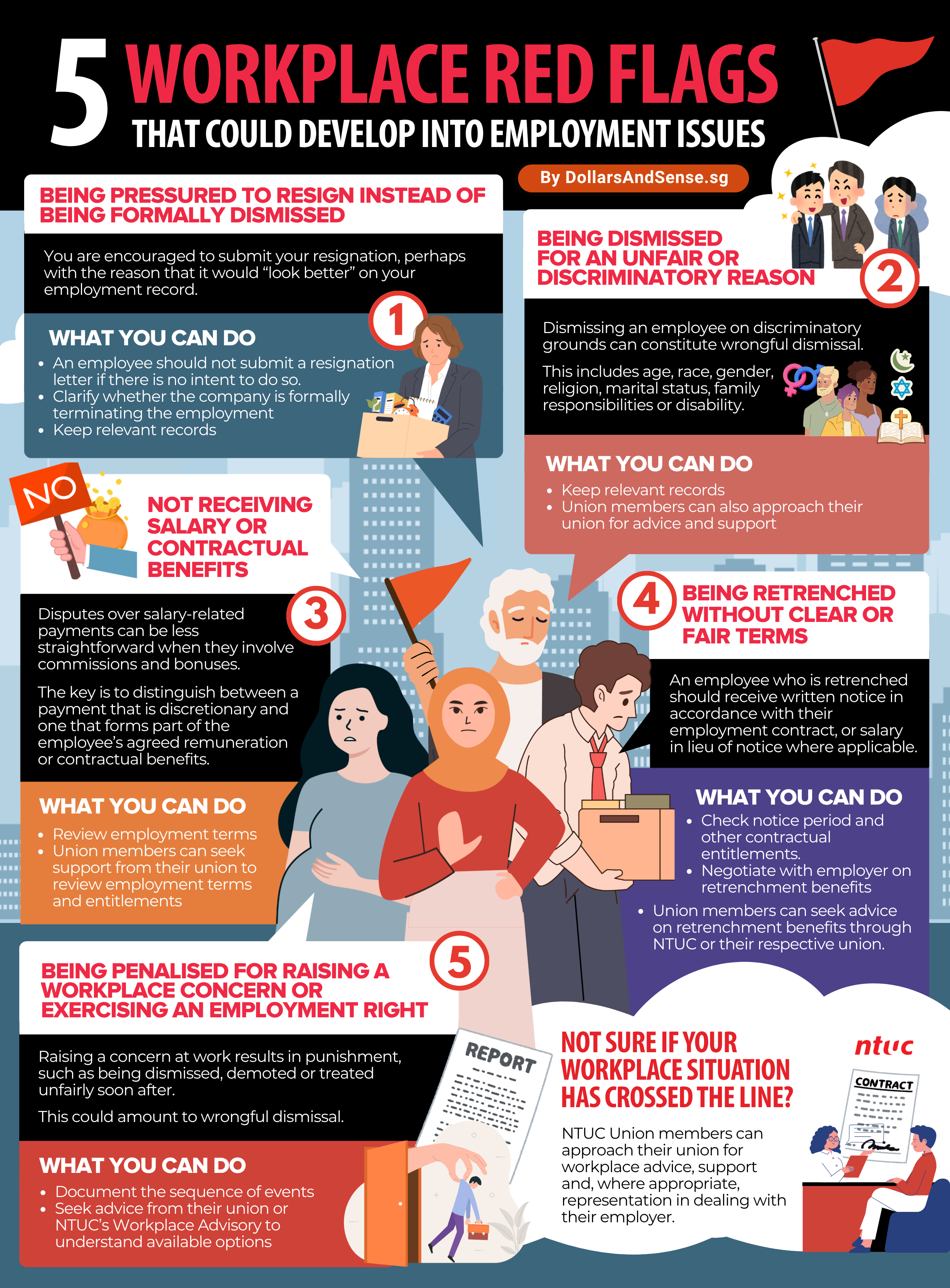
#1 Being Pressured To Resign Instead Of Being Formally Dismissed
Imagine being called into a meeting with your supervisor or Human Resource (HR) manager and being told that things are “not working out”. However, instead of receiving a termination letter, you are encouraged to submit your resignation, perhaps with the suggestion that it would “look better” on your employment record.
Some employees may feel that they do not really have a choice. However, there is an important difference between choosing to resign voluntarily and being pressured into doing so.
Under Singapore’s employment dispute framework, a dismissal can include an involuntary resignation, where an employee is effectively forced to resign. For example, if an employee is told to resign by the end of the day or face termination, then it’s essentially a dismissal. A dismissal may also potentially be considered wrongful if it is carried out without just or sufficient cause.
An employee facing such a predicament should clarify whether the company is formally terminating the employment, the reason being given, and what notice pay or other contractual payments may be due. At this point, it will be vital to keep relevant records, including the employment contract, emails, messages, performance reviews and any written communication relating to the proposed resignation.
For union members, engaging their union early can provide access to practical advice and support when navigating a workplace issue. Through their union or NTUC’s Workplace Advisory Service, members can seek guidance on their employment rights, have their circumstances assessed, and understand the options available for resolving a dispute. Members can also approach TADM@NTUC for employment-related disputes.
NTUC may facilitate these dispute resolutions through the Tripartite Mediation Framework, depending on the circumstances. Where more specialised legal advice is needed, eligible union members can also seek legal guidance through NTUC’s Legal Assistance Panel.
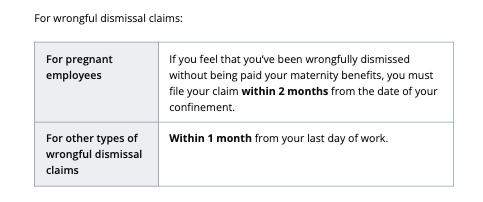
Timing matters too. Wrongful dismissal claims generally have to be filed with the Tripartite Alliance for Dispute Management (TADM) within one month from your last day of work.
Source: MOM
The key point is that being asked to resign does not always mean you need to decide immediately. It can be worth pausing, documenting what has happened and seeking advice before taking the next step.
#2 Being Dismissed For An Unfair Or Discriminatory Reason
Being dismissed can be difficult enough. PMEs may have additional cause for concern if they believe the decision was influenced by factors unrelated to their ability to do their job.
Under Singapore’s wrongful dismissal framework, dismissing an employee on discriminatory grounds, including age, race, gender, religion, marital status, family responsibilities or disability, can constitute as wrongful dismissal.
In the case of a union member who was terminated without proper notice and denied leave encashment, the member shared that the company also claimed she had been overpaid. After she sought advice from an NTUC PME consultant, a formal letter was drafted, and she eventually recovered $1,500.
Employees who suspect that discrimination or another improper reason could have contributed to their dismissal should keep relevant records, including emails, messages, performance reviews and comments made by their supervisors or management. This can be especially important if the official reason for dismissal appears inconsistent with previous feedback. Union members can also approach their union at an early stage for advice and support.
#3 Not Receiving Salary Or Contractual Benefits
Most employees would notice immediately if their monthly salary was not paid. But disputes over pay can be less straightforward when they involve commissions and bonuses.
For example, imagine a salesperson who resigns after closing several deals, only to be told that the commissions earned will not be paid because they are no longer employed when the customers finally make payment. Whether the employee is still entitled to the commission may depend on what the employment contract, incentive scheme or existing company policy says about when the commission is earned and payable.
Bonuses and Annual Wage Supplements (AWS) can also cause confusion. While they are not mandatory by law, an employee may still be entitled to them if they are provided for under the employment contract or other agreed employment terms.
Depending on the circumstances, the union can also help union members review the employment terms, clarify the employee’s entitlement and raise the matter with the employer if necessary.
The key is to distinguish between a payment that is discretionary and one that forms part of the employee’s agreed remuneration or contractual benefits.
#4 Being Retrenched Without Clear Or Fair Terms
Being told that your role is being made redundant can already be difficult. What can make the situation even more stressful is not knowing what you are actually entitled to when you are retrenched.
An employee who is retrenched should receive written notice in accordance with their employment contract, or salary in lieu of notice where applicable. Outstanding salary should also be properly accounted for.
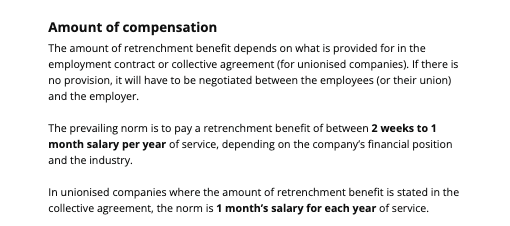
Retrenchment benefits can differ across employers. In Singapore, they are not mandatory by law, so the amount depends on what is provided for in the employment contract or collective agreement. Where there is no stated provision, the benefit may have to be negotiated between the employer and employee, or with the union representing the employee.
MOM states that the prevailing norm is between two weeks to one month of salary for each year of service, depending on factors such as the company’s financial position and industry. Based on retrenchment notifications submitted by companies with 10 or more employees, around 9 in 10 eligible employees received retrenchment benefits from 2020 to 2025. Among them, around 8 in 10 received at least two weeks’ salary per year of service.
Source: MOM
For union members, this is also an area where representation can matter. In unionised companies, unions will help negotiate retrenchment benefits and ensure that agreed terms are honoured according to the Collective Agreement. Members are able to receive job transition support, including career coaching and job placement assistance through NTUC’s e2i.
#5 Being Penalised For Raising A Workplace Concern Or Exercising An Employment Right
Raising a concern at work can already feel uncomfortable. What should be more concerning is when doing so appears to result in punishment, such as being dismissed, demoted or treated unfairly soon after.
For example, an employee may have an outstanding salary dispute and decide to seek mediation through TADM. If the employer subsequently dismisses the employee because they made the claim, this could amount to wrongful dismissal.
Employees who are concerned should document the sequence of events carefully, including when the concern was raised, relevant emails or messages, subsequent warnings or performance reviews, and any communication relating to dismissal.
Union members can also seek advice from their union or through NTUC’s Workplace Advisory. In unionised companies, the union can represent members in resolving disputes with their employer. Rather than waiting for the situation to escalate, it is useful to seek advice early and understand what options are available.
Know When A Workplace Issue Is Beyond Just “Toughing It Out”
Not every difficult situation at work will amount to a formal employment issue. But when the problem involves your pay, dismissal, retrenchment, contractual entitlements or how you are treated after exercising an employment right, it would be worth seeking help and expert advice to evaluate where you stand
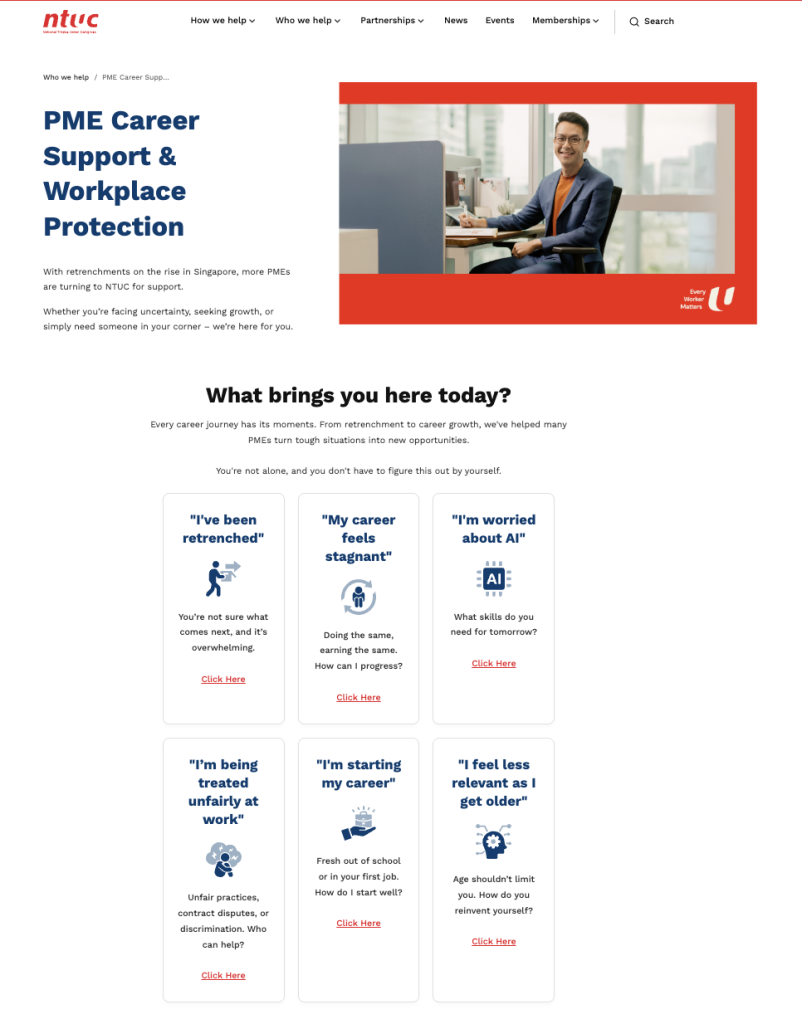
This is where being a union member can make a difference. NTUC Union Members can approach their union for workplace advice, support and, where appropriate, representation in dealing with their employer.
Source: NTUC
Union support can also extend beyond workplace disputes. NTUC and its affiliated unions can support PMEs through career development, upskilling and job transitions as their careers evolve. For workers, including PMEs, who want an added layer of workplace support, joining NTUC and its affiliated unions can provide access to guidance when it matters most.
Photo Credit: iStock/joyt


Lifestyle
15 Of The Cheapest EV Cars In Singapore


Budgeting 101
7 Ways Being Frugal Is Different From Being Cheap

Street Smart
Singapore Gym Membership Price Guide (2026 Edition)


