
With Singapore’s birth rate among the lowest globally, it’s worth trying to understand the cost pressures that families with young children may have. That’s what the Household Expenditure Survey 2023 went into – and it revealed a clear pattern in how couples with young children live and spend different from the general population.
Firstly, this is not an insignificant group. As of 2023, there were 333,650 married couple-based household in Singapore with young children. In layman terms, about 23.5% of resident households in Singapore have a child that’s under the age of 16.
We look a little deeper in the statistics to learn about 10 key differences between families with young children, and those without. For a more in-depth discussion on each point, you can read the full article below.
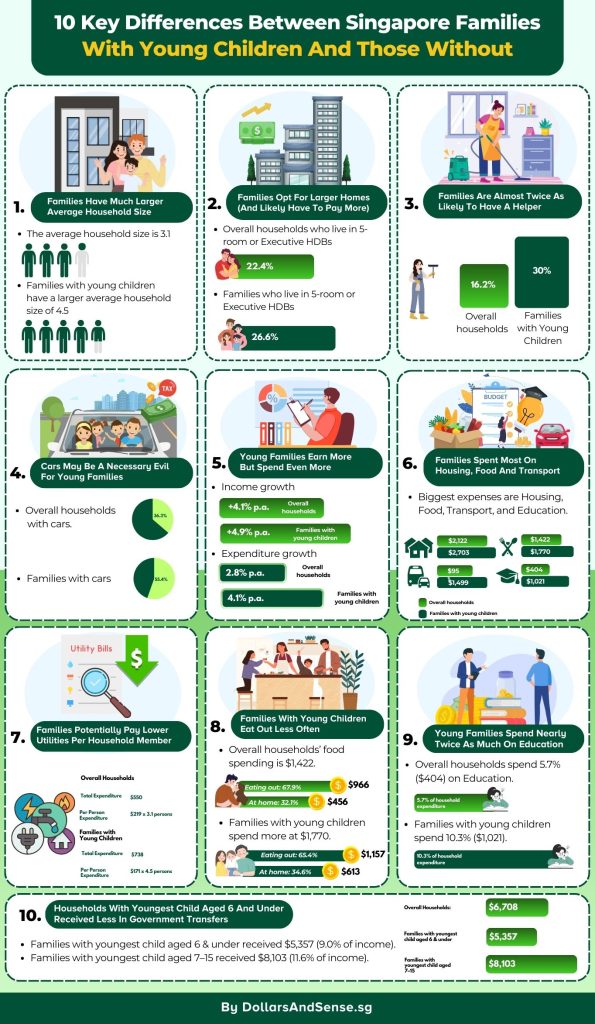
#1 Families Have Much Larger Average Household Size
One of the narratives we constantly hear is that household sizes in Singapore are declining, and that’s why homes are naturally becoming smaller. Looking at the average household size among resident households in Singapore, this is obviously true.
| Year | Average Household Size |
| 1983 | 4.79 |
| 1993 | 4.05 |
| 2003 | 3.52 |
| 2013 | 3.47 |
| 2023 | 3.11 |
Source: Singapore Department of Statistics (DOS)
But, an eye-opening statistic is that the average household size for families with young children is 4.5 today.
Telling them that the average household size is smaller and this they have to cram into smaller homes will only serve to further dampen any inkling they may have about having another child.
#2 Families With Young Children Prefer Larger Homes (And Likely Have To Pay Much More)
With a much larger average household size compared to the general population, families with young children typically stay in larger homes.
26.6% of them live in HDB 5-room & Executive flats, compared to 22.4% of the general population. A higher percentage also live in Condominium & Private Apartment, possibly for the space and amenities they offer. 23.7% of families with young children live in such homes, compared to only 17.2% of the general population.
We can also see from the statistic that only 4.4% of families with young children live in landed properties, compared to 4.8% of the general population. It’s quite interesting to note that despite preferring larger space, families with young children are less likely to be able to afford one at the highest end.
Read Also: How Much You Need To Earn To Afford These Homes In Singapore [2025 Edition]
#3 Families With Young Children Almost Twice As Likely To Have A Helper
This was one of the least surprising stat we learned. 30% of families with young children employed a Migrant Domestic Worker. This was nearly double the overall average, where only 16.2% of households hired a Migrant Domestic Worker.
Again, very unsurprisingly, even among families with kids, there’s a big difference if the child was aged 6 and below. 36.4% of families that had a youngest child aged 6 and below employed a Migrant Domestic Worker, compared to only 23.4% of families that had a youngest child aged 7 to 15.
Read Also: How Much Does It Cost To Hire A Maid In Singapore?
#4 Cars May Be A Necessary Evil For Young Families
The Singapore Government taxes cars very heavily. This may disproportionately penalise families with young children, as 55.4% such households are willing to pay dearly to own a car despite its costs.
In contrast, only 36.3% of overall households in Singapore have cars.
#5 Families With Young Children Had Higher Income Growth, But Also Higher Growth In Expenses
The last Household Expenditure Survey was done in 2017/18. Compared against those numbers, the average household income rose 4.1% p.a. Families with young children, though, enjoyed an even higher growth in average household income which grew 4.9% p.a.
On the flipside, the average household expenditure rose 2.8% p.a. Families with young children saw a 4.1% p.a. increase in their average household expenditure.
#6 Families With Young Children Spent Most On Housing, Food And Transport
It’s not a surprise to learn that families with young children spent more on all types of goods and services.
What’s interesting about the stat is that families with young children spent most on Housing and related expenditure, food, transport and education.
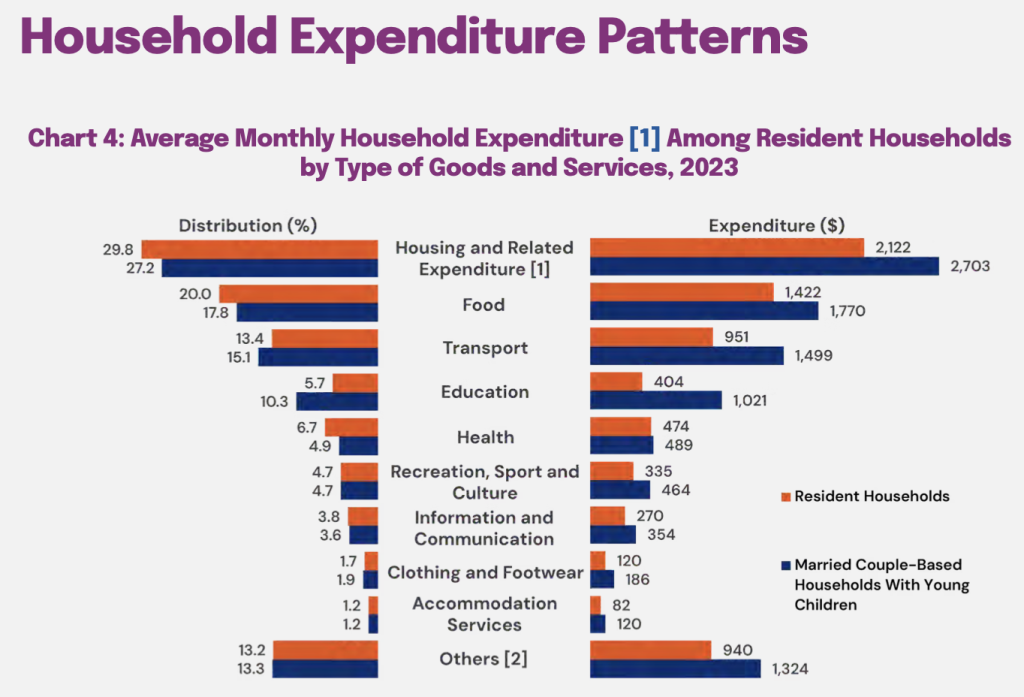
Source: Singapore Department of Statistics (DOS)
#7 Families Potentially Pay Lower Utilities Per Household Member
Households that have children may often see that their utilities bills are higher than their neighbour average and the national average.
According to the Household Expenditure Survey 2023, the average household spends $550 on Utilities, Maintenance and Repairs of Dwelling and Actual Rental. Households with young children spent more – at $738.
However, if we look at the per member expenditure, the average household expense on Utilities, Maintenance and Repairs of Dwelling and Actual Rental goes down to $219. Families with kids may actually have it better – spending $171 on this expense category.
#8 Families With Young Children Eat Out Less Often
On average, households spent $1,422 on the Food category, with $456 (or 32.1%) going towards Food and Non-Alcoholic Beverages and $966 (or 67.9%) going to Food and Beverage Serving Services (i.e. eating out).
Families with young children spent more on Food, at $1,770 on average. But, they spent a slightly lower proportion eating out at $1,157 or 65.4% of their Food expenses.
This perhaps underscore some realities that there’s economies of scale when cooking at home for more individuals. However, we should not discount the fact that cooking at home takes up time and energy, but families with young children may prioritise it because it might be the healthier choice.
#9 Households With Young Children Allocated Nearly Double Their Monthly Expenditure To Education
Households with young children allocated 10.3% of their household expenditure to education – amounting to $1,021. Obviously, this is largely because they have school-going children, and incur expenses due to pre-primary, primary, and secondary education, as well as private tuition.
The average household, though, spent only 5.7% of their monthly expenses on Education – which amounted to $404.
Read Also: How Much Does It Cost To Raise A Child In Singapore Till Age 18?
#10 Households With Youngest Child Aged 6 And Under Received Less In Government Transfers
We all understand how having a child can be very expensive. Intuitively, though, many of us may assume that families with young children enjoy a lot of Government Transfers.
Interestingly, households where the youngest child was aged 6 and below received less in Government Transfers compared to the average resident household. The total amount of $5,357 in Government Transfers represents 9.0% of their average annual household income per household member after government transfers.
When we looked at the number for families with a youngest child aged 7 to 15, it made more sense – they received more than the average households. This was mainly due to more education-related transfers and subsidies. The $8,103 such families receive in Government Transfers amounted to 11.6% of their average annual household income per household member after government transfers.
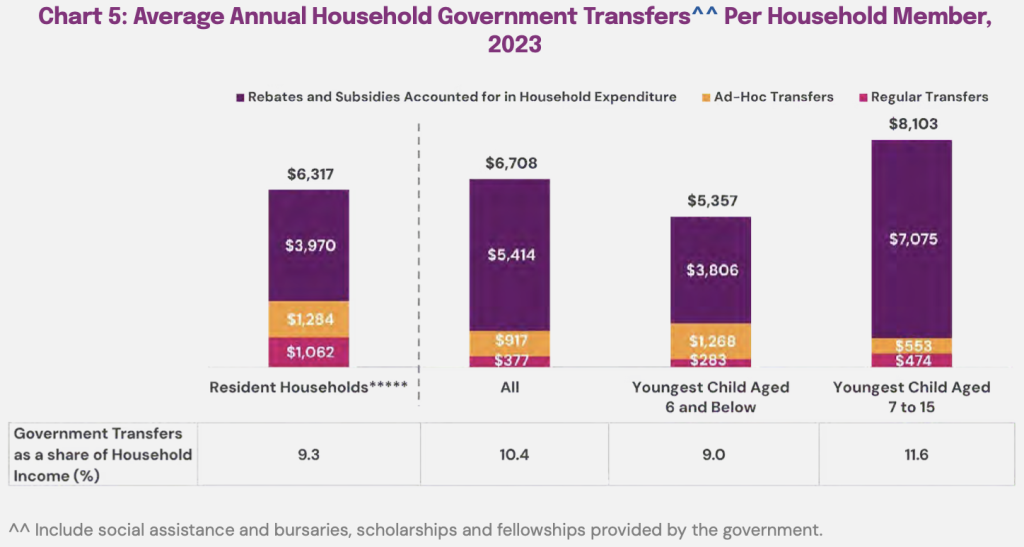
Source: Singapore Department of Statistics (DOS)
Read Also: Guide To All The Benefits For The Large Families Scheme


Budgeting 101
7 Ways Being Frugal Is Different From Being Cheap


Street Smart
Singapore Gym Membership Price Guide (2026 Edition)


Street Smart
Singapore Gym Membership Price Guide (2026 Edition)


