
Caregiving in Singapore is a complex and often costly undertaking. Several more common options here include migrant domestic workers, the professional home‑care sector, senior day‑care centres, and nursing homes. Each comes with its own financial implications, practical considerations, and emotional trade‑offs. Understanding the true cost of care requires not only looking at headline fees but also factoring in subsidies, grants, and hidden expenses that families often overlook.
Domestic Helpers
For many households, hiring a migrant domestic worker (MDW) remains the most accessible form of caregiving. Monthly salaries typically range between $500 and $900, depending on nationality and experience. In addition to wages, employers must pay a monthly levy, along with food, insurance, and accommodation costs.
If you’re employing an MDW for an elderly person 67 years and above, or has disabilities and requires help with at least 1 activity of daily living (ADL), then you qualify for the monthly levy concession of $60, instead of the usual $300.
Agency fees and onboarding expenses can add another S$2,500 to S$3,500 upfront, meaning the true cost over a two‑year contract often exceeds S$29,000 to S$35,000.
The appeal lies in the round‑the‑clock presence of a helper who can provide both household support and basic caregiving. However, MDWs are often not medically trained, and their ability to handle complex care needs is limited. Employers also shoulder significant responsibilities, from compliance with Ministry of Manpower regulations to ensuring the helper’s welfare. For families seeking affordable daily assistance, this option remains viable, but it is not a substitute for professional nursing care.
Read Also: How Much Does It Cost To Hire A Migrant Domestic Worker In Singapore?
Home Care Services
Singapore’s home‑care sector has expanded rapidly, offering services that range from personal care to skilled nursing. The Enhanced Home Personal Care (HPC+) programme, administered by the Agency for Integrated Care (AIC), provides advanced personal care at rates starting from S$25 per hour before subsidies. This service is for seniors who need help with daily or personal care tasks because they are unable to do at least 1 ADL.
Private providers charge more, with professional nursing visits costing $80 to $120 per hour, and live‑in caregivers commanding $3,500 to $6,500 per month.
The advantage of home care lies in its flexibility and clinical expertise. Families can tailor services to specific needs, whether it is wound management, dementia support, or rehabilitation. Some costs may be offset through schemes such as MediSave Care, which allows withdrawals of up to $200 per month, or the Home Caregiving Grant, which provides S$250 or S$400 monthly, depending on eligibility. Yet, the hourly rates add up quickly, and premiums for night shifts, public holidays, and transport can significantly inflate the bill. For households requiring intermittent but skilled support, home care offers peace of mind, though at a higher cost than domestic help.
Read Also: Grants; Subsidies; And Self-Care: Guide To Being A First-Time Caregiver In Singapore
Day Care Centres
Senior day‑care centres provide a middle ground for families who want their loved ones to remain at home but need daytime supervision. Fees vary widely: subsidised centres operated by voluntary welfare organisations (VWOs) can cost from $55 per session, or $400 to $1,200 per month after means-tested subsidies, while private centres charge $800 to $2,500 per month. Specialised dementia day‑care programmes are priced higher due to the need for trained staff and tailored activities.
Day care offers structured programmes that combine social interaction, therapy, and medical monitoring. Transport services are often included within a certain radius, easing the burden on families. The downside is the limited operating hours, which may not align with every household’s schedule, and the long waiting lists for subsidised slots. For working families, however, day care provides a balance between affordability and quality engagement, ensuring seniors remain active while caregivers maintain their employment.
Nursing Homes
Nursing homes represent the most intensive form of care, providing 24/7 medical supervision and support for seniors with high dependency needs. Costs vary dramatically depending on the provider. Subsidised VWOs charge S$1,200 to S$2,800 per month after subsidies, while private facilities charge S$2,500 to S$5,500 per month. Premium nursing homes, offering hotel‑style amenities and specialist dementia care, can cost more than S$12,000 per month.
Subsidies are substantial but means‑tested, covering up to 75–80% of fees for eligible households. Additional support may come from CareShield Life payouts, MediFund assistance, and the Home Caregiving Grant. Despite financial aid, families often face emotional challenges in placing loved ones in institutional care, alongside practical issues such as deposits, waiting lists, and the adjustment period for residents. Nursing homes remain essential for those requiring constant medical oversight, but they are the most expensive option in the long run.
Read Also: Price Guide To Eldercare Services in Singapore
The Bigger Picture
A recently released study on long-term care by Great Eastern revealed a perception gap regarding the actual cost of home care. Respondents estimated the monthly cost of long-term care at around $2,409, while the care provider Care@Homes projected costs of about $3,550 per month. This is an underestimation of approximately 32%.
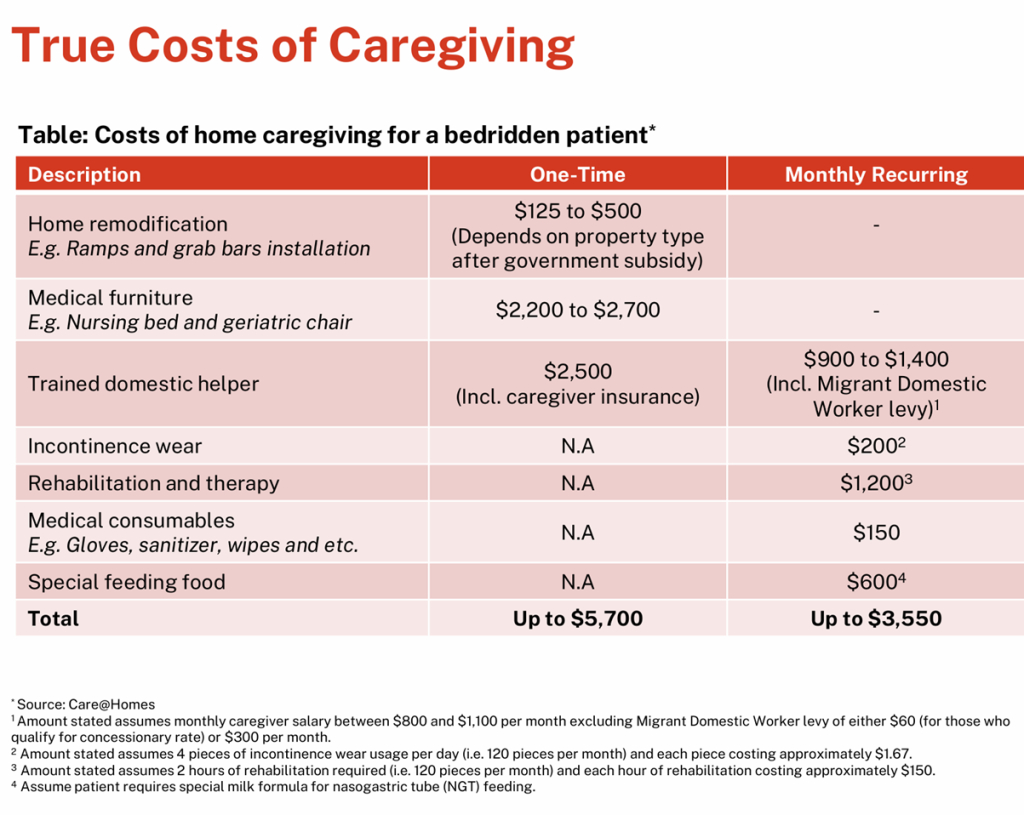
Source: Great Eastern Long-Term Care Study 2025
Families should begin by assessing the level of clinical care required, then explore subsidy eligibility through the Agency for Integrated Care and HealthHub portals. Transparent quotes from providers are essential, as hidden fees such as transport and equipment rental can add thousands to annual expenses. Beyond direct costs, households must also consider indirect burdens such as lost income and caregiver stress, which are harder to quantify but equally significant.
Caregiving in Singapore is not a one‑size‑fits‑all decision. Domestic helpers provide affordable daily support, home‑care services deliver professional expertise, day‑care centres offer structured engagement, and nursing homes ensure comprehensive medical oversight. Each option carries distinct financial and emotional implications, and families must weigh them against their own circumstances. With subsidies, grants, and insurance schemes available, careful planning can ease the financial strain, but caregiving remains a major long‑term commitment. By understanding the true costs and supports available, households can make informed choices that balance affordability, quality of care, and the dignity of their loved ones.
Advertiser Message
Thinking Of Switching Brokers Or Consolidating Your Holdings?
Tiger Brokers is currently running a transfer-in campaign where eligible clients can receive an iPhone 17 Pro Max* when they transfer in their assets.
For SGX investors, there is also a CDP Transfer promotion with 0* commissions on Singapore stocks.
Find out more here. *T&Cs apply.



Lifestyle
15 Of The Cheapest EV Cars In Singapore


Budgeting 101
7 Ways Being Frugal Is Different From Being Cheap


Street Smart
Singapore Gym Membership Price Guide (2026 Edition)


Street Smart
Singapore Gym Membership Price Guide (2026 Edition)

Bonds and Fixed Income
Complete Guide To Buying Singapore Savings Bonds (SSB) [2026 Edition]


