
As of 2025, Singapore’s resident total fertility rate (TFR) has fallen to a historic low of 0.87, down from 0.97 the year before. This is clearly a national problem. Deputy Prime Minister Gan Kim Yong went as far as to describe Singapore’s falling birth rate as an “existential challenge”.
Long gone are the days when it was common for mothers to remain at home rather than join the workforce. Both my grandmothers, who have since passed away, spent a grand total of zero days in the formal workforce. Between them, they had 15 children, including my father and mother.
Modern Singapore is, of course, a very different society. Women today have far greater educational and career opportunities. Unlike my grandparents’ time, most households prefer, or even need, two incomes. However, even while many women are working these days (as of 2025, the labour force participation rate of residents aged 25 to 64 is 80.5% for female and 91.8% for male), Singapore still wants more children.
That raises a broader policy question. If Singapore wants families to have more children, should government policies disadvantage households that decide the most practical arrangement is for one parent (usually the mother) to stay home?
Same Household Income, Different Support
Let us start with a simple example.
Household A has two working parents earning $5,000 each, for a combined household income of $10,000. They have one child, age 3, attending full-day childcare.
Household B also has a household income of $10,000, but only the husband works. The mother is a stay-at-home mum (SAHM), and they have three children. Two attend full-day childcare, while the oldest is in primary school.
Both families earn the same amount each month. Yet their access to childcare subsidies and tax reliefs can be very different.
Working Mothers Receive More Childcare Subsidies
One of the clearest examples of this is childcare subsidies. A Singapore Citizen child enrolled in a full-day infant care or childcare programme can receive a Basic Subsidy of between $300 and $600 a month, depending on the type of care and whether the mother is working. Working mothers may also qualify for an Additional Subsidy, depending on household income.
In contrast, children of non-working mothers generally receive a lower Basic Subsidy. For full-day childcare, this is $150 a month, compared with $300 for a working mothers.
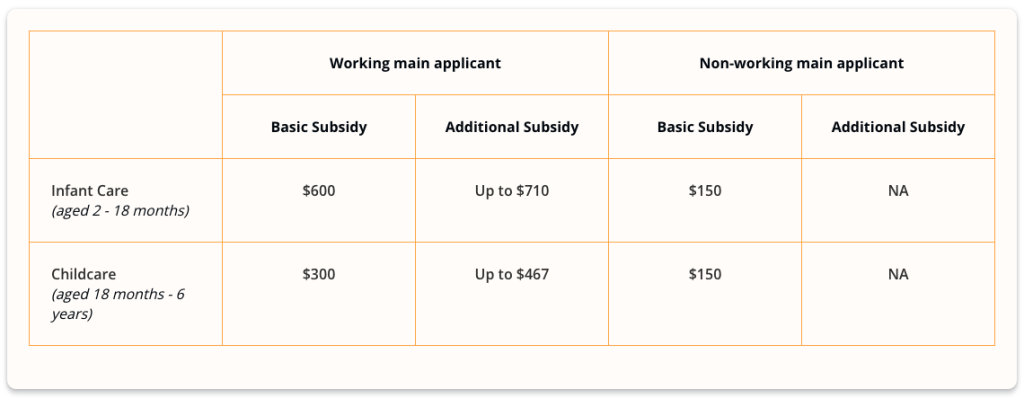
In our example, Household A has a household income of $10,000, with both parents working and earning $5,000 each. For their child attending full-day childcare, they would qualify for a Basic Subsidy of $300 a month. They would also receive an Additional Subsidy of $130, as their household income falls between $9,001 and $10,500. In total, they receive $430 for their child attending childcare.
In contrast, Household B also has a household income of $10,000, but only the father is working. As the mother is a SAHM, each child attending full-day childcare would receive only the $150 Basic Subsidy. With two children in childcare, the household would receive a total of $300 and no Additional Subsidy. In total, they receive just $300 for their two children attending childcare.
The irony is that despite having more children (3 in total), Household B receives less childcare support overall.
The Government’s rationale is that working mothers have a greater need for full-day childcare because they are away at work. That logic is understandable but it also means that a family with a stay-at-home mother ends up receiving less childcare support even when it has more children and, arguably, greater caregiving demands.
Editor’s Note: From 9 Dec 2024, families with an Singapore Citizen child enrolled in a childcare programme and a gross monthly household income of $6,000 and below or per capita income of $1,500 and below will qualify for full childcare subsidies (i.e., a basic subsidy and means-tested additional subsidy, if eligible). This applies regardless of the main subsidy applicant’s working status.
Read Also: How Childcare Spending Has Changed For Singapore Families Over The Years
Working Mother’s Child Relief Favours Dual-Income Families
Another example is the Working Mother’s Child Relief (WMCR). As its name suggests, this tax relief is available only to working mothers. IRAS states that one of its purposes is to encourage married women to remain in the workforce after having children.
For qualifying Singapore Citizen children born or adopted from 1 January 2024, an eligible working mother can claim a fixed WMCR of $8,000 for the first child, $10,000 for the second child and $12,000 for the third and subsequent children.
Going back to our example, Household A has a working mother and can therefore benefit from WMCR. Household B, despite having three children and likely facing higher household expenses, does not qualify. Even though the father is the sole breadwinner, he cannot claim WMCR in place of his wife because she is a SAHM.
When Household A Becomes Household B
Perhaps the twist is that Household B is simply the future of Household A.
As Household A gets older, both parents progress in their careers and eventually earns a good salary of $10,000 each, bringing household income to $20,000 a month. But instead of spending that extra money to upgrade to a condominium, buy a new car and go on more holidays with their one child, they decided to do what the government encourage them to do, and that is to have more children.
And they got twins.
With three children now to care for, the mother eventually leaves her job because the family decides that having one parent at home is the most ideal arrangement. Their household income falls back to $10,000, but since they have budgeted well in their earlier days, they are able to manage.
Yet despite having more children and giving up one income to care for them, they now receive less support from the government than when they were simply a family of three.
And that is the paradox. Even though we, as a country, want couples to have more children, some families may end up receiving less support precisely because having more children leads them to choose a different caregiving arrangement.
Read Also: Are Larger Households Getting Less Support Per Household Member
Photo Credit: iStock/tang90246
Advertiser Message
Thinking Of Switching Brokers Or Consolidating Your Holdings?
Tiger Brokers is currently running a transfer-in campaign where eligible clients can receive an iPhone 17 Pro Max* when they transfer in their assets.
For SGX investors, there is also a CDP Transfer promotion with 0* commissions on Singapore stocks.
Find out more here. *T&Cs apply.