
In last year’s Budget 2025 speech, Prime Minister Lawrence Wong announced new lowered preschool fee caps. It was the second consecutive year that he had done so. Effective 1 January 2026, monthly childcare fees at anchor operator preschools (AOP) are now capped at $610, and fees at partner operator preschools (POP) are now capped at $650. These amounts are before basic childcare subsidies.
Childcare and Infant Care Subsidies Over The Years
Basic subsidies are based on the main applicant’s employment status. By default, ECDA considers the mother as the main applicant for subsidies. If the mother is unavailable, as in cases of divorce, separation, or death, the applicant is the single father. For convenience, this article will default to the mother as the main applicant.
Currently, working mothers are eligible for a monthly Basic Subsidy of $300 for full-day childcare (for children aged 18 months to 6 years old) and $600 for full-day infant care (for children aged 2 months to 18 months old). They may also be eligible for an Additional Subsidy, depending on their family’s gross monthly household income or per capita income. The income ceiling for the Additional Subsidy was raised from $7,500 to $12,000 in 2020.
Non-working mothers are only eligible for a monthly Basic Subsidy of $150 for both childcare and infant care, with no Additional Subsidy. In 2024, the rationale for this distinction was explained in Parliament, as working mothers would have a greater need for full-day childcare while they were away at work.
The same Parliamentary response also noted that, since March 2019, ECDA has provided higher subsidies to non-working mothers under Special Approval. This Special Approval is for a variety of circumstances, including seeking a job, caring for a younger child aged 24 months or less, studying, or on a training course for at least 56 hours a month.
Since 9 December 2024, non-working mothers with a gross monthly household income of $6,000 or less, or a per capita income of $1,500 or less, now qualify for full childcare subsidies. This was announced at the Budget 2024 speech, where Prime Minister Lawrence Wong said this would benefit up to 17,000 children. This move follows calls by former Nominated Member of Parliament Anthea Ong and former Member of Parliament Louis Ng back in 2019 for childcare subsidies to be made more accessible to low-income families regardless of the mother’s working status.
The Basic Subsidy has been $300 for several years, and the question of whether this amount would be reviewed has been raised in Parliament. In response, the Ministry of Social and Family Development (MSF) pointed out that the Basic Subsidy is “only one of several avenues” and that the Government has, in recent years, “enhanced preschool affordability” through raising the household income ceiling for Additional Subsidies and lowering fee caps for Anchor Operators (AOPs) and Partner Operators (POPs).
Read Also: Complete Singapore Parents’ Guide To Childcare Subsidies For Their Little One(s)
Childcare and Infant Care Fee Caps Over The Years
As MSF pointed out in Parliament in 2024, keeping fees at Government-supported preschools affordable by lowering fee caps and increasing the number of places enables more families to benefit from them. This is “more effective than increasing the Basic Subsidy”.
In October last year, an additional 49 preschools were appointed as POPs, bringing the total to 380. As mentioned earlier, fees at these schools would be capped at $650. They join the five AOPs, namely, PCF Sparkletots Preschool, My First Skool, M.Y World Preschool, Skool4Kidz, and E-Bridge Pre-School. Fees at AOPs are now capped at $610.
| Anchor Operators | Partner Operators | |
| 2020 | $720 | $800 |
| 2021 | $720 | $760 |
| 2022 | $720 | $760 |
| 2023 | $680 | $720 |
| 2024 | $680 | $720 |
| 2025 | $640 | $680 |
| 2026 | $610 | $650 |
Read Also: Complete Guide To Childcare Operator Fees In Singapore
How Childcare Subsidies And Fee Caps Work Together
According to MSF’s Family Trends Report 2025, lowered childcare fee caps brought down the industry median fees from $800 in 2020 to $720 in 2024. This ensured that a median-income household with a child attending full-day childcare in an AOP would spend 3.5% of their household income on preschool in 2024. This means that out-of-pocket expenses remained relatively stable over the five years.
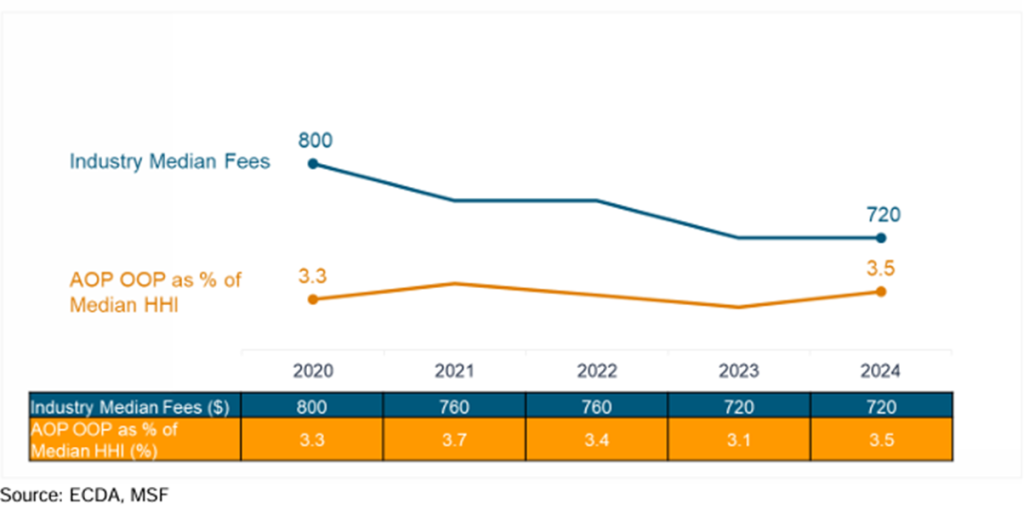
Source: Family Trends Report 2025
Meanwhile, the number of full-day childcare places increased from 170,932 in 2020 to 200,847 in 2024. This meant that more families could benefit from the lowered fee caps and subsidies.
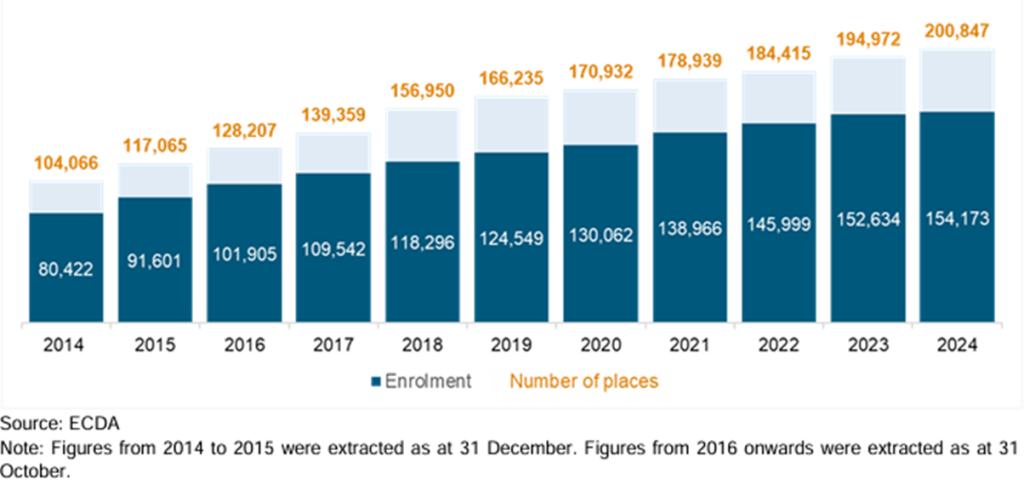
Source: Family Trends Report 2025
The infant care statistics paint an even better picture. With the raising of the income ceiling for the Additional Subsidy in 2020, and the fee caps for full-day infant care lowered in 2023, the industry median infant care fee dropped from $1,275 in 2020 to $1,235 in 2023 and families’ out-of-pocket expenses reduced from spending 6.5% of their household income on preschool in 2020 to only 6.0% in 2024.
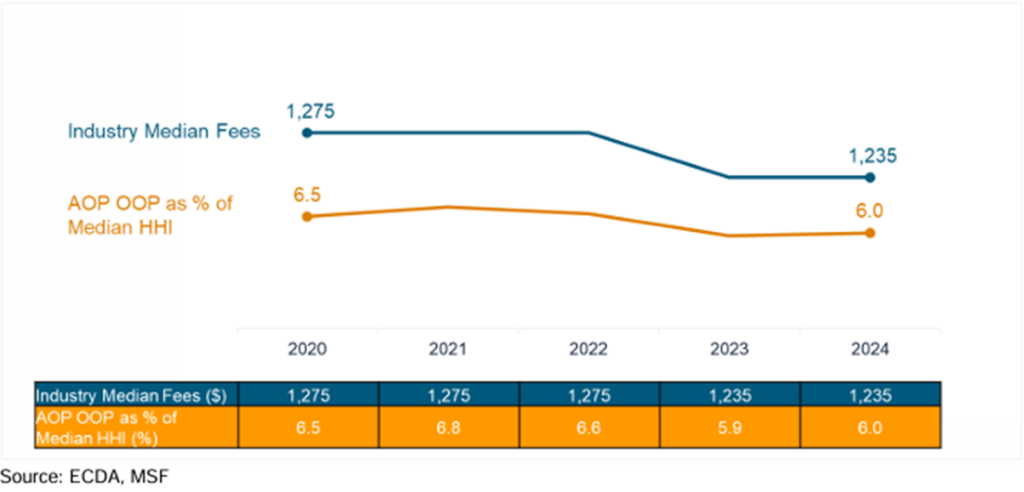
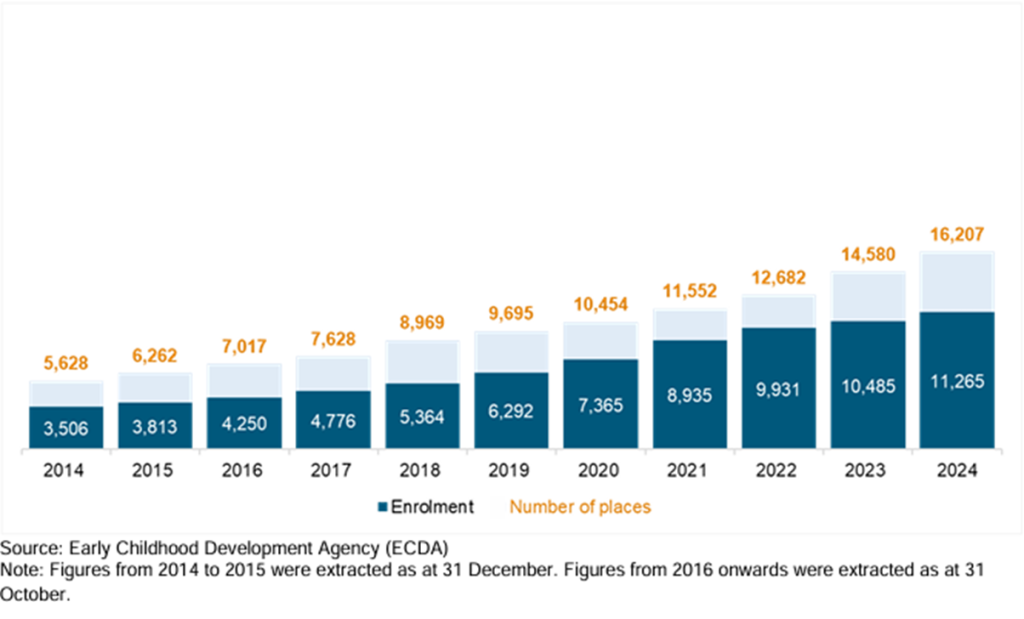
Source: Family Trends Report 2025
Advertiser Message
Thinking Of Switching Brokers Or Consolidating Your Holdings?
Tiger Brokers is currently running a transfer-in campaign where eligible clients can receive an iPhone 17 Pro Max* when they transfer in their assets.
For SGX investors, there is also a CDP Transfer promotion with 0* commissions on Singapore stocks.
Find out more here. *T&Cs apply.