
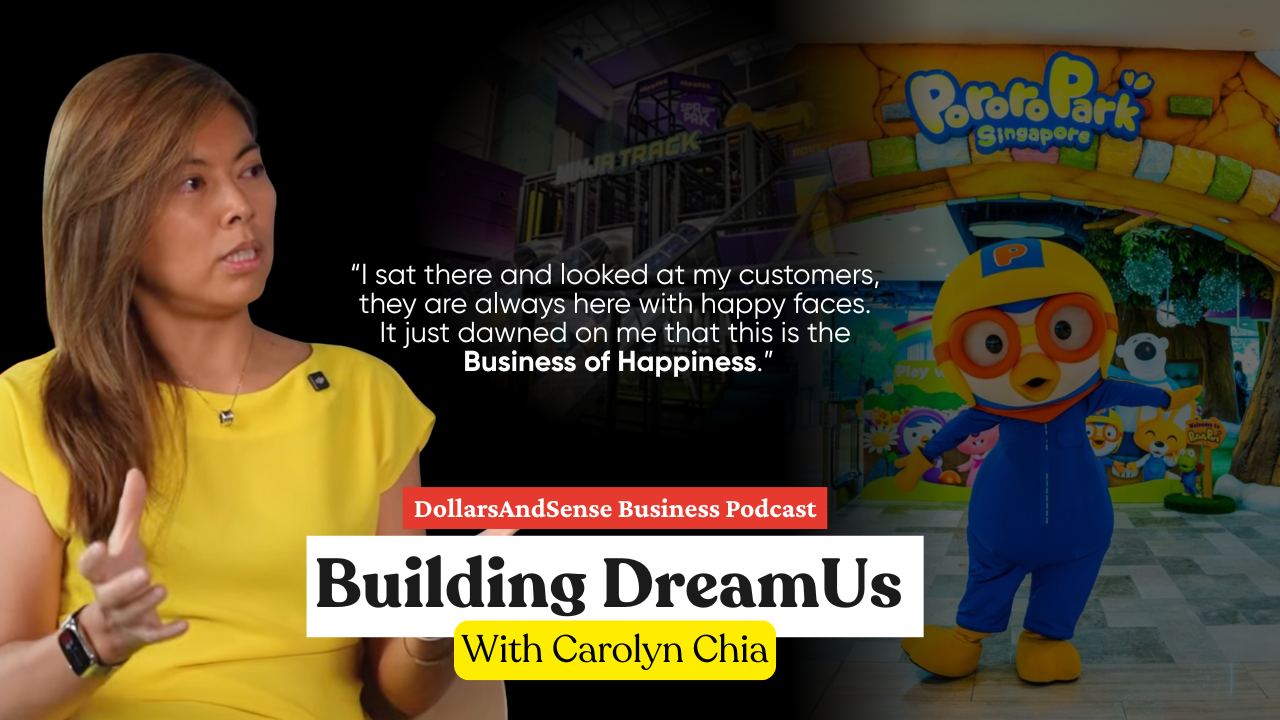
When most people think of theme parks, sprawling outdoor rides often come to mind. But for DreamUs Group, the magic happens indoors, in carefully designed spaces where children can play, learn and immerse themselves in familiar characters.
In this episode of the Building Series podcast, we spoke with Carolyn Chia, General Manager and shareholder of DreamUs Group, the company behind Pororo Park, Tayo Station and SuperPark in Singapore and Indonesia..
Watch the full Building Series Podcast episode here:
Over the course of the conversation, Carolyn reflects on how the business began, how it expanded beyond a single concept, and the decisions behind scaling across markets while working with globally recognised intellectual property.
A Parent’s Observation That Sparked DreamUs’ First Play Concept
In the podcast, Carolyn traces the company’s beginnings back to a personal observation rather than a formal business plan.
More than a decade ago, DreamUs’ founder (a Korean national living in Singapore) was spending time with his young child when he noticed a gap in the indoor play space landscape. While such playgrounds were common, many felt designed for one-off visits, offering limited thought around repeat use or what children were learning through play.
That observation led to the creation of Pororo Park, DreamUs’ first indoor play concept. The focus, Carolyn explains, was on building an environment parents could feel comfortable returning to, and one that children would remain engaged with over time.
As the conversation unfolds, she goes on to explain how this early thinking shaped DreamUs’ approach to growth. Instead of scaling a single concept, the company developed multiple play formats, each built around a different theme and audience.
Pororo Park centres on Pororo the Little Penguin, while Tayo Station uses transport-themed play to introduce basic road-safety concepts. SuperPark, which originated in Finland, extends the offering to teenagers and adults.
What becomes clear through the discussion is that these concepts were not selected simply for familiarity. Carolyn shares that the characters and formats were chosen deliberately, for the values embedded in their original stories such as cooperation, non-violence and social learning which continue to influence how DreamUs designs its play environments today.
How Life Stage Shaped Carolyn’s Role at DreamUs
Carolyn joined DreamUs in 2017 after more than a decade in marketing roles. While the move appeared to be a shift into day-to-day business operations, she shares in the podcast that it aligned with where she was in her career at the time.
Having just had her second child, the move coincided with her taking on a broader role within a business centred on indoor play experiences. That period also placed her closer to how the parks were used on a daily basis. Spending time in the parks alongside her children gave her first-hand visibility into how young visitors moved through and interacted with the spaces.
As DreamUs expanded from one park to multiple concepts, Carolyn’s responsibilities widened accordingly. Becoming a shareholder did not materially change her day-to-day involvement, but shifted her focus toward longer-term considerations around growth and sustainability.
Working within the parks meant being surrounded by families and children on a daily basis. Sitting in a café that also served as her office, she began to view DreamUs less as a conventional operations role and more as a business centred on creating shared experiences.
Becoming a shareholder also reshaped her working relationship with the founders. Conversations, she shares, evolved from employer-employee discussions to open exchanges between partners, grounded in trust and aligned goals.
What It Takes to Adapt Global IP Across Markets
As DreamUs expanded beyond Singapore, Carolyn shared how they work closely with global IP holders from markets such as South Korea and Finland, where characters and concepts are governed by defined brand, design and content frameworks.
Expansion into new markets also surfaced practical differences on the ground. For instance, localising Korean brands for Singapore required adjustments around language and cultural nuance. In Indonesia, however, the changes went further into spanning pricing strategies, marketing approaches and a deeper understanding of how customers interact with the parks.
Even within Jakarta, Carolyn noted that customer behaviour varied significantly depending on location. Parks were placed in different parts of the city to account for traffic conditions and travel patterns, recognising that accessibility could influence visit frequency and usage.
One early lesson, Carolyn reflects, was underestimating how differently customers behave across markets. From how often families return, to how much they spend, and how the parks are used for birthday parties, school visits or group activities. Over time, these differences became critical inputs into how each park was designed, positioned and operated.
The Operational Reality Behind Scaling
Despite operating across different markets, Carolyn notes that many of the complexities of scaling are operational rather than geographic. Recruitment, training and team alignment remain constant considerations, requiring deliberate systems and processes to maintain consistency as the business grows.
To manage multiple locations effectively, DreamUs relies on systems that reduce the need for constant physical oversight. Carolyn highlighted that cashless ticketing offers real-time insight into visitor volumes and sales, while cloud-based CCTV allows teams to monitor operations remotely.
Indoor theme parks are also capital-intensive by nature. Significant upfront investment is required to build immersive environments that stay true to the original shows, alongside ongoing costs such as rent and manpower.
Before committing to a new park, the team evaluates location, foot traffic, customer profiles and the likelihood of breaking even within a realistic timeframe. Consumer trends are also monitored closely, with parks refreshed regularly to remain relevant. Major upgrades are often aligned with lease renewals, allowing the business to invest with a longer-term horizon.
Looking ahead, Carolyn shares that DreamUs intends to continue adding new brands and entering new markets but only when operational readiness and commercial fundamentals are firmly in place.
Read Also: From Online To Offline: How Roy Ang Plans To Scale Stryv Into A Billion-Dollar Brand
A Final Lesson in Leadership
Looking back on her journey, Carolyn points to one principle that has shaped how she leads: transparency. For her, effective leadership starts with listening — not only to customers, but also to staff, brand owners and partners. That openness has guided DreamUs’ steady growth, while keeping the business anchored to its original purpose.
At its core, DreamUs is more than an entertainment company. As Carolyn describes it, it is a business built around happiness — shaped one park, one family and one conversation at a time.
Designed For Growing And Serial Entrepreneurs
As businesses grow more complex, so do their banking needs. OCBC, Asia’s Best SME Bank, has been working with serial entrepreneurs across Singapore, Malaysia and Hong Kong since 2019, helping them manage multiple businesses more seamlessly — from consolidated support to earning more interest across business balances.
Start your journey with OCBC here.


Street Smart
Singapore Gym Membership Price Guide (2026 Edition)


