
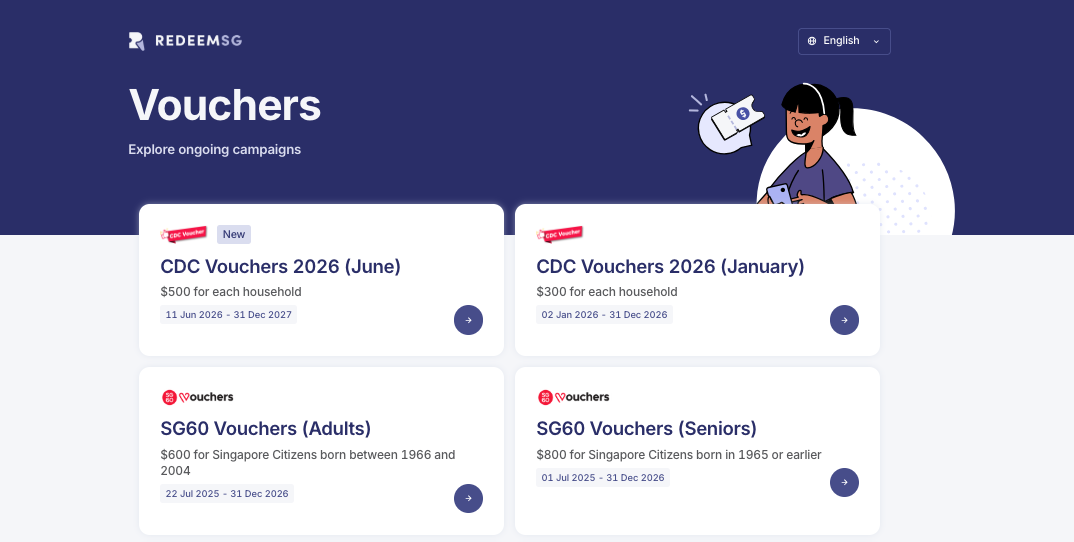
Since the CDC Vouchers Scheme was first introduced in June 2020, it has become a familiar form of support for Singaporean households. What started as a scheme to help lower-income households cope with living expenses during the COVID-19 pandemic, while supporting heartland merchants and hawkers, has since expanded into a broader cost-of-living measure.
For most of us, receiving more CDC vouchers is unlikely to be something we would complain about. The vouchers can be used for expenses that households would already incur, whether that means buying groceries at participating supermarkets, having a meal at a neighbourhood hawker stall, or purchasing everyday necessities from heartland merchants.
For example, in 2026, every Singaporean household received $300 in CDC Vouchers in January, followed by another $500 from June. The June tranche was split equally, with $250 for participating hawkers and heartland merchants, and another $250 for participating supermarkets.
While this support is undoubtedly useful in helping households offset everyday expenses, one feature of the CDC Vouchers Scheme may be a potential shortcoming when comparing households of different sizes.
CDC vouchers are distributed on a per-household basis, rather than according to the number of people living in the household. As a result, larger households receive less support on a per-person basis. This includes “Large Families”, which the Government defines as families with three or more children.
A Family Of Seven Receives The Same CDC Vouchers As A Single-Person Household
Take two households as an example. The first is a 38-year-old single who lives on his own. The second is a family of seven, comprising a married couple and five children.
Under the CDC Vouchers Scheme, both receive the same amount of vouchers.
Yet their needs are clearly different. A family of seven has more mouths to feed, more groceries to buy and more daily expenses to cover. Even without judging how either household chooses to spend, the same amount of CDC vouchers will naturally stretch very differently.
While this may sound like an extreme comparison, these are not hypothetical households created to make a point. Both are real households known personally to the writer, who has spoken to them about how they use their CDC vouchers.
Both households shared that they are generally frugal. Even so, the family with five children shared that they typically uses up their CDC vouchers within a few weeks, while the single-person household shared with me that he takes a few months to use up his vouchers.
In other words, even though the government want couples to have more children and have large families, families with multiple young children are obviously at a disadvantage based on the current method that CDC vouchers are allocated.
Read Also: Are Larger Households Getting Less Support Per Household Member
Giving Individual Vouchers Helps, But Large Families With Young Children Are Still Not Accounted For
To some extent, the Government has already introduced voucher support that recognises individuals rather than just households.
A good example is the SG60 Vouchers announced in 2025. Unlike CDC vouchers, which are allocated once per Singaporean household, SG60 Vouchers were given to eligible Singaporeans individually. Singapore Citizens born between 1966 and 2004 received $600 each, while those born in 1965 or earlier received $800 each.
This helps reduce some of the imbalance created by household-based support. A household with three eligible adults (2 working adults, 1 senior) now receives three separate sets of SG60 Vouchers, while a single-person household would receive only one.
However, this still does not fully address large families with multiple children. A married couple with five young children would receive 2 sets of SG60 Vouchers. However, their five children again do not qualify for these vouchers even though the household’s grocery, meal and daily living expenses are like to be much higher as compared to a dual-income, no kids (DINKS) couple who will also receive a similar amount of CDC vouchers.
If Singapore Wants Larger Families, Our Support Schemes Should Naturally Reflect That
The government has made it clear that Singapore wants couples to have more children. Yet some of our broad-based support schemes such as the CDC Vouchers are still designed in ways that give larger families less support on a per-person basis.
CDC Vouchers are a good example. A family with five children receives the same household allocation as a single person living alone, even though its day-to-day expenses are substantially higher. Individual schemes such as SG60 Vouchers narrow this gap, but again, young children are still not counted.
Of course, CDC Vouchers were never intended to be a fertility policy, and a flat household payout is simple to administer. But if Singapore is serious about encouraging larger families, it may be worth asking whether more cost-of-living support should take household size into account.


Budgeting 101
7 Ways Being Frugal Is Different From Being Cheap


Street Smart
Singapore Gym Membership Price Guide (2026 Edition)


Street Smart
Singapore Gym Membership Price Guide (2026 Edition)


