

This article was contributed to us by Sebastian Sieber, Founder of Cashew.sg.
At the start of this year, a 3-year fixed home loan cost about 5 basis points more than a 2-year. Locking in an extra year of certainty was almost free.
Today that gap is 20 basis points. That is the single clearest change in the Singapore mortgage market this year, and it is worth understanding before you choose a package, because it changes the answer to a question almost every refinancer asks: two years or three?
Where The Benchmark Actually Sits
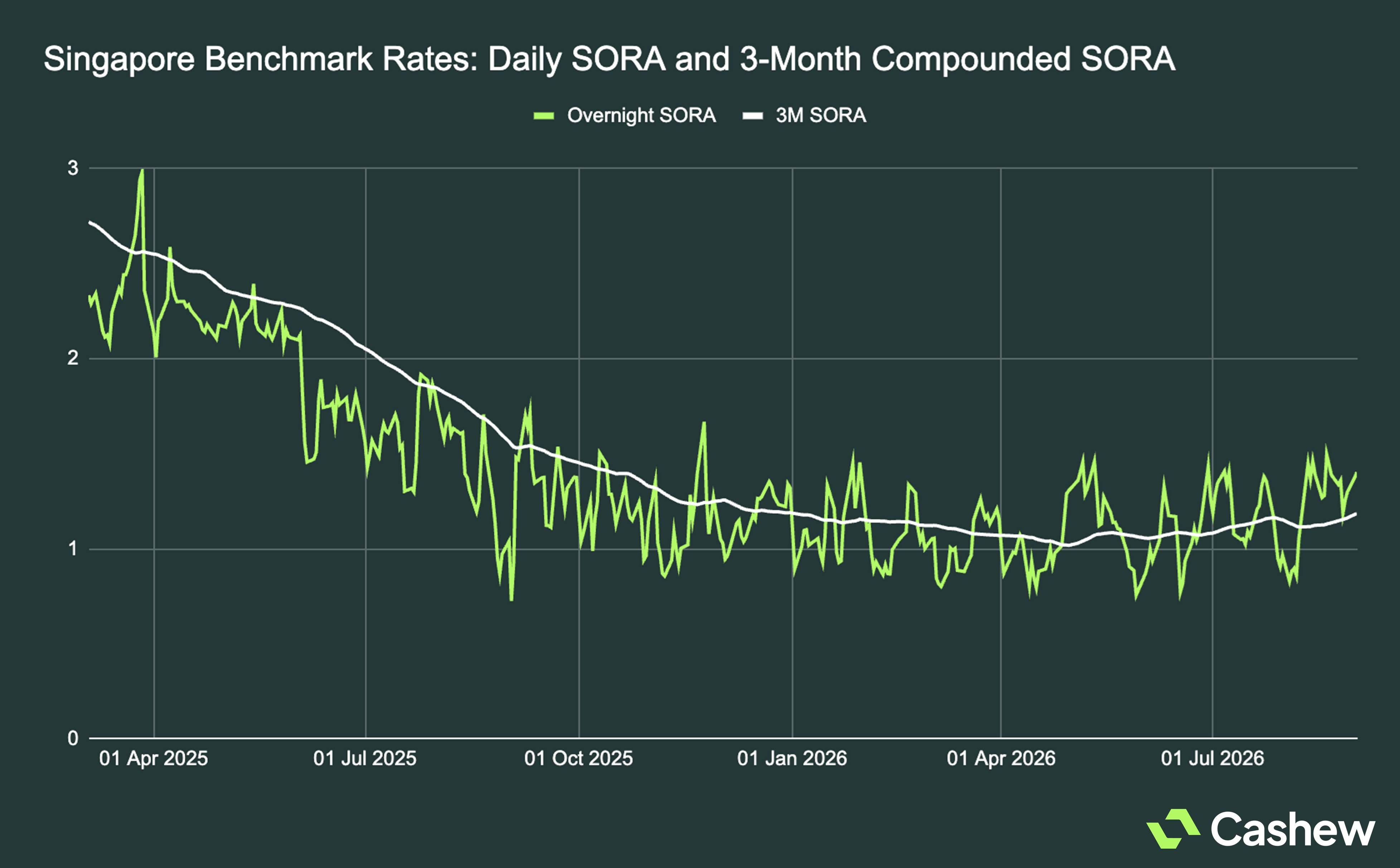
The 3-month compounded SORA is the benchmark behind most floating home loans, and the reference point banks use when pricing fixed ones. As you can see, it was above 3 per cent at the start of 2025. Over the eighteen months in the chart, it fell from 2.71 per cent to 1.02 per cent on 28 April 2026, a drop of roughly 170 basis points.
Then it stopped. As of 18th September it is 1.2 per cent, 18 basis points off the low, having risen gently for four months. It tells a clear picture: A steep fall, a floor in April, a mild drift upward since.
The 2-year and 3-year gaps in fixed-rate packages widened.
Fixed rates are not priced off today’s SORA. They are priced off what a bank expects average SORA to be over the life of the lock-in, plus a margin for the risk of being wrong.
That makes the gap between tenors readable. A cheap 3-year relative to the 2-year means banks are relaxed about the next three years. An expensive one means they are not.
In January they were relaxed and charged 5 basis points for the third year. Now they charge 20. Over the same period, 2-year pricing broadly has only increased slightly.
| Lowest on the board | Jan 2026 | Sep 2026 | Change |
| 2-year fixed | 1.35% | 1.40% | +5bp |
| 3-year fixed | 1.40% | 1.60% | +20bp |
| 5-year fixed | 1.78% | 1.98% | +20bp |
Fixed rates are the average across the lock-in period.
Banks are not saying rates are about to spike sharply. If they believed that, the 2-year would have moved significantly higher too. They are saying they are comfortable committing to a cheap rate for two years but not for a third.
The five-year premium tells the same story. A 5-year fixed sits roughly 38 basis points above the 3-year, and that premium has barely changed all year.
Comparison sites publish the lowest number on the board. That number is almost never yours.
Here is the best 2-year fixed rate available today for an HDB refinance, by loan size:
| Loan size | Best 2-year fixed |
| $300,000 | 1.65% |
| $600,000 | 1.55% |
| $2,000,000 | 1.50% |
The 3-year looks similar, shifted up, and the premium for that third year is smallest on the loans that are already paying the most:
| Loan size | Best 3-year fixed | Cost of the 3rd year |
| $300,000 | 1.85% | 20bp |
| $600,000 | 1.70% | 15bp |
| $2,000,000 | 1.60% | 10bp |
One useful exception: floating packages do not discriminate this way. So if you are refinancing a smaller HDB loan, floating is 27 basis points below the best fixed rate you can get, where a $1 million borrower sees barely any difference. Small loan, and the fixed premium is real. Large loan, and it is close to free.
*Note: Subsidies to refinance do not apply for loans below 200K.
The Arithmetic
Every fixed package is a bet on what you will be able to refinance at when it ends. Take the two-year and your betting rates in 2028 will be low. Take the three-year and you are betting they will not be. The board tells you exactly what odds you are being offered.
Here is what each tenor costs today, and what the years you have not covered would have to come in at for the shorter option to have been the cheaper one.
| Loan size | 2-year | 3-year | 5-year | For 2Y to beat 3Y, year 3 must come in below | For 2Y to beat 5Y, years 3 to 5 must average below |
| $300,000 | 1.65% | 1.85% | 1.98% | 2.25% | 2.20% |
| $600,000 | 1.55% | 1.70% | 1.98% | 2.0% | 2.27% |
| $2,000,000 | 1.50% | 1.60% | 1.98% | 1.8% | 2.30% |
Breakevens compare total interest at each fixed rate over the longer term, on a flat balance. Amortisation reduces the dollar figures slightly and barely moves the breakeven rate.
We are not going to tell you which of those bets to take, because it depends on something nobody knows. What the table does is tell you what you are being charged for each one.
Ensure you are not overpaying on your home loan.
Nobody can 100% predict where SORA goes from here. Not us, not your banker, not the economists who were confidently forecasting further cuts in March.
But there is one thing in this article that does not depend on any forecast.
If your lock-in has expired, you are almost certainly overpaying. This is the one part of the mortgage market that is designed to work against you. When your lock-in ends, your bank does not put you on its best rate. It moves you onto a standard package that is materially more expensive, and it does not ring you to say so. There is no penalty for leaving at that point and no notice that you should. The rate simply changes and it keeps running until someone realises they are overpaying.
If your lock-in is ending in the next six months, or has already ended, check in on the best packages now. On Cashew you can see every package from every major lender, filtered to the ones you actually qualify for at your loan size, in about a minute. No phone calls, and nothing to sign to find out where you stand.
The Best Rates On The Market Right Now
Fixed rates shown are the average across the lock-in period. Rates move weekly.
HDB refinancing
| Loan size | 2-year fixed | 3-year fixed | Best floating |
| $300,000 | 1.65% | 1.85% | 1.40% |
| $600,000 | 1.55% | 1.70% | 1.38% |
| $2,000,000 | 1.50% | 1.60% | 1.35% |
Private property (condo and landed)
| Loan size | 2-year fixed | 3-year fixed | Best floating |
| $1,000,000 | 1.4% | 1.6% | 1.35% |
| $2,000,000 | 1.4% | 1.6% | 1.35% |
| $4,000,000 | 1.4% | 1.6% | 1.35% |
About Cashew
Cashew.sg is Singapore’s leading digital mortgage platform. We track every package from every major lender daily, which is where the rates and the SORA history in this article come from. Tell us your loan size, property type and when your lock-in ends, and we show you the packages you qualify for straight away, ranked by what they actually cost you rather than by headline rate. If you decide to move, our advisors handle the application with the bank.


