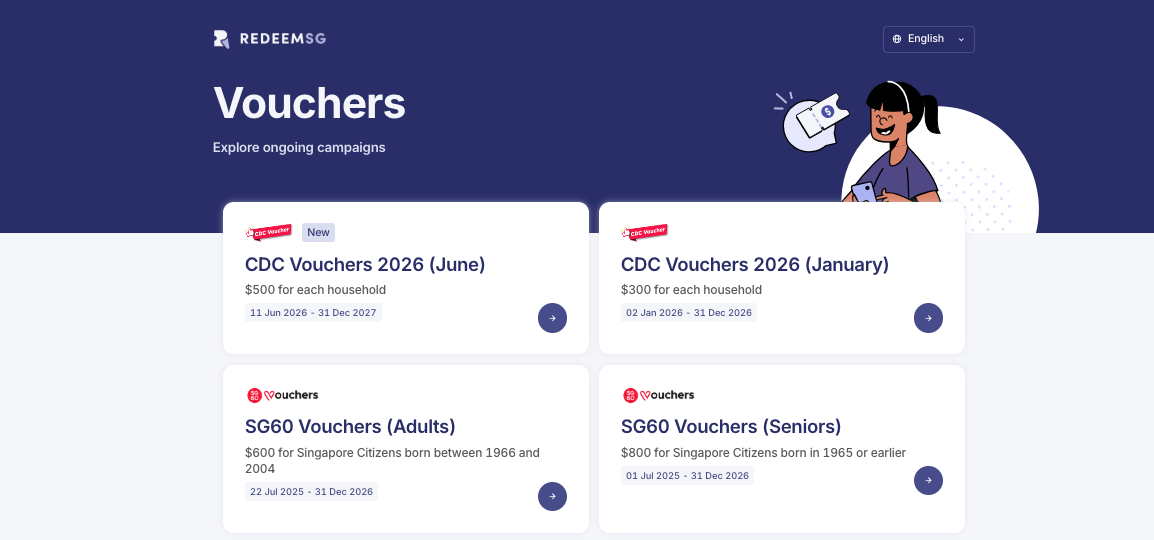
In a recent video published on his Instagram, Prime Minister Lawrence Wong spoke to a couple eating Bak Kut Teh. The man explained that CDC Vouchers had allowed them to order a fish as well.
While it was a light-hearted exchange, it got me thinking about how people treat government vouchers differently from their own money. Without the vouchers, the couple might still have been able to afford the fish. Yet having a separate pool of credits made it easier for them, and many others, to justify spending extra.
Singaporeans have received various forms of government support in recent years, including CDC Vouchers, LifeSG credits and household rebates to help with living expenses. Although these benefits have a clear dollar value, we may not treat them in the same way as our salary or savings.
In fact, instead of helping us save more by offsetting our usual expenses, vouchers may sometimes encourage us to spend more.
Why does $100 in vouchers sometimes feel easier to spend than $100 in cash?
In Theory, $100 Is Still $100
Economically speaking, money is supposed to be fungible. This means one dollar should be interchangeable with another dollar.
Suppose someone earns $3,000 a month. They spend $2,000 and save $1,000. If they then receive $100 in government vouchers, they could use the vouchers to pay for groceries and save an additional $100 from their salary. So for the month, they now spend $1,900 (+ $100 in voucher) and save $1,100, $100 more than before.
In this scenario, the vouchers function almost like cash.
However, many people may treat the $100 as an additional spending allowance rather than using it to replace expenses they would already have incurred.
Instead of buying the same groceries and saving more, they might purchase better ingredients, visit a more expensive food stall or add another dish to the table. They would still spend $2,000 in cash, plus another $100 through the vouchers. Total consumption would rise to $2,100, while savings would remain at $1,000.
The household receives the same $100 benefit in both cases. In one scenario, savings rise. In the other, consumption rises.
We Put Money Into Mental Buckets
One explanation is mental accounting.
In behavioural finance, mental accounting refers to our tendency to treat money differently depending on where it came from, what it is intended for or which mental “bucket” we place it in.
Here’s an example. Suppose I receive $500 for achieving Gold in my IPPT. I may be more willing to spend $100 on a meal at Jumbo Seafood because the reward feels like “bonus money”, even though I could have saved or invested it.
That is mental accounting: treating cash differently because of where it came from.
To be clear, this is different from receiving $100 in Jumbo vouchers, which can only be spent there. Using those vouchers for a meal is simply making use of a restricted benefit.
People often divide money into separate mental categories, even when it is technically interchangeable. For instance, salary may be treated as “hard-earned money” while a year-end bonus may become holiday money.
This is also why tax refunds, rebates and bonuses are often spent more freely than regular income. They arrive separately and are mentally labelled as “extra”, even though they could just as easily be saved.
Once money has been placed into a mental category, we tend to apply different rules to it.
Are Vouchers The Same As Cash?
Treating vouchers differently from cash is not always irrational.
Cash can be spent, saved, transferred, invested or kept for emergencies. CDC Vouchers cannot easily perform all these functions. They can only be used at participating merchants and supermarkets. They cannot be placed in a fixed deposit, invested or used to pay every type of bill.
This makes them less flexible than cash.
However, for a household that already spends regularly at participating supermarkets and hawkers (which is pretty much almost every Singapore family), the vouchers is almost as useful as cash. Singapore families can simply use the voucher to offset their usual expenses, thus allowing them to keep more money in the bank.
Expiry Dates Encourage Action
Cash in a bank account can remain there indefinitely. Expiring vouchers cannot.
The fact that vouchers come with expiry dates creates a use-it-or-lose-it decision. As the deadline approaches, spending becomes more attractive because letting the vouchers lapse would mean losing their remaining value. That’s why we always see more frivolous spending on 31 December, as it’s the last day before the vouchers expire anyway.
A household may bring forward a grocery purchase or choose a slightly more expensive meal simply to use the balance. This does not always mean the household has become reckless. Spending $20 on useful items is still better than allowing $20 to disappear.
However, expiry dates can also weaken normal spending discipline. A person may buy something they do not need just to use it up.
Vouchers Can Also Serve A Policy Purpose
There is another reason a government may prefer to provide vouchers instead of cash.
Cash gives households maximum flexibility. Recipients can spend it, save it, invest it or use it to repay debt.
Vouchers can direct spending towards particular parts of the economy. CDC Vouchers can be used at participating hawkers, heartland merchants and supermarkets, helping households with everyday expenses while channelling spending towards local businesses.
Some LifeSG credits are less restrictive than CDC Vouchers but still cannot be used in exactly the same way as cash. For instance, NS LifeSG credits can be spent at physical and online merchants that accept eligible PayNow UEN QR or NETS QR payments.
Unlike cash transferred into a bank account, these credits must be redeemed through eligible payment channels. This encourages their value to be spent through participating businesses rather than saved or invested directly.
In this sense, the tendency to spend vouchers and credits is not necessarily an unintended side effect. It may be part of the policy design. The Government is not only transferring value to households. It is also encouraging that value to circulate through selected parts of the economy.
Or as PM Wong said, win-win.
Advertiser Message
Thinking Of Switching Brokers Or Consolidating Your Holdings?
Tiger Brokers is currently running a transfer-in campaign where eligible clients can receive an iPhone 17 Pro Max* when they transfer in their assets.
For SGX investors, there is also a CDP Transfer promotion with 0* commissions on Singapore stocks.
Find out more here. *T&Cs apply.