

Whether it is due to social factors or personal reasons, the age when Singapore women have their first child is getting later and later. In 2020, the median age of resident live births for first-time mothers is 31 and this has been steadily increasing over the years.
Biologically, fertility declines with age. As women marry later in life or couples choose to put off having children until later, this has knock-on effects on fertility.
In Singapore, women (between 21 and 35 years old) will finally be allowed to undergo elective egg freezing from early 2023. This is welcome news for women who are worried about their fertility but delay conception (either by circumstance or choice). It is also a big change from the previous policy which only allowed for egg freezing only for medical reasons that permanently impact fertility (e.g. chemotherapy)
So, how much does it cost to undergo elective egg freezing and assisted conception in Singapore?
Read Also: What Is The Cost Of Delivering A Baby In Singapore?
Elective Egg Freezing Will Require Preprocedure Counselling
One of the action plans under the White Paper on Singapore Women’s Development, elective egg freezing (also known as social egg freezing) will be allowed with the introduction of the Assisted Reproduction Services Regulations under the Healthcare Services Act in early 2023.
This will be open to all women between the age of 21 and 35, regardless of their marital status. The age limits are set to be aligned with the age limits for egg donation. While egg freezing may be done without regard to marital status, the use of their frozen eggs is restricted to legally married couples. This is to continue the principle of upholding parenthood within marriage.
To ensure that women make an informed choice, there will be a preprocedure counselling. This will include highlighting its invasive nature, limitations e.g. low success rate of live births, that it does not guarantee motherhood, risks of late pregnancy, challenges of aged parenthood, and costs of elective egg freezing such as storage and insurance.
(Note: abortion is another reproductive procedure that requires mandatory counselling.)
Each Cycle Of Egg Freezing Costs About $10,000
Based on the current estimates from the private sector, each cycle of egg freezing costs about $10,000 and higher. As elective egg freezing will only be allowed in 2023, there are no rates available for public sector (nor any indication of whether this procedure will be offered in public hospitals).
However, a single cycle of egg freezing (oocyte preservation) may not be enough. Egg freezing is a numbers game. There is no assurance that the eggs frozen will develop into live births, as there are risks at every stage. Not all eggs will survive the thawing process. After successful thawing, they are fertilized with sperm. Again, not all will be successfully fertilized and not all embryos may be viable. This is not even accounting for the risks of pregnancy at a mature age. According to a 2017 study, the chances of woman who is 35 with 10 eggs to have a live birth is 69%. This increases to 90% with 20 eggs.
Depending on your individual fertility and response to the procedure, a woman may or may not be able to obtain enough viable eggs within a single cycle of egg freezing.
Egg Freezing Incurs Additional Costs In The Future
With egg freezing, there is the immediate cost of the procedure (i.e. the hormonal stimulation, egg collection and freezing). There are also the ongoing and future costs of egg freezing. The eggs must be frozen until they are either used or discarded. This means ongoing storage costs.
Post-procedure, the eggs are typically stored for a limited time (which ranges from no storage, 90 days to 3 years) as part of the procedure cost. After this, the cost of keeping the eggs frozen is charged separately.
You Must Undergo Assisted Conception Procedures (Including IVF) To Use These Eggs
The fact that the eggs are frozen also means that you must undergo assisted conception procedures (ACP) in order to use these frozen eggs.
The two main ACP used after egg freezing are In-Vitro Fertilisation (IVF) and Intra-Cytoplasmic Sperm Injection (ICSI):
- IVF is when the eggs and sperms are put together in the laboratory. By natural selection, the egg is fertilized by the sperm. In about 10% of couples, no fertilization may take place
- ICSI is when the egg is injected with a single sperm in the laboratory.
After successful fertilization, the viable embryo(s) are transferred to the uterus.
In general, the private sector charges between $13,000 to $19,000 for IVF and the rates in public hospitals are around $10,000 to $12,000. This includes the process of egg collection (which is part of egg freezing). As elective egg freezing is not yet allowed, there are no published rates on IVF treatments using frozen eggs alone.
Couples May Use MediSave For Assisted Conception Procedures (Not For Elective Egg Freezing)
As part of the Marriage and Parenthood Package, couples can undergoing Conception Procedures (ACPs) can tap on their MediSave.
Couples may withdraw $6,000 for the first treatment cycle, $5,000 for the second cycle and $4,000 for the third and subsequent cycles from either spouse’s MediSave account. In total, the maximum amount of MediSave withdrawal across cycles allowed for Assisted Conception Procedures is $15,000. The same MediSave withdrawal limits apply per patient for both Singapore Citizen or Permanent Resident.
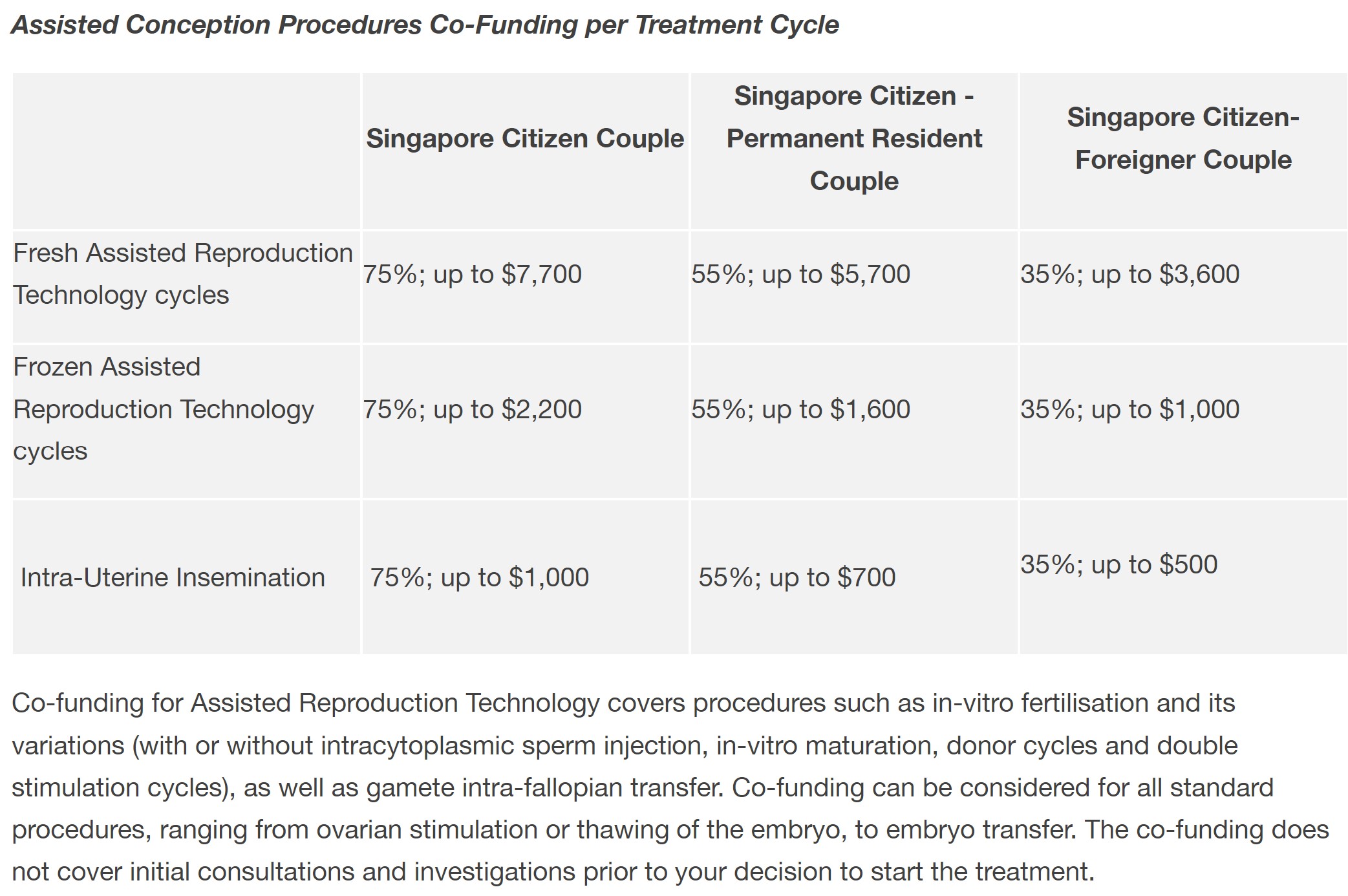
Eligible couples undergoing Assisted Conception Procedures (ACPs) in public Assisted Reproduction (AR) centres can receive up to 75% in co-funding from the Government. The co-funding will cover:
- Intra-Uterine Insemination procedure, for a maximum of three cycles;
- Assisted Reproduction Technology treatment, up to three fresh and three frozen Assisted Reproduction Technology cycles
- If you are 40 years old and above, up to two out of six Assisted Reproduction Technology cycles can be co-funded, provided you have attempted the treatment or an Intra-Uterine Insemination procedure before age 40
However, do note that while elective (or social) egg freezing will be allowed in 2023, there is no government support in terms of MediSave usage or co-funding given.
Read Also: 9 Ways You Can Use Your MediSave To Pay For Your Healthcare Expenses
Advertiser Message
Thinking Of Switching Brokers Or Consolidating Your Holdings?
Tiger Brokers is currently running a transfer-in campaign where eligible clients can receive an iPhone 17 Pro Max* when they transfer in their assets.
For SGX investors, there is also a CDP Transfer promotion with 0* commissions on Singapore stocks.
Find out more here. *T&Cs apply.




Street Smart
Singapore Gym Membership Price Guide (2026 Edition)


