
After home loan rates in Singapore peaked in 2023, with some packages hovering around 4.0%, homeowners can now breathe a sigh of relief. Since 2024, mortgage rates have fallen steadily, with banks in Singapore now offering home loan packages around 1.40%. If you have an existing home loan and are paying more than 1.5%, now may be the right time to refinance.
Refinancing In Singapore
Refinancing is the process of moving your existing home loan to another bank. Refinancing often gives you access to the lowest available home loan rates, since banks are keen to attract new customers.
Most home loan packages in Singapore offer relatively low interest rates for the first 3 years, followed by a substantial jump from the 4th year onward. This applies whether the packages are fixed or floating. Refinancing gives you the opportunity to move away from your existing home loan package, which may be charging you higher monthly repayment amounts due to a higher interest rate, therefore saving you money in the long term.
If you choose to switch your home loan package to a new loan within the same bank, the process is called repricing.
Read Also: Refinancing VS Repricing Your Home Loan: What Are The Differences?
Mortgage Rates Are Falling
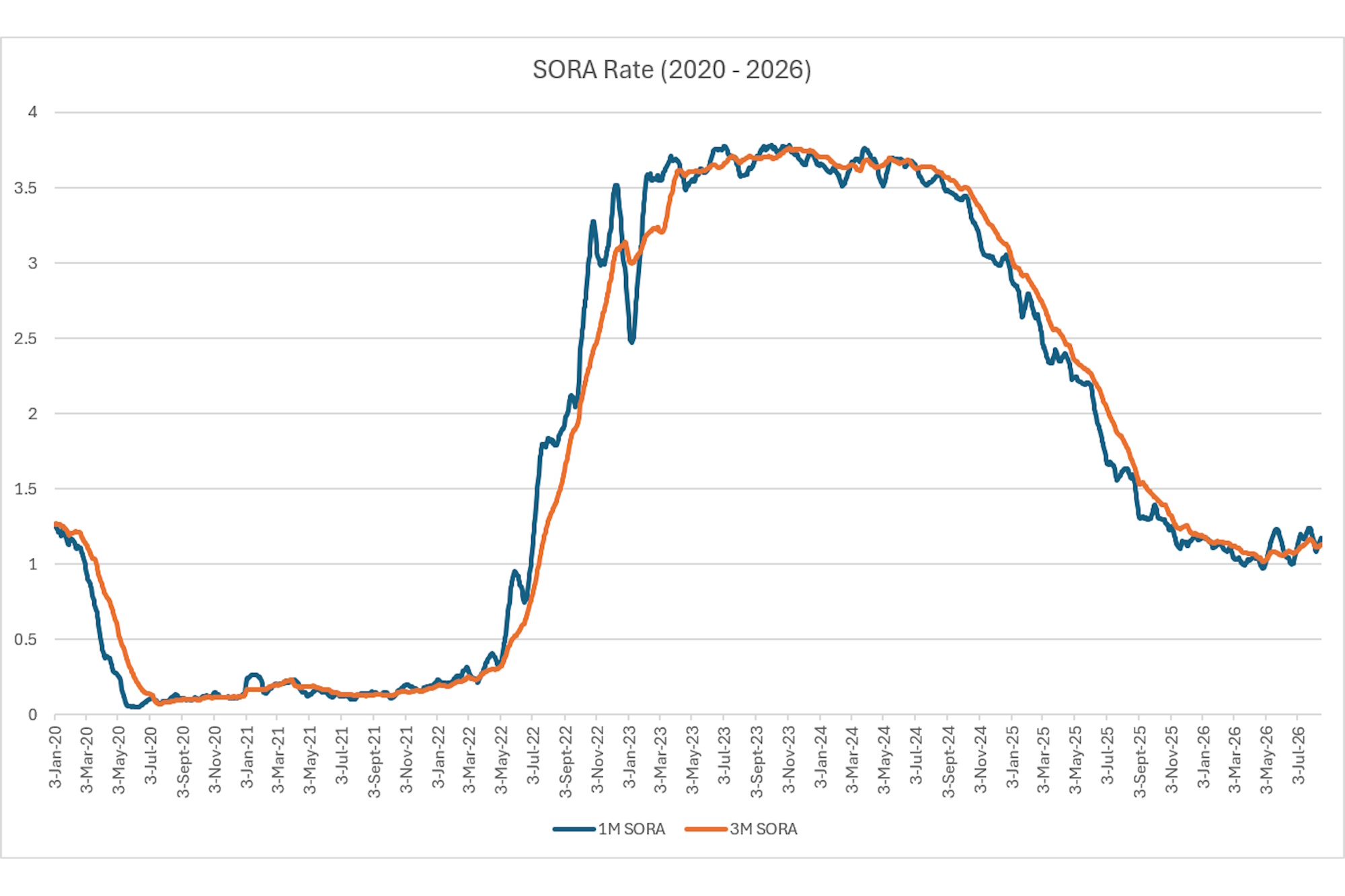
Since peaking in late 2023, three‑month compounded SORA (3M SORA) has been dropping steadily for over two years, falling below 3.0% in January 2025, below 2.0% in July 2025 and reaching a low of 1.02% in April 2026. It is currently at 1.13%. One-month compounded SORA (1M SORA) follows the same trajectory. 3M SORA and 1M SORA are the two financial benchmarks for home loans in Singapore.
Data Source: MAS
3M SORA and 1M SORA are published daily by the Monetary Authority of Singapore. This makes home loan rates based on SORA the most transparent and fairest option. Such home loan rates pegged to either of these benchmarks are often displayed as 3M SORA + X% or 1M SORA + X%. This X% refers to the bank spread. Think of it as a surcharge the bank can set.
Since 3M SORA and 1M SORA are the same regardless of which bank you get your home loan from, banks will need to compete by adjusting their spread. The spread can therefore change each year of your home loan, depending on the package you sign up for. Currently, banks are typically offering a spread of 0.25% for the first two years.
Floating Vs Fixed
Mortgage loan packages often come in two forms: fixed rate home loan packages or floating rate home loan packages. The name explains the difference: fixed rate packages offer a single rate for a number of years, so you pay the same amount each month.
Fixed loans lock in your interest rate for a defined period of one to five years, with one and two years being the most common fixed-rate terms today, due to the low interest rate environment. Because the interest rate is fixed, your monthly instalments remain constant, regardless of market fluctuations. However, the home loan will eventually transform into a floating rate loan.
Floating rate loans change periodically, typically every one to three months, depending on the benchmark rate, 1M SORA and 3M SORA, respectively. That means your monthly instalment will likely change every few months, depending on market fluctuations.
Typically, in a falling interest rate environment, like the one we are currently in, the common wisdom is to refinance to a floating rate package, as you will save more when rates fall. Of course, the decision is ultimately up to you, depending on your current financial situation and other factors including whether you plan to sell your current property in the near future.
Read Also: Floating Vs Fixed Loans: Pros and Cons Of Either Option
The “Best Time” To Refinance Is Usually Now
Even though mortgage rates are currently falling, this doesn’t mean that you should wait till rates bottom out before you consider refinancing.
First, since refinancing takes about 8 to 13 weeks to process, start comparing options three to six months before your lock-in ends.
Second, as mentioned earlier, floating mortgage rates are made up of two components: the SORA benchmark, and the bank spread. Historically, when the benchmark is low, the bank spread tends to rise – banks typically want to keep rates around the 1.5% mark. While bank spreads are currently low at about 0.25%, there’s no guarantee that they will continue to remain low if rates continue to fall.
Consider Asking A Mortgage Broker For Advice
With mortgage rates currently low, homeowners should definitely consider refinancing or repricing their home loan to lower their monthly repayments. Ultimately, the decision to adjust your home loan is highly personal, but you don’t have to make it alone.
Mortgage brokers in Singapore offer their time and advice to help you make the decision that is right for your individual needs. Since they are often paid the same commission rates by the banks they refer you to, they offer their services to you for free. Consider our friends over at RedBrick and Cashew.
If you prefer a DIY approach, Cashew offers a user-friendly platform to compare packages across banks based on your loan inputs. Additionally, Cashew’s advisors also assist you in applying for the preferred loan package, all from the comfort of your home.
Alternatively, RedBrick offers a more personalised experience, with its professional mortgage brokers sharing insights into the nuances of each loan package during a free, non-obligatory consultation. Check out our home loan guide for more information.
This article contains affiliate links. DollarsAndSense may receive a share of the revenue from your sign-ups. You can refer to our editorial policy here.


Lifestyle
15 Of The Cheapest EV Cars In Singapore


Budgeting 101
7 Ways Being Frugal Is Different From Being Cheap


Street Smart
Singapore Gym Membership Price Guide (2026 Edition)
Street Smart
Singapore Gym Membership Price Guide (2026 Edition)


