

I walked in bracing for the worst. I left with a to-do list instead.
SuperAI is Asia’s largest artificial intelligence (AI) event, and its third edition was held on 10 and 11 June 2026 at Marina Bay Sands. This year’s edition sold out, drawing around 10,000 attendees, more than 1,500 AI companies and over 150 speakers, and anchored Singapore AI Week.
DollarsAndSense was a media partner, and I attended as a Gen Z writer with a media pass and, I will admit, a healthy dose of scepticism. I walked onto the show floor carrying one question: should people my age actually be afraid of this technology? Two days later, I had a very different answer from the one I came in with.
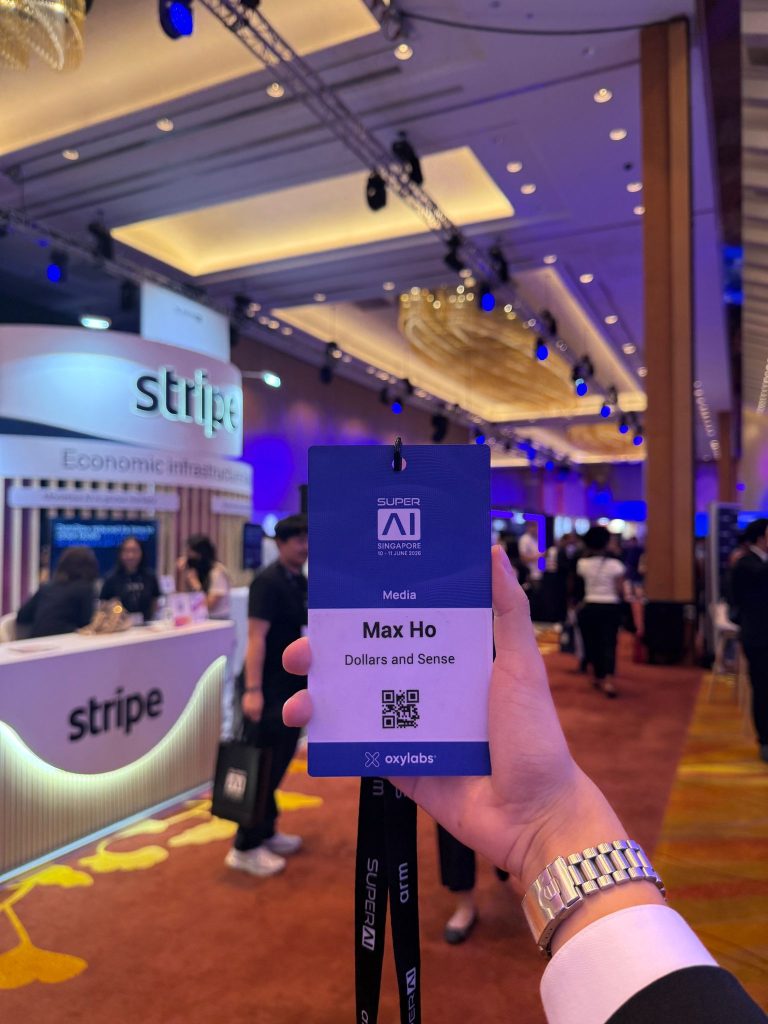
Collecting my media pass at SuperAI 2026, held at Marina Bay Sands
Read Also: AI Is Changing Work, Business And Investing. Here’s Why SuperAI 2026 Is Worth Watching
Why My Generation Is So Nervous About AI
Let me be honest about where my generation stands first. Overseas, graduation ceremonies this year became a flashpoint: when speakers raised AI, students booed. At the University of Arizona, former Google CEO Eric Schmidt was booed simply for saying AI “will touch every profession, every classroom, every hospital, every laboratory.”
We did not have those exact scenes at our local graduations, but the anxiety underneath them is one my friends and I know well. We are the cohort applying for precisely the entry-level jobs AI is supposed to be wiping out, and that worry sits beneath almost every career conversation we have.
That was the baggage I carried onto the floor. And to be fair to the cynics, the first half hour did little to lift it. The big, glossy stands were wall-to-wall enterprise cloud software, relentlessly B2B and, frankly, a little sleepy. The stuff that actually made me think took some hunting.
Losing To A Chess Robot Was The Best Possible Start
The first exhibit to stop me was SenseRobot, a chess-playing robot with a screen for a face and a mechanical arm that lifts and places pieces with surprising delicacy. What struck me was not its chess strength. It was the queue of grown adults cheerfully lining up to lose, and the little smile the robot pulled whenever it had someone cornered.
Nobody in that queue looked threatened. It was my first clue that meeting AI in person feels nothing like meeting it online, where the loudest voices are usually the most fearful.
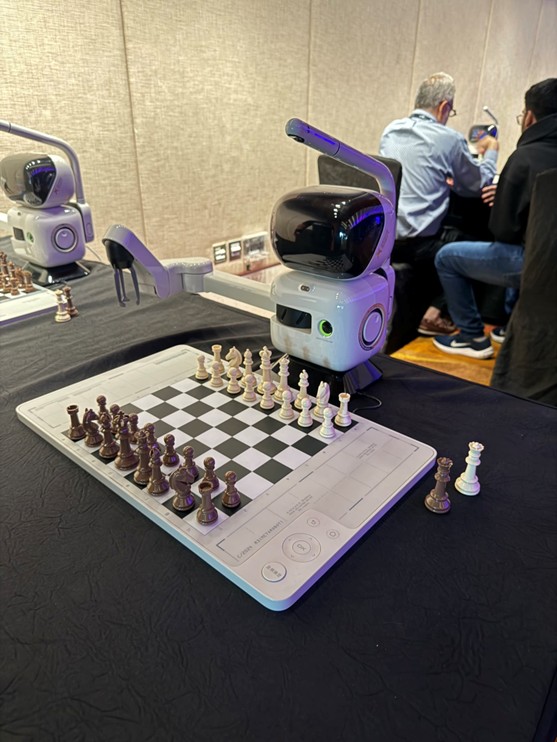
SenseRobot calmly dismantling another challenger, a returning favourite from last year
The Conversation That Changed My Mind: The Notion Booth
The conversation that really shifted me happened at the booth of Notion, the productivity app that now calls itself “the AI workspace that helps teams, humans and agents work together”.
I asked what their AI actually does for a student like me. The answer was instantly practical: it transcribes lectures and tutorials, then pulls from those notes when you study. One subscription also covers multiple AI models, including ChatGPT, Claude and Gemini, so, as the rep put it, “you’re not locked in”.
Then we got onto work, and this is where my assumptions cracked. Notion now lets companies build their own AI agents in plain English, no coding required, to handle routine tasks. It even lets external agents work inside a page alongside human colleagues. So I asked the obvious Gen Z question: if agents do all this, what is left for someone like me? The busy work goes to the agents, the rep explained, so humans can focus on “strategy, creativity, and problem solving”. The bet is not that AI replaces the junior hire. It is that the junior role changes, away from the grunt work that used to fill a graduate’s first two years.
I heard the same logic at Heidi, an “AI care partner” that takes over a doctor’s paperwork without touching clinical judgement. The machine absorbs the admin. The human keeps the part that needs a human.
Notion’s booth, where the company now bills itself as an AI workspace for humans and agents alike
“You Cannot Fire Your AI”
Later, I fell into conversation with a software engineer working in AI. He had nothing to sell me and no stage to perform on, which is probably why he gave me the most honest answers of the event.
When I asked whether AI would take the jobs my friends are chasing, he refused to predict. He gave me a principle instead: you cannot fire your AI. In any serious workflow, someone has to answer for the output. “The same way you need a lawyer to sign off,” he said, “because if anything goes wrong, you fire your lawyer. AI cannot be that person.” A human has to stay in the loop to check the work, catch the mistakes, and carry the blame.
Then he said something I did not expect from someone who builds this for a living: “At the end of the day, I trust a human more than I trust AI.” His advice was bracingly free of hype. Do not bet on predictions. Test the tools yourself rather than trusting influencers who “make claims that they have not actually tested”. And do not wait for the perfect plan: “Don’t try to get a comprehensive master plan. Just start using it.”

Conversations kept circling one question: who answers when an AI workflow goes wrong?
But Let’s Be Honest About The Risk
I do not want to oversell my change of heart. The fear my generation feels is not irrational. Some entry-level work genuinely is being automated, and “your job will be rewritten, not removed” is cold comfort when you are firing off applications and hearing nothing back.
What changed for me was not deciding that the risk was fake. It is that the risk turned out to be specific. And a specific risk is something you can prepare for, in a way that vague dread never is. The main stage reinforced that shift, where MIT professor Max Tegmark spoke on how to build a pro-human future with AI, not on whether humans still have one. The serious people here are not debating whether humans stay in the picture. They are debating how to redesign work so machines carry the repetitive load while people do the judging, creating and deciding.
What I’d Tell Other Gen Z Graduates
I came expecting my fears confirmed. What I found was more useful than fear.
The entry-level job is not vanishing so much as being rewritten. The formatting, the data-pulling, and the minute-taking that filled our seniors’ first two years are heading to the machines. What replaces it starts higher up: supervising AI output, asking sharper questions, being the human who signs off. Those are skills, and skills can be learned, which means whoever learns them first gets the edge.
So whether you are a student picking a course, a fresh grad dreading the job hunt, or someone avoiding AI out of unease, my honest advice after two days up close is simple: stop reading about it and start using it. The future looks far less frightening in person than it does in a headline.
Read Also: AI: The Quiet Job Threat No One Wants To Talk About



Street Smart
Singapore Gym Membership Price Guide (2026 Edition)


