

According to the Ministry of Education (MOE), about 98% of Primary One students are posted to a school of their choice, or within 2km of their homes, with a minority using school bus services to commute to and from school.
For parents who rely on school bus service to ferry their children between home and school, school bus fares are an additional cost. And with the cost of transport operations increasing due to higher manpower and fuel costs, as well as higher COE prices, MOE recently announced that it would allow current school bus operators to increase their prices by up to 13% in 2024.
But how exactly do primary school bus operators operate? And how much are they allowed to charge for bus fare?
School Bus Operators Have To Tender For Each Primary School
The first thing to know is that every school bus operator providing transport services at a primary school must follow a tendering process to win its contract. As explained by MOE, schools appoint bus operators through an open and competitive bidding process based on quality and bus fares for various route distances. This also means there is no uniform fixed fare among schools.
Fare prices are based on a cap, which means that the operators, if they win the contract, are contractually obliged to provide service to students in the primary school at a fare that does not exceed what they state. They can, of course, charge a lower price if they want.
Once the school bus operator wins a contract, the contract period typically lasts 4 years.
School Bus Fares Depend On Various Factors
As schools would appoint their own operators based on the tender received, there is no fixed price for primary school bus fares across different schools. MOE also explains that fares proposed by bus operators would take into account specific operating conditions, such as route distance, bus capacity, and the number of students along the route.
For example, a Straits Times article reported that bus fares for Pathlight School will increase by 40-50 per cent from January 2026. And while the new monthly fares for students at Pathlight School (Ang Mo Kio Campus 2) seem high, as they range from $179 for a one-way trip within 2km of the school to $592 for a two-way trip over 20.01km away, the requirements for the bus, given that it serves students with specific and higher needs, may also be a contributing factor.
Charges for smaller buses, which likely would serve less popular routes, would be generally higher, as students enjoy more benefits such as mandatory seat belt installation, one-to-one seating, easier access to pick-up points, and shorter journey times. Also, the number of students a small bus can take is much fewer than that of a big bus, so there is less economies of scale.
Parents can opt for 1-way or 2-way services. Based on online research, while some bus operators charge a slightly lower price for 1-way service, others may charge the same amount regardless of whether you opt for 1-way or 2-way transport.

Example of school bus fare
For lower-income families, as part of the MOE Financial Assistance Scheme (MOE FAS), 65% of school bus fares per year for primary school students who take school bus would be covered by the scheme.
Bus Operators Are Contractually Required To Transport Students Within 6km Of Their School
When tendering for the school bus contract, operators are contractually required to transport students who live up to 6km from their schools, regardless of the demand for the route. This is when they would have to state in their tender documents the maximum fares they would charge based on the various distances.
Example of school bus fare up to 6km

Do note that for contracts commencing in 2024 onwards, bus operators will only be contractually required to transport students living within 4km of their school, down from the current 6km. So this means that moving forward, once the current bus contracts are renewed, we may see operators no longer providing bus service beyond 4km of the school.
Example of school bus fare up to 4km
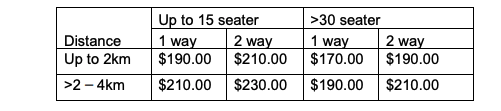
Students who live farther away can still request that the bus operator provide service. For such cases, bus operators can consider the request on a best-effort basis, at a negotiated price. They are not contractually obliged to provide the service.
MOE Do Allow Bus Operators To Increase Their Fares
To address cost increases during contract periods, MOE allows school bus operators to raise the pricing cap for school bus fares under existing contracts.
For example, in January 2023, MOE adjusted the pricing cap for existing contracts by 7%. From January 2024, school bus operators under existing contracts can increase their prices by up to 13%. According to MOE, these adjustments will significantly minimise the risk of disruptions and inconvenience to families should these incumbent operators be unable to sustain their operations.
It’s important to note that parents do not have to automatically pay or accept any of these fare increments. If parents find the revised fare from the bus operators too high, they can choose not to continue with the school bus service. Likewise, bus operators have to also consider whether an increase in price could reduce the demand for their bus service and hence revenue.
Read Also: HDB Property Prices Near Popular Primary Schools: Do They Really Cost More?


Budgeting 101
7 Ways Being Frugal Is Different From Being Cheap


Street Smart
Singapore Gym Membership Price Guide (2026 Edition)


Street Smart
Singapore Gym Membership Price Guide (2026 Edition)


