

To encourage the adoption of electric cars in Singapore, the Singapore government announced that as part of the Singapore Green Plan, every HDB town will be an EV-ready town by 2025. To support this transition, around 60,000 EV charging points are expected to be installed in Singapore by 2030.
On the flip side, the government also announced an increase in petrol duty that would make it more expensive to continue driving cars that run on gasoline (which will affect most cars in Singapore). Also, from 2025 onwards, new diesel cars and taxis will not be allowed to register in Singapore. All these are clear indications that cars of the future, in Singapore at least, are likely to be powered by electricity.
In this article, we will provide a breakdown of how much you can expect to spend if you wish to buy and own an electric car in Singapore.
Types Of Electric Cars In Singapore
First, it’s worth noting that there are three main types of electric cars that you can find in Singapore.
Battery Electric Vehicles (BEVs): These are cars that are fully powered by electricity only. They do not have an internal combustion engine and use no fuel, so there is no option to run them via gasoline. Most of these cars are also capable of both direct current (DC) fast-charge and the slower alternating current (AC) charge.
Examples of BEVs include the Audi Q4 e-tron Electric (about $302,000) and Tesla Model 3 (about $199,000). More affordable options include the MG 4 EV (about $159,000) and the BYD Atto 3 Electric ($178,000).
Plug-in Hybrid Electric Vehicles (PHEVs: These are cars that can run on both electricity and petrol. PHEVs can run on electricity for some distance being switching to gasoline when the electric battery is depleted. In some sense, they offer the best of both worlds. You can charge it at an EV charging point and yet, have the option of using gasoline as well to give you additional mileage without being worried about having to find a charging point.
Examples of PHEVs in Singapore include the BYD Sealion 6 Plug-in Hybrid (about $226,000), Mazda CX-80 Plug-in Hybrid (about $360,000) and the Volvo XC60 Plug-in Hybrid (about $373,000).
Hybrid Electric Vehicles (HEVs): While they have both an internal combustion engine and an electric motor, HEVs cannot be plug-in to charge the car. Rather, the battery is charged through regenerative braking. The result is that it gives you better fuel efficiency. If you don’t have regular access to a charging point, it might be better to consider a HEV.
Many popular car models today are HEVs such as the Kia Niro Hybrid (about $179,000) and the Toyota Prius Hybrid (about $195,000).
Prices Of Electric Cars In Singapore
When it comes to PHEVs and HEVs, there are many models available in Singapore. However, battery-only powered electric cars are still less common in Singapore though more cars. Here are some fully-electric car models that you can buy in Singapore.
All prices and information below are as found from SgCarMart or as reported by the manufacturers. COE prices as of the point of writing are $109,000 (Cat A) and $129,890 (Cat B).
| Car Model | Price (inclusive of COE) | Maximum Range |
| Audi Q4 e-tron Electric | $302,000 | 466 km |
| BYD Atto 3 Electric | $178,000 | 420 km |
| Hyundai Ioniq 5 Electric | $226,000 | 384 km |
| Kia Niro Plus Electric | $188,000 | 400 km |
| MG 4 EV | $159,000 | 450 km |
| Mazda MX-30 Electric | $175,000 | 224 km |
| Nissan Leaf | $186,800 | 311 km |
| Polestar 2 Electric | $245,000 | 568 km |
| Tesla Model 3 RWD110 | $199,000 | 520 km |
| Volvo EX30 Electric | $223,000 | 337 km |
Read Also: 5 Cheapest Electric Cars In Singapore
What Rebates Do I Get If I Buy A Fully Electric Car In Singapore Today?
To encourage the early adoption of fully-electric cars in Singapore, the government has introduced the EV Early Adoption Incentive (EEAI).
From 1 January 2024 to 31 December 2025, electric cars registered in Singapore will receive a rebate of 45% off their Additional Registration Fee (ARF). This is capped at $15,000, and also subject to a minimum ARF payable of $5,000. This minimum ARF payable of $5,000 will be lowered to $0 for electric cars registered between January 2022 to December 2025.
From 1 January 2026 to 31 December 2026, Electric cars registered in Singapore will receive a rebate of 45% off their Additional Registration Fee (ARF) with a lower revised cap of $7,500.
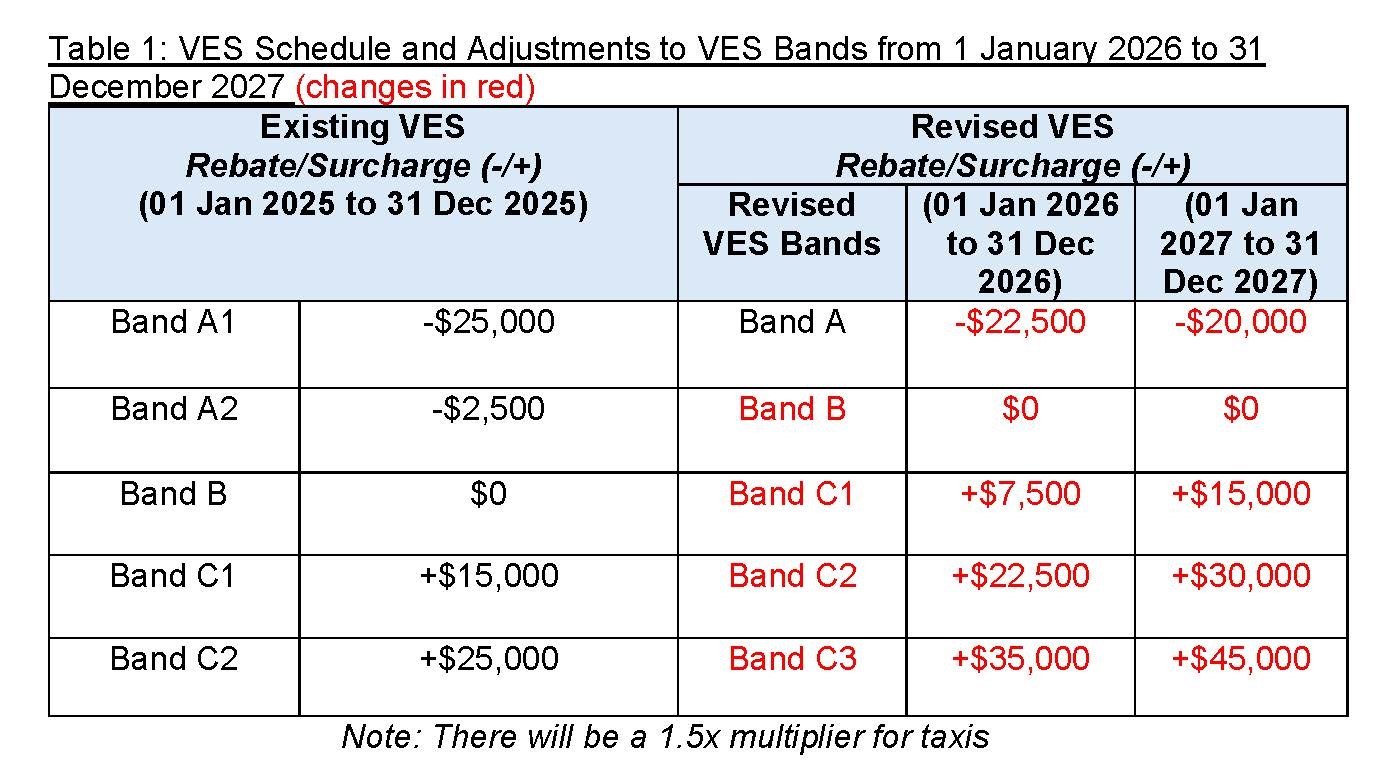
In addition, you also receive the Vehicle Emission Scheme (VES) rebate of up to $25,000 in 2025, $22,500 in 2026 and $20,000 in 2027 if the car qualifies for the highest band of A.
 Source: LTA
In other words, the total rebate for ARF can be as high as $40,000 for electric cars in Singapore if you purchase it by 31 December 2025. In 2026, this will be reduced to a maximum of $30,000.
Read Also: Guide To Understanding Vehicle Emissions Scheme (VES) In Singapore
Road Tax Cost For Electric Cars
If you are buying an electric car, the road tax schedule is different from regular cars. Here’s how it’s calculated.

Source: OneMotoring
There is also an additional tax of $700/year for fully electric cars, since fully electric cars do not pay fuel excise duties.
For example, a Tesla Model 3 that has a power rating of 110 kW will incur 6-month road tax of $430 [$250 + $3.75 (110-30)] X 0.782], or $861 a year. After adding the additional road tax of $700, the annual road tax for the car is $$1,561.
Charging Points Access And Price
While the annual road tax that you pay is higher, you will also save on fuel costs. But how much exactly can you expect to save?
To make a fair comparison, we decided to compare the Hyundai Kona Electric with the Hyundai Kona Hybrid. We assume a monthly usage of 1,000 km, which means you drive about 33 km on average each day.
| Energy Usage | Electricity Tariff: | Cost per 100 km | |
| Hyundai Kona Electric | 13.8 kWh/100km | 30.03 cents/ kWH | $4.14 |
| Fuel Consumption | Petrol Price | Cost per 100 km | |
| Hyundai Kona Hybrid | 21.3km/L | $2.88/l | $13.52 |
From the table above, we can expect to save about $93.80 each month, assuming a mileage of 1,000 km. This translates to savings of about $1,125.60 each year.
Do note that the figures above are based on the assumption that you have access to your own charging station at home or in the office. If you intend to charge at an external EV charging point such as Shell Recharge & SP Mobility, the cost will likely be higher. So how much you end up saving will ultimately depend on 1) where you charge and how much you pay for electricity as well as 2) how often you drive.
Advertiser Message
Thinking Of Switching Brokers Or Consolidating Your Holdings?
Tiger Brokers is currently running a transfer-in campaign where eligible clients can receive an iPhone 17 Pro Max* when they transfer in their assets.
For SGX investors, there is also a CDP Transfer promotion with 0* commissions on Singapore stocks.
Find out more here. *T&Cs apply.




Street Smart
Singapore Gym Membership Price Guide (2026 Edition)


