

It’s no secret that Artificial Intelligence (AI) is disrupting all sorts of industries and is displacing workers in the process. That requires a forceful policy response from governments worldwide to ensure workers remain relevant in the age of AI. Indeed, Singapore has been doubling down on this front. Its AI initiatives, unveiled by Prime Minister Lawrence Wong in Budget 2026, make that crystal clear.
PM Wong’s Budget statement outlined a comprehensive AI strategy that touches everything from tax breaks for businesses to free premium AI tools for individuals looking to upskill. If you’ve been wondering how AI might affect your career or your business, Budget 2026 has some answers.
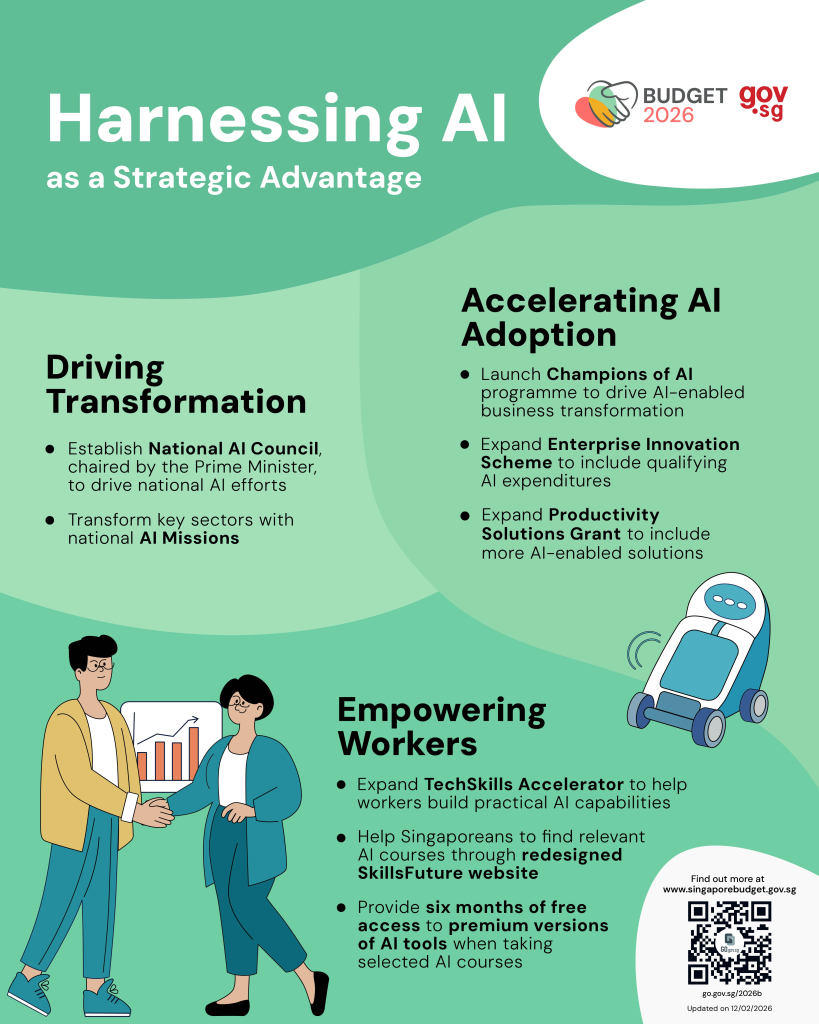
National AI Council To Lead The Charge
The Singapore government announced in Budget 2026 that it’s setting up a National AI Council, chaired by PM Wong himself. It’ll be an inter-ministerial body tasked with providing strategic direction for Singapore’s entire AI agenda.
The council includes heavy hitters Deputy PM Gan Kim Yong and Health Minister Ong Ye Kung, as well as several other ministers. This is the clearest sign that AI is being taken seriously in Singapore. Their job will be to oversee Singapore’s National AI Missions in four key sectors: advanced manufacturing, connectivity, finance, and healthcare. Think of it as the government’s very own strategic task force to tackle how AI is deployed throughout Singapore’s economy.
These aren’t vague aspirations either. The council will commission specific AI projects in priority sectors and unlock regulations and resources to accelerate both the development and deployment of AI solutions. It’s the Singapore government’s way of ensuring AI adoption happens systematically, not haphazardly.
Source: Singapore Budget
Tax Breaks For AI-Friendly Businesses
Here’s where things get more financially interesting, at least for businesses, in terms of the potential tax breaks. The Enterprise Innovation Scheme (EIS), administered by the Internal Revenue Authority of Singapore (IRAS), is getting enhanced for Years of Assessment 2027 and 2028.
Currently, businesses can claim 400% tax deductions on qualifying expenditure for activities like Research and Development (R&D), intellectual property registration, and training courses. The expenditure cap for most qualifying activities is $400,000 per year. The new enhancement adds a specific category for qualifying AI expenditures. Businesses can claim 400% tax deductions on up to $50,000 of AI-related spending per year. That’s a potential $200,000 in tax deductions annually if you max out the limit.
There’s a catch though. Unlike other EIS categories, you can’t convert this AI expenditure into a direct cash payout. Still, for profitable businesses looking to invest in AI tools, software, or implementation, this makes the financial equation that much more attractive. IRAS will provide more details by mid-2026. If you’re running a business considering AI adoption, then this is something to monitor closely.
Free Premium AI Tools For Course Participants
Here’s where the most immediately accessible benefit for individuals lies. If you take selected AI training courses, you’ll get six months of free access to premium versions of AI tools. This is a pretty big deal. Premium subscriptions to AI tools like ChatGPT Plus (or similar services) can cost $20 to $30 per month. Six months of free access could save you $120 to $180, and give you hands-on experience on how best to utilise professional-grade AI tools.
The government is encouraging learning-by-doing with AI. This isn’t just about attending lectures or watching videos. Using AI tools in your work and daily life is arguably the best way to understand their capabilities and limitations. The Ministry of Manpower (MOM) will share more details at the Committee of Supply 2026. These debates on spending plans are set to run from 24 February to 6 March, and include which courses qualify and which AI tools are included in the offer.
Read Also: 5 Ways Artificial Intelligence Can Be Used To Improve Your Job
Expanded Support Through The PSG
The Productivity Solutions Grant (PSG) is also getting an AI makeover. The PSG helps small- and medium-sized enterprises (SMEs) adopt pre-approved IT solutions and equipment to improve productivity and automate processes
PM Wong announced at Budget 2026 that “a wider range of digital and AI-enabled solutions” will be made available, under an expanded PSG. This means subsidising more off-the-shelf AI tools, making it easier and cheaper for businesses to implement. The Ministry of Digital Development and Information (MDDI) will share more details at the Committee of Supply 2026, so businesses will have to wait to see which solutions will make the cut.
“Champions Of AI” Programme For Ambitious Firms
AI is dominating the conversation for both individuals and businesses alike. Some firms aren’t merely satisfied with dipping their toes into AI. Instead, they’re preferring to dive in headfirst. That’s where the “Champions of AI” programme comes in.
This new programme will provide tailored support for firms that have the ambition to use AI to comprehensively transform their businesses. We’re talking about companies like DBS and Grab, which PM Wong specifically namedropped as examples of firms moving decisively on AI transformation.
The idea is that these champion companies will be the benchmarks for their industries and inspire others to follow suit as they adopt AI. Support includes customised enterprise transformation guidance and workforce training. The Ministry of Trade and Industry (MTI) will share more details at the Committee of Supply 2026, but this programme signals that Singapore wants to create AI success stories that others can learn from.
AI Park At One-North And AI Skills Training
There were also some exciting announcements in terms of physical infrastructure related to AI. JTC is establishing an AI park at One-North, the same area that already houses many tech companies and research institutions. This will be a dedicated space for AI startups, researchers, and industry partners to collaborate, test-bed solutions, and scale their innovations.
The goal is to create an ecosystem where AI innovation can flourish. Having everyone in one place makes it easier to form partnerships, share resources, and accelerate development, just like renowned tech clusters like Silicon Valley.
Read Also: 5 Job Trends In 2025 And What They Mean For 2026
The government isn’t just thinking about tech companies and AI developers but also about raising AI literacy and competency across the entire workforce, particularly non-tech workers. They’re expanding the TechSkills Accelerator (TeSA), which helps mid-career workers transition into tech roles. The new focus will be on AI skills training in non-tech, cross-sectoral occupations.
IMDA is also working with professional bodies to develop frameworks that identify key training needs and transform workflows with AI. They’re starting with the accountancy and legal professions, then progressively extending to other fields.
This matters because AI isn’t just changing tech jobs but changing how everything else in the economy works. How accountants crunch numbers, how lawyers research cases, how marketers analyse data, and how virtually every professional does their job. The expanded TeSA recognises that AI literacy needs to be widespread, not just in siloed IT departments.
What This Means For You
Budget 2026’s AI initiatives aren’t abstract policies. They have real-life implications depending on where you sit in Singapore’s economy. If you’re an employee, especially in fields like accounting or law, the expanded TeSA and free premium access to AI tools give you a clear pathway to upskill and adopt AI in your processes. Think of it as “AI won’t directly replace you, but someone who knows how to use AI might.”
If you’re a business owner, the enhanced EIS and expanded PSG make AI adoption financially more attractive. The 400% tax deduction on AI expenditure significantly reduces your effective cost. The PSG expansion means you’ll have access to more pre-approved, subsidised AI solutions without having to figure everything out yourself.
The flurry of AI initiatives announced in Budget 2026 are a tacit recognition by the Singapore Government that AI is here to stay. As a result, Singapore needs to remain one step ahead of the competition if it wants to improve its citizens’ quality of life and remain attractive to international businesses.
Read Also: Singapore Budget 2026: 5 Announcements That Will Benefit Everyday Singaporeans Financially


Budgeting 101
7 Ways Being Frugal Is Different From Being Cheap


Street Smart
Singapore Gym Membership Price Guide (2026 Edition)


Street Smart
Singapore Gym Membership Price Guide (2026 Edition)


