
The annual Singapore Budget is always a closely watched event. Every year, both Singaporeans and businesses tune in to see what support measures and benefits might be coming their way. Often, especially in election years, it delivers, with announcements that help ease costs or strengthen our personal financial footing.
While this year’s Budget may not feel as headline-grabbing as last year’s GE2025/SG60 package, there’s still plenty of good news for everyday Singaporeans delivered by Prime Minister Lawrence Wong.
#1 The Usuals (CDC Vouchers, U-Save, COL Payment)
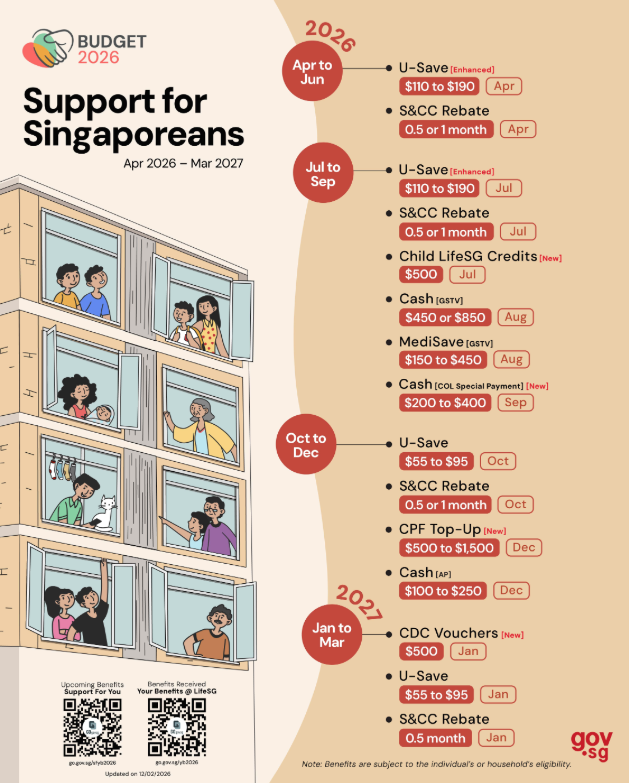
By now, it almost feels like a yearly tradition to receive another tranche of CDC vouchers. For Budget 2026, each Singapore household will receive $500 in CDC vouchers, to be disbursed in January 2027. For those keeping score at home, yes, this is lower than the $800 announced under Budget 2025.
In addition to CDC vouchers, eligible Singaporean households living in HDB flats will receive 1.5 times their regular GST Voucher (GSTV) – U-Save rebates in the 2026 financial year. This provides additional help with utility bills.
Finally, there will be a Cost-of-Living Special Payment of between $200 and $400 in cash for Singaporeans aged 21 and above in 2026. To qualify, individuals must earn up to $100,000 in assessable income and not own more than one property. This payment will be disbursed in September 2026.
#2 Greater Support For Singapore Workers
Support measures for Singapore workers are a regular fixture in every Budget, and this year is no different.
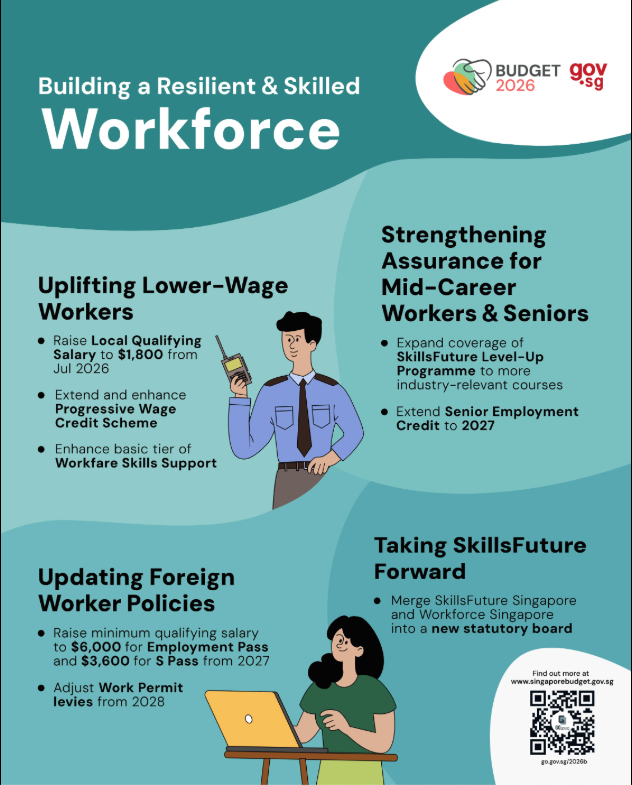
From 1 July 2026, the Local Qualifying Salary (LQS) for full-time employees will be raised from $1,600 to $1,800. For workers currently earning $1,600, this is welcome news. This means employers must pay at least $1,800 per month to continue hiring foreign workers. In short, if companies want access to foreign manpower, they must first meet the higher wage floor for their local employees.
At the same time, hiring foreign workers will become more expensive. The minimum qualifying salaries for Employment Pass and S Pass holders will also be raised, increasing overall manpower costs for businesses.
| Existing | New (From 1 Jan 2027) | |
| Employment Pass | $5,600 | $6,000 |
| Employment Pass (Finance) | $6,200 | $6,600 |
| S Pass | $3,300 | $3,600 |
| S Pass (Finance) | $3,800 | $4,000 |
Work permit levies will also be raised by $100 and $150 for the marine and process sectors, respectively, from 2028.
For SMEs, this will likely mean high cost. Businesses that rely heavily on labour, particularly in sectors such as F&B, retail, and services, may feel the pressure more acutely. Some may have to absorb higher wage costs, pass them on to consumers, or rethink their operations.
#3 More Benefits For Families With Young Children
Introduced in last year’s Budget, the Child LifeSG Credits, disbursed via the LifeSG app, were designed to help parents defray some of the costs of raising a child.
For Budget 2026, each Singaporean child aged 12 and below will continue to receive $500 in Child LifeSG Credits. For example, a family with three children under 12 can expect a total of $1,500. The credits will be paid out in July 2026, while children born in 2026 will receive theirs in April 2027.
Beyond the credits, more families will qualify for additional preschool subsidies as the Government raises the income thresholds under the Infant and Childcare Additional Subsidy Scheme.
The highest gross monthly household income (HHI) threshold will be raised from $12,000 to $15,000. For larger households (with at least five family members), the per capita income (PCI) threshold will increase from $3,000 to $3,400.
There will also be adjustments to the subsidy tiers. For instance, families with an HHI of $8,000 can now receive up to $260 in additional subsidies, up from $190 previously.
#4 More Investment Options For CPF Members Through The Life-Cycle Investment Scheme
First mooted by a CPF Advisory Panel almost 10 years ago, the Life-Cycle Investment Scheme is finally set to be introduced.
Under the Life-Cycle Investment Scheme, CPF members who are willing to take some risk but may lack the expertise to navigate the wide range of CPF Investment Scheme (CPFIS) options, or simply prefer a hands-off approach, can invest through life-cycle investment products instead. The CPF Board will work with two to three commercial product providers to offer curated options, simplifying members’ decision-making.
The new scheme aims to bridge this gap, allowing CPF members to potentially earn higher returns without actively picking and managing investments.
A life-cycle investment approach follows a predefined “glidepath” towards retirement. This means greater exposure to equities when members are younger and have longer investment horizons, and automatic rebalancing toward safer assets as they approach retirement age. In short, the portfolio gradually adjusts over time without requiring members to constantly monitor or rebalance it.
Prime Minister Wong also noted that similar products already exist in the market, but they often come with relatively high fees. Keeping all-in fees low and capping them where possible will therefore be a key focus for the CPF Board as it rolls out this scheme.
#5 ComLink+ Scheme To Be Enhanced
Introduced in 2024 to replace the old ComLink scheme, ComLink+ is designed to encourage and support lower-income families as they work towards longer-term goals such as securing stable employment, enrolling their children in preschool, owning a home and clearing debt.
To strengthen support under ComLink+, families who continue working with their family coaches and take concrete steps toward these goals will receive a new quarterly $500 payout. This consists of $200 in cash and $300 credited to their CPF accounts.
From the third quarter of 2026, changes will also be made to two of the four existing ComLink+ packages. A higher proportion of payouts will be in cash, and intermediate milestones will be introduced so more families can qualify for support along the way, rather than only upon reaching major end goals.
With these enhancements, a ComLink+ family with two preschool children can receive up to $10,200 annually (after CDA matching under the Baby Bonus Scheme). This is an increase over the current structure, under which families receive up to $10,000 in the first year and $8,000 in subsequent years.
Read Also: Singapore Budget 2026: Live Coverage And Real-Time Commentary
Photo Credit: iStock/Jimmyli


