
Prime Minister and Minister for Finance, Lawrence Wong, will deliver the Singapore Budget 2026 Statement in Parliament on Thursday, 12 February 2026, 3.30pm.
Stay tuned to our live coverage, for the latest announcements and updates of Singapore Budget 2026, as it happens. We will also provide real-time commentary on the potential implications that the announcements may have for Singapore and Singaporeans.
This page will be updated periodically as the Budget 2026 statement is delivered.
3:31pm: Prime Minister and Minister for Finance, Lawrence Wong, Parliament delivers Budget Statement 2023 in Parliament.
Securing Our Future Together In A Changed World
3:33pm: PM Wong began by reiterating that we are in a “changed world”, with trade rules being “set aside”, and long-standing norms becoming less reliable. In particular, he noted that the US is re-assessing, and in some areas undoing, “the very system it once helped to build”. This echoes the Ministerial Statement he made last year in Parliament following the US Liberation Day tariffs imposed by President Donald Trump.
3:34pm: Fortunately, with firms adjusting quickly, new trade deals, and shifts in global supply chains, growth in the major economies “held up”. The resilient global economy, combined with Singapore’s economic strength, resulted in “better-than-expected” growth of 5% in 2025. However, “amidst heightened global uncertainties”, a more moderate outlook is expected this year. Mr Wong projected growth in 2026 at 2 to 4%, with inflation expected between 1% and 2%.
Supporting Businesses
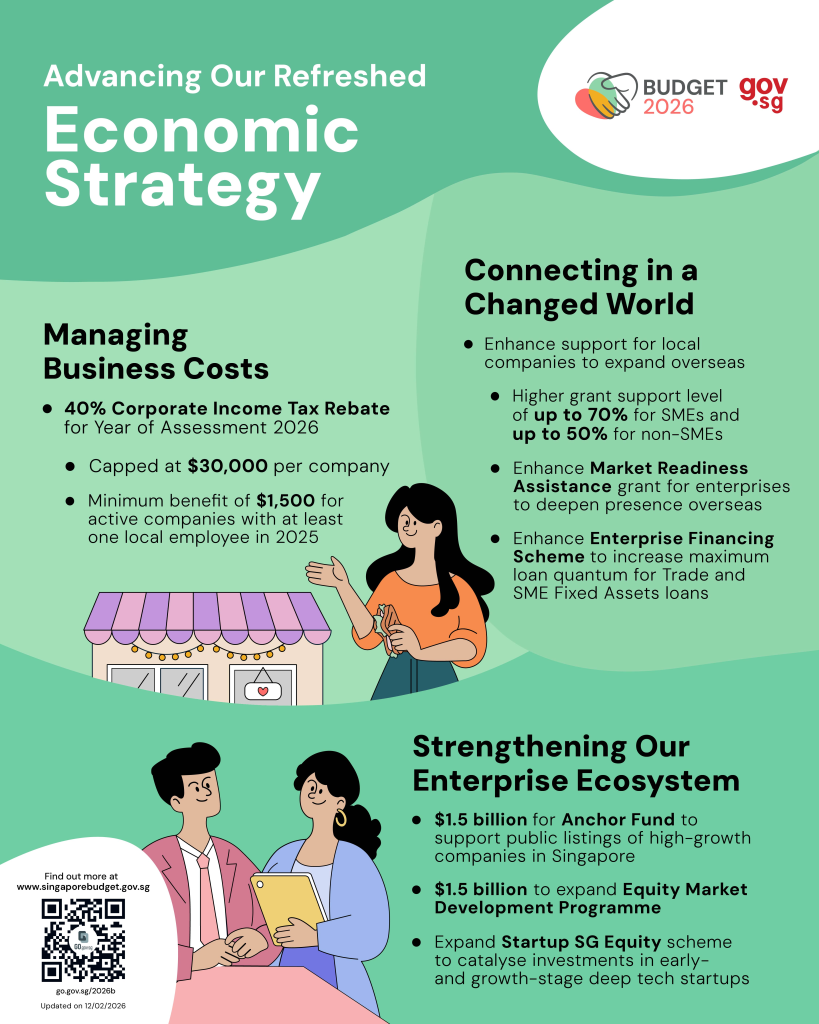
3:36pm: To support businesses and to help them stay competitive, PM Wong announced a 40% Corporate Income Tax rebate for Year of Assessment 2026. This means that every active company that employed at least one local employee in 2025 will receive a minimum rebate of $1,500. The total benefit for each company will be capped at $30,000.
3:43pm: Mr Wong said that for Singapore to prosper, we need to remain connected to the world. The government will therefore do more to support companies with overseas expansions, enhancing the support levels of existing grant schemes by up to 70% for Small and Medium Enterprises, and up to 50% for non-SMEs.
3:44pm: Under the Double Tax Deduction for Internationalisation scheme, companies currently qualify for an automatic 200% tax deduction for selected activities. They will now benefit from a higher cap, from $150,000 to $400,000, and more qualifying activities will be eligible for tax deduction claims.
3:49pm: PM Wong said Singapore has had success with its long-term investments in semiconductor research and development over the past two decades. Recognising similar patterns in the aerospace and biomedical industries, $37 billion will be invested under the Research, Innovation and Enterprise (RIE2030) plan. This amounts to about 1% of GDP and reflects Singapore’s sustained commitment to research. The government will also set aside $1 billion to enhance the Startup SG Equity scheme, which will also be expanded to cover growth-stage companies.
New National Artificial Intelligence Missions
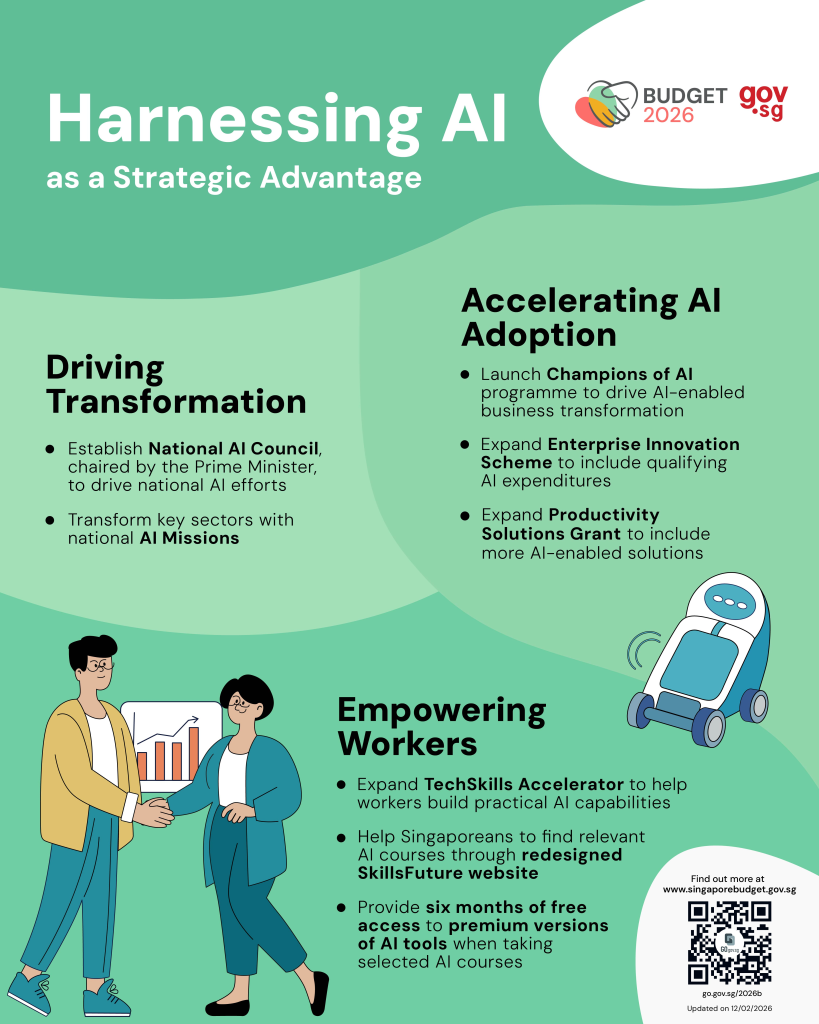
3:55pm: PM Wong said that to fully realise AI’s potential, Singapore needs to organise at the national level and “move with speed and scale”. He launched a new set of “national AI missions”, which will drive AI-led transformation with a focus in four sectors: Advanced Manufacturing, Connectivity and Logistics, Finance, and Healthcare. A new National AI Council will also be established, with PM Lawrence Wong as the chair, to “provide strategic direction and drive Singapore’s AI agenda”.
3:57pm: To support businesses with the AI transition, the Enterprise Innovation Scheme (EIS) will be expanded to include AI expenditure as a qualifying activity. The EIS provides businesses with 400% tax deductions on expenditure for qualifying activities. This will apply to Years of Assessment 2027 and 2028, with a $50,000 cap per year.
4:04pm: To encourage all Singaporeans to learn AI-related skills on their own, the SkillsFuture website will be redesigned to make AI learning easier to access. Singaporeans will also get six months of free access to premium AI tools. These are to be used when taking up selected AI training courses. This initiative will be further elaborated by the Ministry of Digital Development and Information, Ministry of Education, Ministry of Manpower, and Ministry of Trade and Industry.
More Support For Workers
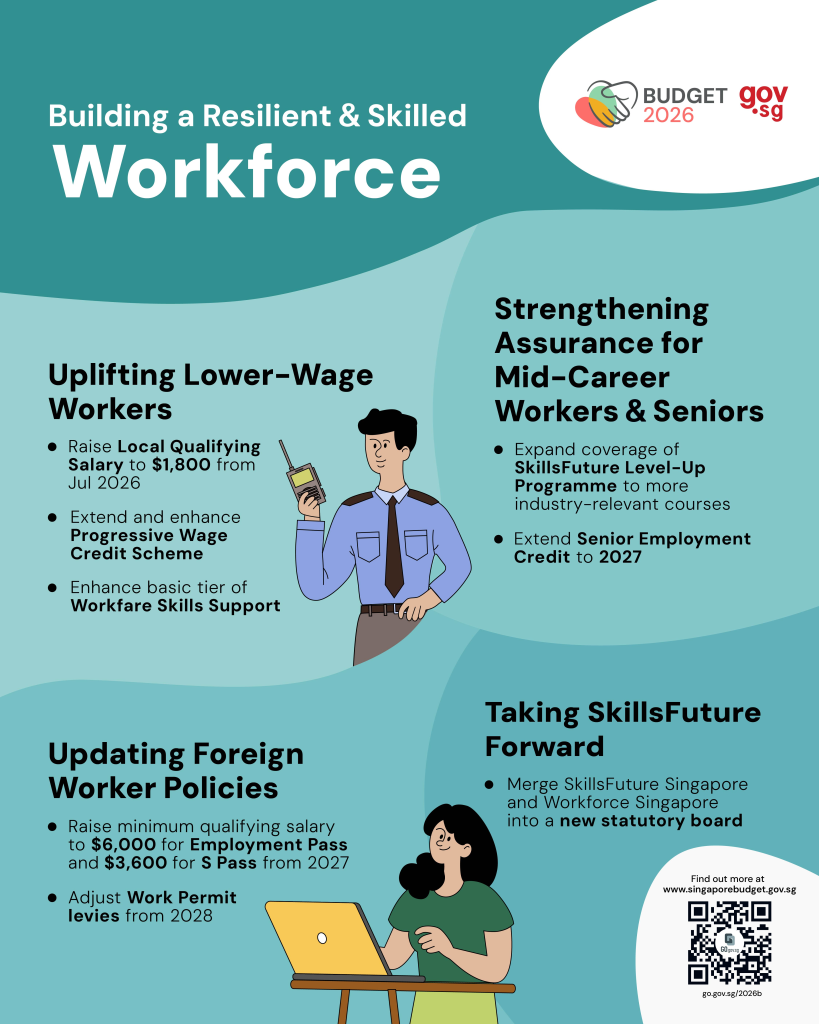
4:07pm: To strengthen support for lower-wage workers, the Local Qualifying Salary (LQS) will be raised from $1,600 to $1,800 in 2026. This is the minimum salary that local employees must be paid in firms that hire foreign workers. To help businesses defray this cost, the Progressive Wage Credit Scheme (PWCS) co-funding support will be increased from 20% to 30% and extended by two more years to 2028. Furthermore, the minimum wage increase required to qualify for PWCS support will rise from $100 to $200 from 2027.
4:11pm: SkillsFuture Singapore and Workforce Singapore (WSG) will be merged into a new statutory board. Over the years, said PM Wong, the two agencies have coordinated, but “stronger alignment is needed”. The new agency will therefore be a “one-stop shop for skills training, career guidance, and job matching services.”
4:14pm: The Senior Employment Credit scheme will be extended to end-2027. This helps defray wage costs for employing Singaporeans aged 60 and above, earning $4,000 or more a month.
4:15pm: From 2027, Employment Pass (EP) minimum qualifying salary will be raised from $5,600 to $6,000. The minimum qualifying salary for EPs in the financial services sector will be raised from $6,200 to $6,600. This change will apply to all new EP applications, while the renewal applications will only be affected in 2028. This is so that businesses that already hire workers with EPs will have more time to adjust.
4:16pm: The minimum qualifying salary for new S-Pass applicants will likewise increase, from $3,300 to $3,600. The financial services sector will see the minimum qualifying salary for S-Passes rise from $3,800 to $4,000. Like EP renewal applications, S-Pass renewal applications will only apply in 2028.
More Support For Families
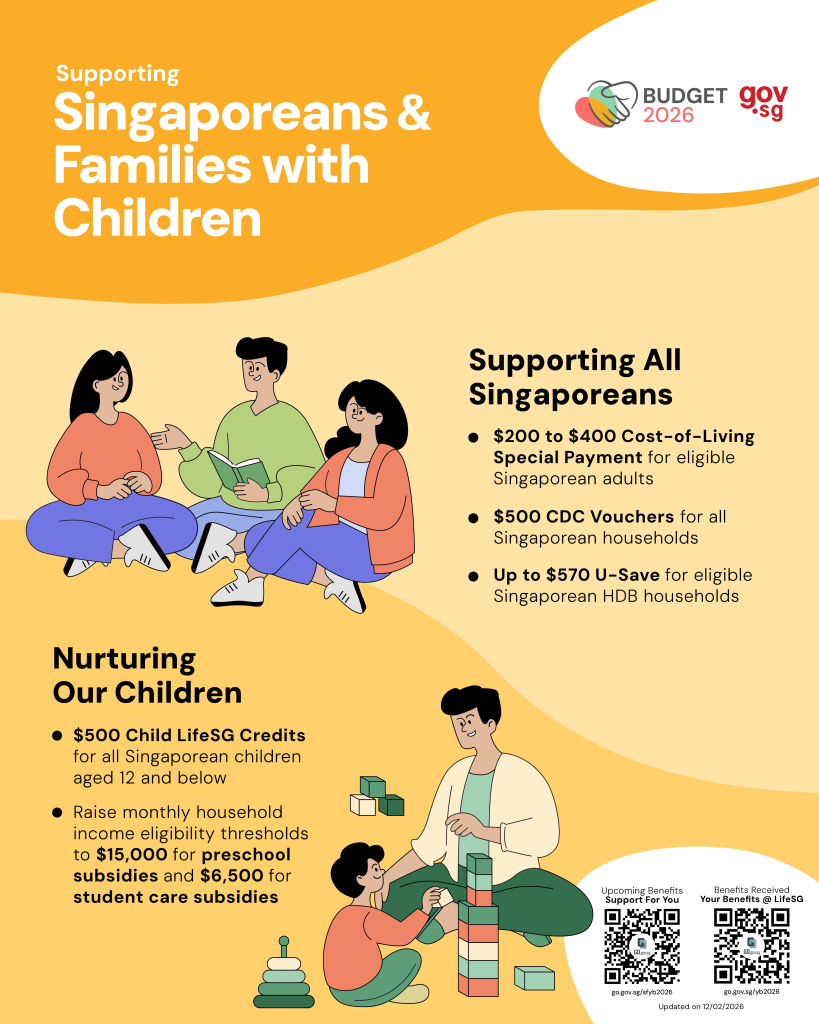
4:19pm: Recognising that families are “the bedrock of society and the first line of support” for every Singaporean, PM Wong said this Budget will give families more support and greater assurance. Families with Singaporean children aged 12 and under will receive an additional $500 in Child LifeSG credits. This follows the $500 Child LifeSG credits announced at last year’s Budget.
4:20pm: Means-tested preschool subsidies will also be extended to more families, with the monthly household income threshold raised from $12,000 to $15,000. According to PM Wong, this will benefit more than 60,000 families. It was previously raised from $7,500 to $12,000 in 2020.
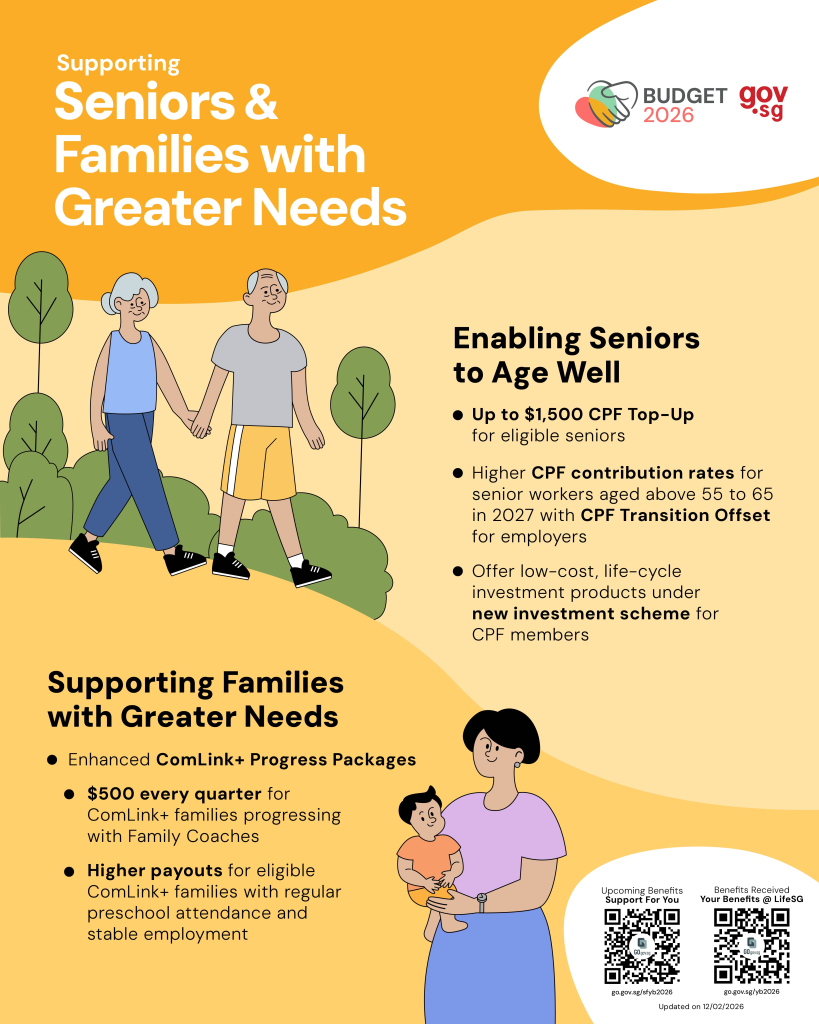
4:21pm: Families in the ComLink+ scheme will now get an additional $500 each quarter if they commit to work with family coaches. The government will also increase the existing payouts that families receive as they progress toward their goals of stable employment and preschool attendance. PM Wong also shared that more of these payouts will be in cash to help families meet immediate needs. With these enhancements, a family with two preschoolers under ComLink+ can receive approximately $10,000 in cash and CPF top-ups annually.
4:23pm: In response to higher CareShield Life premiums, there will be a $400 million top up to the Long-Term Care Support Fund to fund additional CareShield Life premium subsidies. These ensure that those aged 30 and above don’t lose CareShield Life coverage even if they cannot afford the premiums.
4:24pm: The government will provide a CPF top-up of up to $1,500 to Singaporeans aged 50 and above, and with CPF retirement savings below the Basic Retirement Sum. Those with lower CPF balances will receive larger top-ups. PM Wong also said that the planned CPF contribution rate increases for senior workers will continue in 2027, as well as the planned CPF Transition Offset for employers to cover half of the increase in employer contributions.
4:25pm: A new CPF Lifetime Retirement Investment Scheme will be introduced, with two to three potential providers. Providers must ensure fees remain low, and the Government will provide some time-limited support to kick-start the scheme. Participation in this new investment scheme will be voluntary. The Ministry of Manpower and CPF will share more details when ready.
Support For All Singaporeans
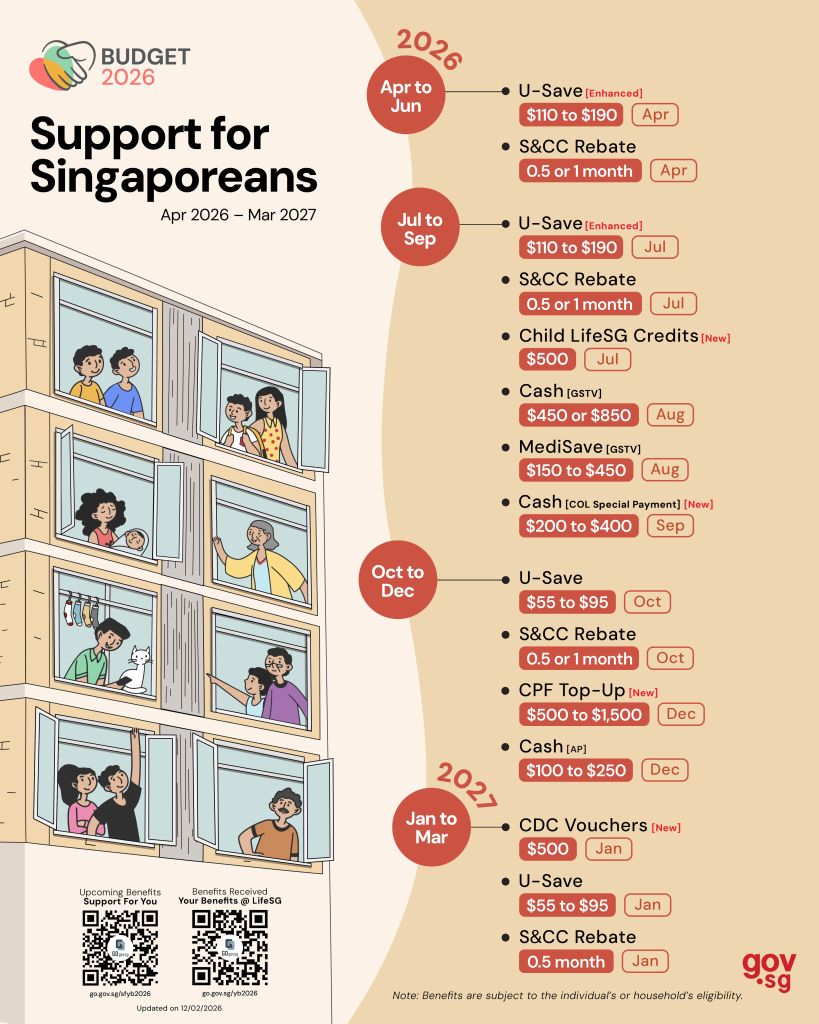
4:30pm: The government will provide a Cost-of-Living Special Payment between $200 to $400 in cash. These are for Singaporean adults who earn up to $100,000 in assessable income and do not own more than one property.
4:30pm: Additional U-Save rebates will be provided to eligible HDB households. They will receive 1.5 times the regular amount of U-Save rebates, up to $570.
4:30pm: Singaporean households will receive another $500 in CDC vouchers for January 2027. As in previous years, half can be used at participating heartland merchants and hawkers, and the other half at participating supermarkets.
Singapore’s Security Challenges And Climate Concerns
4:33pm: With a “more dangerous” world in recent years, PM Wong reiterated that “we alone are responsible for our defence and survival”. The government is investing “decisively” in new technologies that are “essential to Singapore’s defence”, including unmanned systems such as drones. As PM Wong explained, “drones are cheaper, more accessible, and increasingly sophisticated”.
4:35pm: Cyberattacks are also on the rise, with Singapore being an “attractive target”. The threat landscape continues to evolve, and thus defending government systems is no longer sufficient. The government is therefore committed to deepen partnerships with companies, especially those with critical information infrastructure.
4:36pm: Singapore’s defence expenditure is expected to remain at 3% of GDP, though the government is prepared to spend more if necessary.
4:37pm: Despite a slowdown in “global momentum on climate action”, Singapore is still prepared to do our part, by addressing climate risks. One aspect of this is the carbon tax, which PM Wong calls a “key pillar of our climate strategy”. This sends a price signal to encourage companies to adopt energy-efficient solutions, and the plan remains to raise the carbon tax to $50 to $80 per tonne of carbon emissions by 2030. PM Wong mentioned that the U-Save rebates mentioned earlier will help cushion the impact of the carbon tax on households.
4:40pm: However, beyond 2027, the government will reassess Singapore’s carbon tax trajectory “in light of international developments”. If global momentum on climate action continues to weaken, Singapore may opt to keep the carbon tax closer to $50 per tonne. Currently, Singapore’s carbon tax rate is the highest in the whole of Asia.
4:41pm: When it comes to clean energy, Singapore has reached its 2030 solar deployment target of 2 gigawatt-peak (GWp) ahead of schedule and will raise the target to 3 gigawatt-peak by 2030. Singapore is also looking at further diversifying its energy mix, including plans to import lower-carbon electricity from the region, or developing hydrogen, geothermal energy, or civilian nuclear power.
4:42pm: Singapore remains committed to achieving 100% cleaner energy vehicles by 2040. Early adoption of electric vehicles continues to be incentivised, and charging infrastructure is being expanded nationwide.
The Foundation Of A “We First” Society
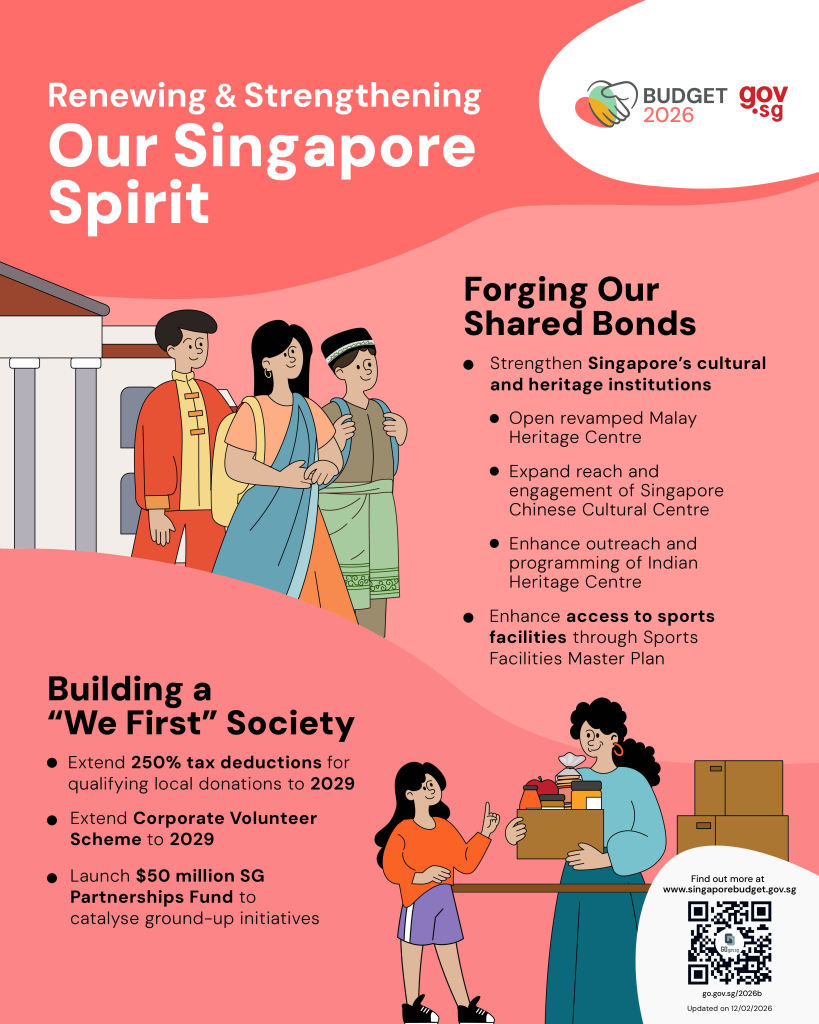
4:46pm: The government will continue to encourage giving to Institutions of a Public Character (IPCs) and other eligible institutions. Currently, qualifying donations to these qualify for a 250% tax deduction. The government will extend this until end-2029.
4:47pm: The Corporate Volunteer Scheme, which provides 250% tax deduction when employees volunteer or are seconded to IPCs, will also be extended till end-2029.
4:48pm: A new SG Partnerships Fund will be launched. The $50 million initiative will support ground-up intiatives, providing differentiated tiers of funding over different time frames. This complements the existing Our Singapore Fund, which has supported more than 800 ground-up projects since 2016.
Tax Adjustments – PARF Rebates And Tobacco Tax
4:51pm: Vehicle taxes in Singapore are meant to encourage the timely renewal of the vehicle population in order to ensure safety and lower pollution. As electric vehicles become more common, the need to encourage early deregistration is reduced. Therefore, from the next COE bidding exercise, all cars will have a 45% reduced Preferential Additional Registration Fee (PARF) rebate. The rebate cap will also be lowered from $60,000 to $30,000.
4:56pm: There will also be a 20% increase in tax on tobacco products, starting today.
Singapore’s Fiscal Position
4:56pm: Revenues from Corporate Income Tax continues to increase. In Financial Year 2024, it contributed 4% of GDP, and based on latest estimates, this is expected to increase in Financial Year 2025. Revenues from vehicle quota premiums and stamp duties were also higher than previous years, reinforcing the strong demand for private vehicles and properties in Singapore. PM Wong said he expects to end Financial Year 2025 with a surplus of $15.1 billion, or 1.9% of GDP. He also expects a smaller surplus of $8.5 billion, or 1% of GDP, for Financial Year 2026.
4:59pm: As part of Pillar Two of the BEPS project, a global coordinated effort to address tax avoidance by multinational companies, Singapore will proceed with a domestic top-up tax for businesses. This will raise the effective tax rate of large multinational companies in Singapore to 15% from Financial Year 2027 onwards.
5:01pm: Prime Minister Lawrence Wong concluded his Budget 2026 speech.
Where To Catch Singapore Budget Statement 2026 Live?
For those who interested to catch the live broadcast of Prime Minister Lawrence Wong’s Singapore Budget 2026 live, you can do so via the following platforms:
- Television: Channel 5
- Radio: CNA938 and Capital 958
- Browser: Singapore Budget website, CNA website, 8world website and MediaCorp’s meWATCH
- YouTube: CNA, 8world, MDDI Singapore and PM Lawrence Wong’s official YouTube channel
- Facebook: CNA and 8world News
Pre-Budget 2026 Reading List
This year, Prime Minister and Finance Minister Lawrence Wong will be delivering the Singapore Budget 2026, titled Securing Our Future Together in a Changed World.
According to PM Wong, Budget 2026 will address the “uncertain external environment”, the impact of technology and artificial intelligence on the job market, and “cost pressures”. He shared these three points in a short video published in January on all his social media channels.
In the days leading up to today, two videos posted on his official YouTube channel this week offer a preview of what Budget 2026 may hold.
The first video was posted on Monday, following the release of the Ministry of Finance’s Occasional Paper on Income Growth, Inequality and Social Mobility Trends. After sharing his key takeaways, Mr Wong added that although it was an “encouraging picture”, Singapore “cannot be complacent”. As our economy matures, he noted “early signs of slowing social mobility”. Once again, he acknowledged the anxiety of many Singaporeans over the cost of living and economic uncertainties. “Amid new headwinds, keeping Singapore moving in the right direction will require more effort and a willingness to adapt and do things differently.”
Read Also: 5 Things We Learnt From MOF’s Income Inequality Report
The second video, posted yesterday, reiterated the concern about jobs and the government’s commitment to providing more support for workers. These include measures such as managing job transitions and staying competitive with relevant skills. In the first part of the video, PM Wong spoke to two workers with decades of working experience, saying he wanted to do more to support workers like them.


