

This article was written in collaboration with Capital Group. All views expressed in this article are the independent opinion of DollarsAndSense.sg based on our research, are purely for informational purposes, and should not be relied upon as financial advice. DollarsAndSense.sg is not liable for any financial losses that may arise from any transactions, and readers are encouraged to do their own due diligence. You can view our full editorial policy here.
If you have been investing over the past few years, you might have noticed something: markets no longer feel predictable anymore.
One moment, inflation is the biggest concern. The next, it is interest rate swings and shortly after that, geopolitical tensions leading to multiple wars and sudden policy changes. Not surprisingly, markets have been swinging sharply, often reacting to headlines that seem to change by the week.
It raises a difficult question for many investors: how do you continue investing when the environment constantly feels uncertain?
The Real Challenge Isn’t Actually Volatility. It Is About Staying Invested
For many investors, the hardest part of investing is not necessarily picking an asset class or finding the “right” stocks. Those are easy, especially when the financial markets are performing well.
The hard part is actually how you stay invested through uncertainty.
When markets fall sharply, it is natural to feel tempted to sell and wait for conditions to improve, or to shift your portfolio to safer asset classes that are less volatile. When markets rise, the opposite occurs and now, there is a fear of missing out. Over time, this cycle of reacting to short-term movements can end up hurting long-term returns more than the volatility itself.
In other words, the real risk is not just market swings. It is making the wrong decisions because of these market swings.
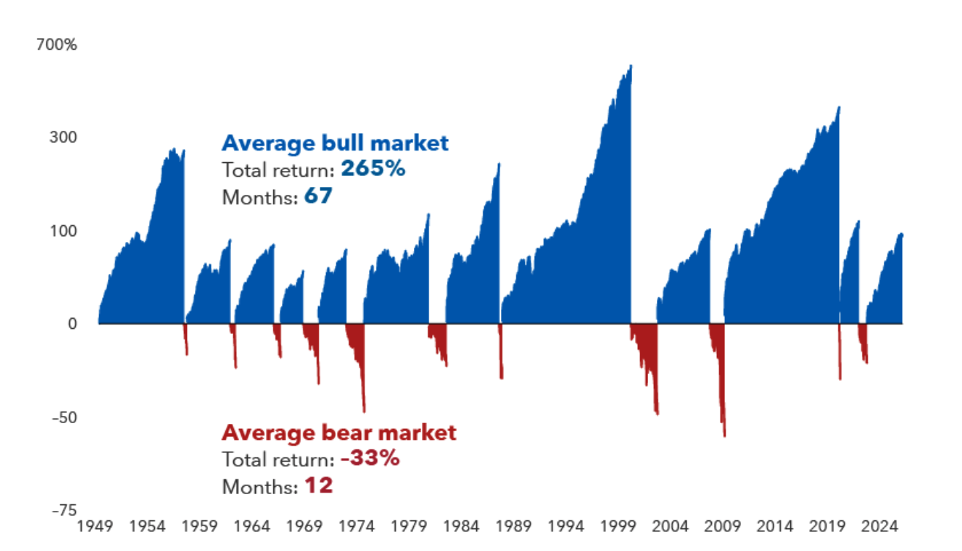
History offers a useful perspective. Bear markets have tended to be relatively short-lived when viewed against the full arc of a market cycle. While the losses can be painful to endure, the recoveries that follow have historically been far more rewarding and longer in duration. The greater risk, then, is not the downturn itself, but missing the rally that follows.
Bull Markets Have Been Much Longer And Stronger Than Bears
Cumulative price return for each bull and bear market
Past results are not a guarantee of future results.
Sources: Capital Group, RIMES, Standard & Poor’s. The bull market that began in 2022 is considered current as of 28 February 2026, and not included in the average bull market calculations. Bear markets are peak-to-trough price declines of 20% or more in the S&P 500. Bull markets are all other periods. Returns shown on a logarithmic scale.
Why A Balanced Portfolio Makes Sense
In such a market environment, trying to predict every market move can be difficult, exhausting and most importantly, potentially not even worth the effort. A more practical approach may be to build a portfolio that is designed to cope with different market conditions.
At its simplest, a balanced portfolio combines equities for growth and bonds for stability and income. Equities help investors participate in long-term market upside, while bonds can provide a steadier source of income, and help cushion the portfolio when markets become more volatile.
This type of approach is often associated with a “60/40” portfolio, where roughly 60% is allocated to equities and 40% to bonds. While simple, the idea behind it remains relevant: investors do not need to rely entirely on one part of the market to achieve their goals.
In a world where uncertainty may remain elevated, that balance can matter even more. Rather than trying to constantly reposition a portfolio based on the latest headlines, investors may benefit more from having exposure to both growth and stability from the outset.
Focusing On Income, Quality & Resilience
Simply holding an allocation of equities and bonds and thinking it’s a good enough portfolio isn’t sufficient. What matters just as much is the quality of the assets within the portfolio.
To see how these principles can be applied in practice, consider how a fund like Capital Group American Balanced Fund (LUX) (AMBAL) is constructed. The fund is built around the idea of combining income, quality and resilience within a single portfolio.
- Income can provide a steadier stream of returns, even when markets are uneven. Receiving income from a portfolio may make it easier to stay invested during more volatile periods.
- Quality matters because not all companies and bonds are equal. In uncertain times, investors may prefer businesses with stronger balance sheets, more consistent earnings and durable business models.
- Resilience means building a portfolio that may be better able to withstand periods of stress, recover more steadily and avoid extreme swings.
AMBAL utilises these three characteristics to invest in a mix of US equities and high-quality bonds. On the equity side, the focus is on established businesses, including dividend-paying companies and market leaders. On the fixed income side, the portfolio is anchored in investment-grade bonds, including government-related securities.
Together, this creates a portfolio designed not just for growth, but for a smoother investment journey over time.
You can read more about the fund in its product brochure.
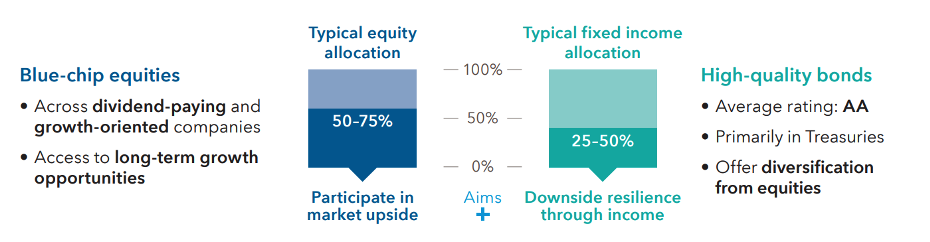
By emphasising prudent security selection, AMBAL ensures that only high-quality assets are included
Why This Matters For Investors
In today’s environment, many investors are not just asking where returns will come from. They are also asking how to build a portfolio that they can realistically stay invested in.
That may mean focusing less on chasing the next market winner, and more on whether a portfolio is built to deliver income, hold quality underlying assets and remain resilient when conditions become more difficult.
Think of this as building a home with a strong foundation. You do not build it only for sunny days. You build it so that it remains strong through changing weather and tougher conditions as well. In the same way, a portfolio focused on income, quality and resilience is designed not just to perform when markets are calm, but to help investors stay invested when conditions become more challenging.
The Goal Is Not To Predict The Market, But To Endure It
There will always be another headline, another risk to worry about and more reasons for markets to be volatile. But enjoying the results of long-term investing is rarely about getting every call right, or being able to predict the future correctly. Instead, it’s about building a portfolio that can endure uncertainty, and allow time and compounding to work in our favour.
That is why a balanced portfolio may matter even more today. In a volatile world, it can offer investors a more practical way to stay exposed to growth opportunities while also grounding their portfolio in income, quality and resilience.
You can find out more about Capital Group American Balanced Fund (LUX), and how it is positioned to combine growth, income and resilience in a single portfolio here.
Glossary
Blue-chip equities: Stocks that have a long record of profit growth and dividend payment and a reputation for quality management, products and services.
Credit rating: Independent ratings assigned by credit agencies, from AAA/Aaa (highest) to D (lowest), that measure an issuer’s ability to repay its debt.
Downside resilience / protection: An investment position that seeks to reduce the frequency and/or magnitude of capital losses resulting from the decline of a stock or a fall in the overall market.
Treasury: A type of debt issued by the US Treasury.
Upside: Refers to the potential for an investment to increase in value, as measured in terms of money or percentage.
Disclaimers – Capital Group
Risk factors you should consider before investing:
• This material is not intended to provide investment advice or be considered a personal recommendation.
• The value of investments and income from them can go down as well as up and you may lose some or all of your initial investment.
• Past results are not a guarantee of future results.
• If the currency in which you invest strengthens against the currency in which the underlying investments of the fund are made, the value of your investment will decrease. Currency hedging seeks to limit this, but there is no guarantee that hedging will be totally successful.
• Some portfolios may invest in financial derivative instruments for investment purposes, hedging and/or efficient portfolio management.
• The Prospectus – together with locally required offering documentation – sets out risks which, depending on the fund, may include risks associated with investing in fixed income, derivatives, emerging markets and/or high-yield securities; emerging markets are volatile and may suffer from liquidity problems.
In Singapore, this communication has been prepared by Capital Group Investment Management Pte. Ltd. (CGIMPL), a member of Capital Group, a company incorporated in Singapore.
This advertisement or publication has not been reviewed by the Monetary Authority of Singapore or any other regulator.
This communication is of a general nature, and not intended to provide investment, tax or other advice, or to be a solicitation to buy or sell any securities. All information is as at the date indicated and attributed to Capital Group unless otherwise stated. While Capital Group uses reasonable efforts to obtain information from third-party sources that it believes to be accurate, this cannot be guaranteed.
The fund(s) is (are) offered only by Prospectus, together with any locally required offering documentation.
In Singapore, this is the Product Highlights Sheet (PHS).
These documents are available free of charge and in English and local languages at capitalgroup.com, and should be read carefully before investing.
The material is not intended to be distributed or used by persons in jurisdictions that prohibit its distribution. If you act as representative of a client it is your responsibility to ensure that the offering or sale of fund shares complies with relevant local laws and regulations.
The information in relation to the index is provided for context and illustration only. The fund is actively managed. It is not managed in reference to a benchmark.
For Singapore: CGIMPL is the appointed Singapore Representative of the Fund.
The list of countries where the Fund is registered for distribution can be obtained online at www.capitalgroup.com
All Capital Group trademarks are owned by The Capital Group Companies, Inc. or an affiliated company. All other company names mentioned are the property of their respective companies.
© 2026 Capital Group. All rights reserved.
Photo Credit: iStock/William_Potter


Street Smart
Singapore Gym Membership Price Guide (2026 Edition)


