
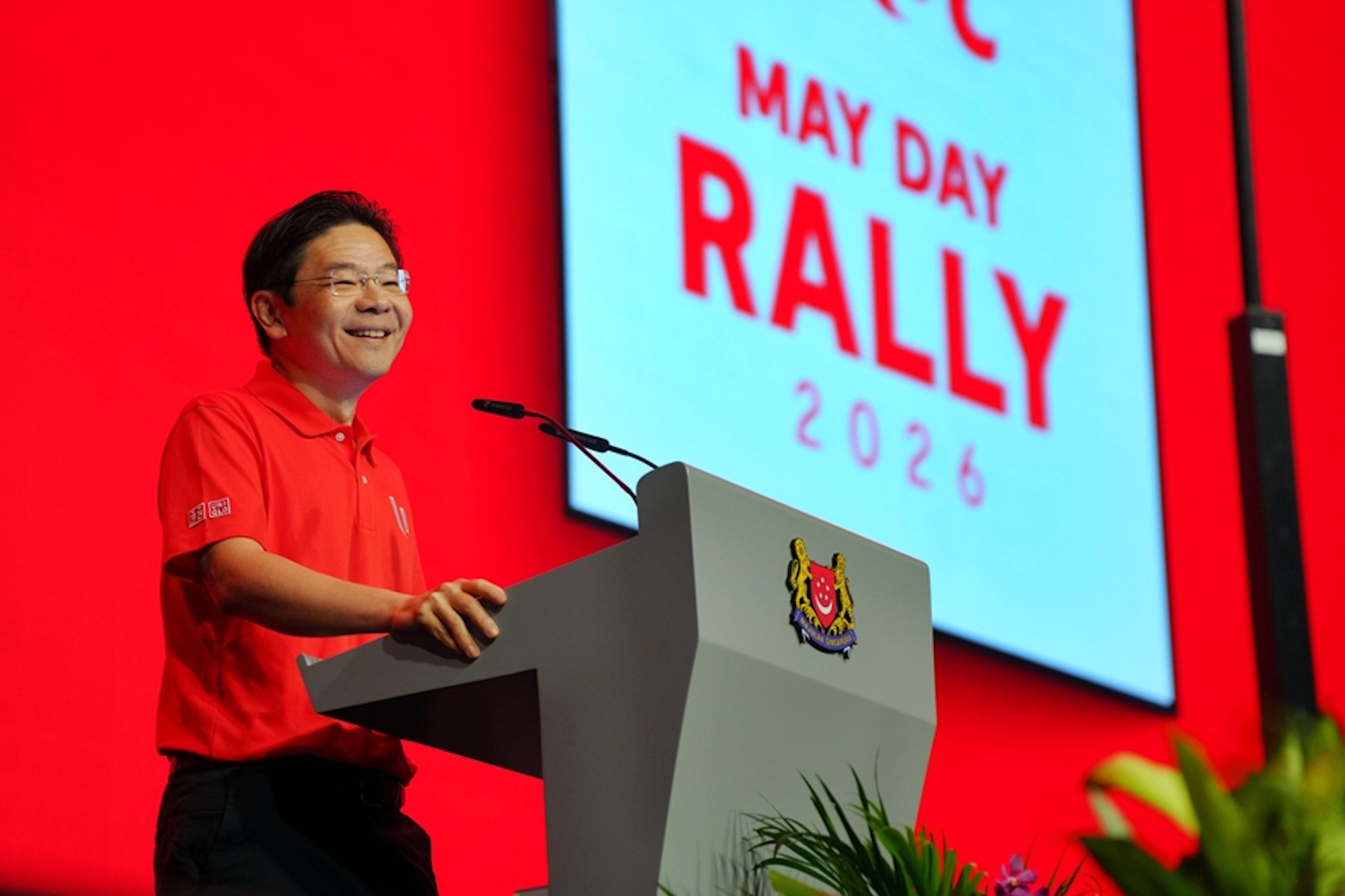
At this year’s May Day Rally, Prime Minister Lawrence Wong addressed the challenges Singapore faces amid global uncertainty and laid out how workers and households can remain resilient. He also spoke on a range of topics, from inflationary pressures to opportunities in artificial intelligence (AI).
Read Also: Why We Celebrate Labour Day On 1 May
#1 Inflation Risks Will Impact Singapore Directly
PM Wong cautioned about the possibility of stagflation, which he defined as “a combination of stagnation and inflation”. He spoke about the stagflation of the 1970s due to the “oil shocks” and echoed the International Energy Agency in saying that the current crisis, driven by energy supply disruptions in the Middle East, “could be even more severe”.
Rising fuel costs are expected to spill over into food, transport, and everyday essentials, as airlines cut flights, factories report delays, and “fertiliser, food, and other essential inputs” also face disruption. PM Wong warned of slowed growth and higher inflation in the months ahead, putting “real pressure on businesses, workers and households.”
Read Also: What You Need To Know About PM Wong’s Message Amid Rising Oil Prices
#2 Singapore Is Looking Ahead With “Quiet Confidence”
Yet, PM Wong also reassured that Singapore has “invested to strengthen our energy resilience”. The investments in energy infrastructure, including Jurong Island’s facilities and the underground storage tanks at Jurong Rock Caverns, are buffers that help protect Singaporeans from sudden supply shocks.
Singapore is also “a key node in global energy flows”, and having the “world’s leading energy companies” operating here gives us a significant advantage. Singapore is also “working closely with like-minded countries to strengthen supply chain resilience”.
#3 Government Support Packages Are An “Initial Response”
PM Wong emphasised that the government has already brought forward next year’s CDC vouchers and enhanced cash payouts. He also mentioned U-Save vouchers for households and providing “more help” for businesses, especially those “most affected by higher energy prices”.
He was quick to point out that this was an “initial response” to the crisis, and should things get “more challenging” in the months ahead, the government would “do more to help” and would expand support if and when conditions worsen.
Read Also: Singapore Budget 2026: 5 Announcements That Will Benefit Everyday Singaporeans Financially
#4 AI Transformation Will Reshape Career Opportunities
A major theme of the rally was the transformative power of AI. He pointed to Google as an example, where AI is helping generate and refine code. In two years, AI went from writing just 25% of new code to 75% today. He was quick to emphasise that software engineers were still in demand at Google, but they were “changing their roles”, from “just coding” to becoming “system builders”.
PM Wong also cited DBS as an example, showing how jobs there are evolving into higher-value roles thanks to over a decade of investment in AI. He mentioned how embedding AI “across their operations” helped DBS improve productivity and allowed employees to expand their job scope.
He was clear that he could not promise that “there will be no disruption” with AI, acknowledging that jobs will change and “some will disappear”, with the pace of change “faster than anything we have seen before”. That is why the Government is strengthening support for workers.
Read Also: 5 Takeaways From PM Lawrence Wong’s First May Day Rally 2025 Speech As Prime Minister
#5 The “Singapore Way” Of Overcoming Disruption
PM Wong brought up the merger of Workforce Singapore (WSG) and SkillsFuture Singapore (SSG) into the new Skills and Workforce Development Agency (SWDA), first announced at Budget 2026. This integrated body will oversee both skills training and job placement, ensuring workers can upgrade skills and immediately connect to relevant opportunities.
He also mentioned that SkillsFuture will be strengthened, and the SkillsFuture Jobseeker Support Scheme, which provides temporary financial support to involuntarily unemployed individuals, are there “if you face a setback”.
Finally, PM Wong reaffirmed the importance of tripartism, the partnership between government, employers, and unions. Just like last year, he mentioned Company Training Committees (CTCs), which identifies “skills needed for transformation to put in place concrete plans to uplift workers”. He gave the example of Tan Tock Seng Hospital, where the CTC was responsible for developing an “AI-powered rostering tool” that plans the nurses’ duty roster in 15 minutes instead of an hour.
He also mentioned “Queen Bee” companies such as SMRT, where productivity improvements are not just shared with workers via bonuses and wage progression, but also with “its network of SME contractors” as they “adopt new technology and improve operations”. The success of the CTC is the basis for the formation of the newly formed Tripartite Jobs Council. More details on the composition and plans will be revealed in the coming weeks.
Read Also: From Tax Filing To BTO Launches: Singapore’s Personal Finance Calendar For 2026


Lifestyle
15 Of The Cheapest EV Cars In Singapore


Budgeting 101
7 Ways Being Frugal Is Different From Being Cheap


Street Smart
Singapore Gym Membership Price Guide (2026 Edition)


Street Smart
Singapore Gym Membership Price Guide (2026 Edition)

Bonds and Fixed Income
Complete Guide To Buying Singapore Savings Bonds (SSB) [2026 Edition]


