
The past decade has seen Singapore trying its best to encourage couples to have more children. From enhanced parental leave schemes to larger Baby Bonus payouts, the government has repeatedly tried ways to encourage Singaporean couples to have more kids. Deputy Prime Minister Gan Kim Yong even calls it an existential challenge for Singapore.
First coined by Prime Minister Lawrence Wong in Budget 2025, Large Families refer to married couples in Singapore with three or more children. They are now benefits specifically for these “Large Families”, including the Enhanced CDA First Step Grant of an additional $5,000, the Large Family MediSave Grant and the Large Family LifeSG Credits.
While useful, these cash benefits do not solve a practical challenge that many larger families will also face: finding enough living space at home.
Larger Flats With More Rooms For Bigger Families
Living spaces need not refer to just the total floor area of a home. While a home with a larger floor area will obviously be better suited to large families, the layout is equally important.
Currently, large families that outgrow their 4 or 5-room BTO flats often turn to the resale market in search of larger housing options such as jumbo flats, executive apartments (EAs) and executive maisonettes. The problem is that these flat types are no longer being built, which means supply is limited, and prices can be correspondingly higher.
In a previous DollarsAndSense article, we discussed why HDB may eventually need to build larger flats if Singapore is serious about supporting bigger families.
The underlying issue is straightforward. Housing policies have evolved over time to accommodate changing household structures. For example, HDB is building more 2- and 3-room flats today to accommodate singles and couples without kids. However, families with three or more children often find that the available flat types no longer adequately match their space requirements.
However, instead of introducing an entirely new flat category, there may already be an existing housing type that could help address this issue. The 3Gen HDB flat.
What Is A 3Gen Flat?
First introduced in 2013 by HDB, the 3Gen flat is meant to support multi-generational living arrangements.
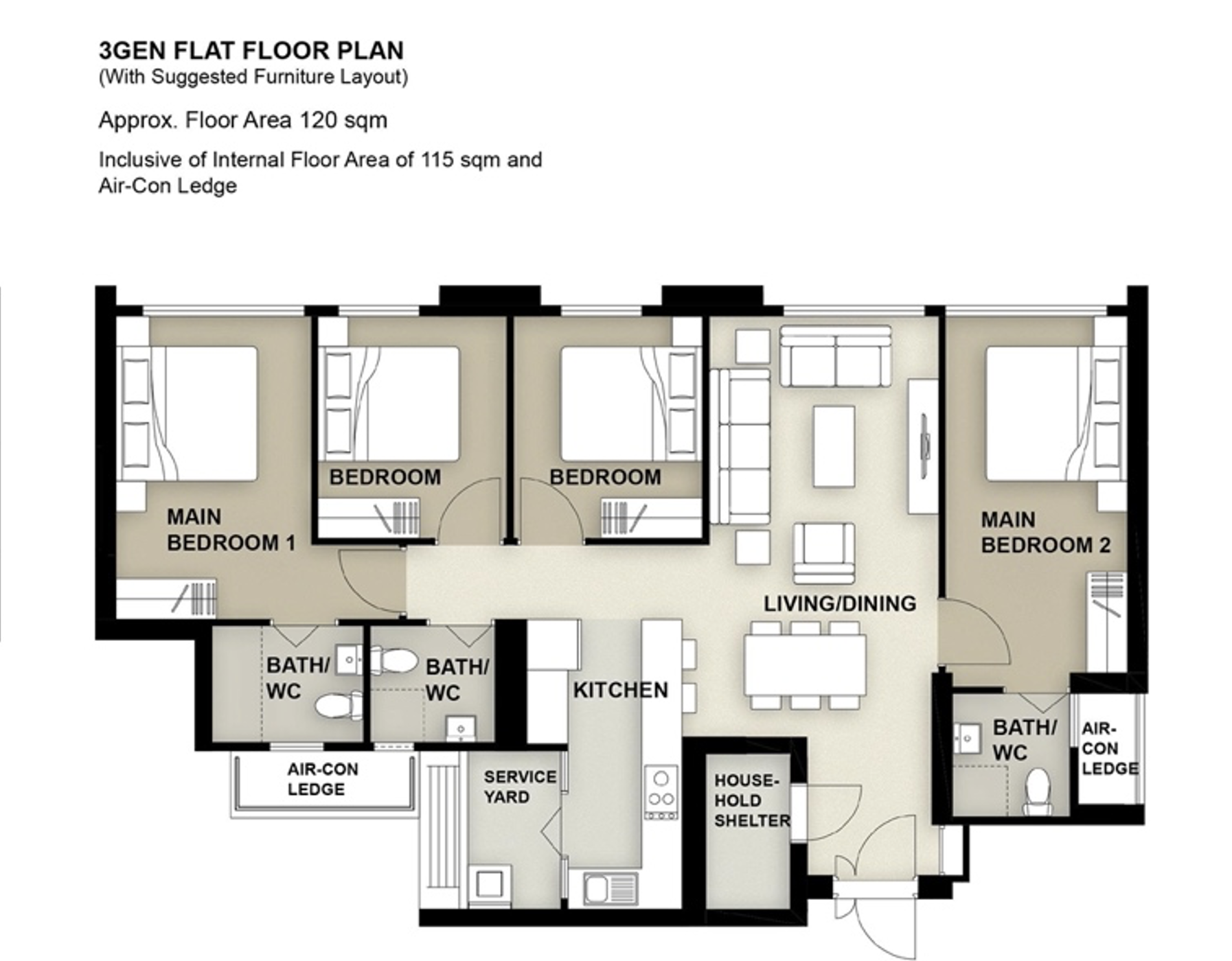
These flats are designed to accommodate larger households and typically offer around 120 square metres of living space, making them slightly larger than standard 5-room flats. They include four bedrooms and three bathrooms.
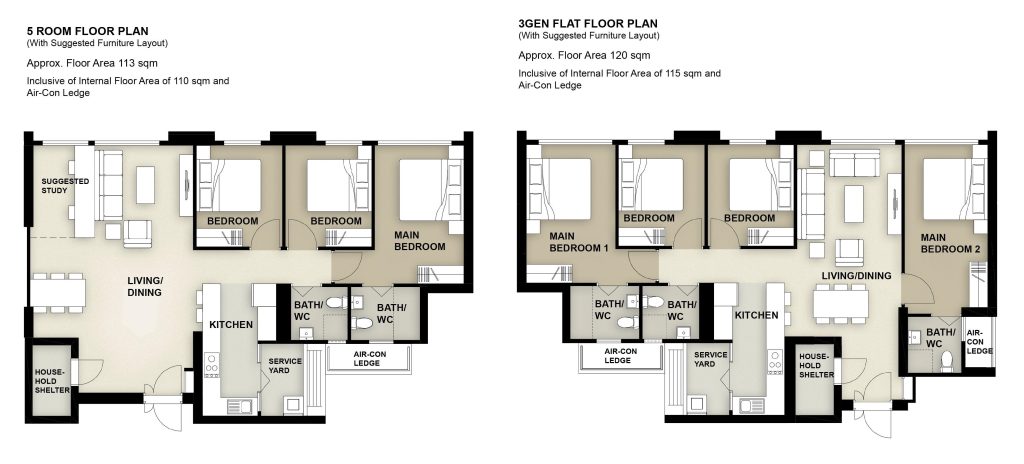
When you compare the floor area of a new 5-room flat BTO flat (113 sqm) against a 3Gen BTO flat (120 sqm), the difference isn’t much. However, when you compare the actual layout, the difference is substantial.
Though it has a smaller living and dining area, the 3Gen flat comes with an additional master bedroom with an ensuite toilet. This makes it more practical for large families with three or more children, as well as for those with a domestic helper.
However, 3Gen flats are only available to a small niche group.
Under current HDB rules, 3Gen flats can only be purchased by eligible multi-generational households. Typically, this means a married or engaged couple applying together with at least one parent (who must be listed as an essential occupier and cannot have another property in their name). Applicants must satisfy HDB’s eligibility requirements for multi-generational families.
As a result, a family with four children may not qualify for a 3Gen flat despite having a larger household than some multi-generational applicants. If they are not applying together with their parents, they are generally unable to purchase a new 3Gen flat.
Large Families Are Exactly The Type Of Household 3Gen Flats Were Built For
Consider two households.
The first is a large family comprising a married couple, their four children and a domestic helper. In total, seven people are living under one roof. Despite this, the largest BTO flat they can apply for is typically a 5-room flat with three bedrooms and two bathrooms. In practice, this could mean four children sharing two bedrooms, while the helper is either sharing a room with the children (assuming they are girls), or having to do with a makeshift sleeping area. For a household of seven, space, including the toilets, can quickly become a challenge.
The second household consists of a married couple, one child and two grandparents. With five occupants, they may qualify for a 3Gen flat. This gives them access to four bedrooms and three bathrooms, including two ensuite bedrooms. The parents and grandparents can each have their own ensuite bedroom, while the child can have a room of their own with an additional bedroom available.
Yet only the second household currently qualifies for a 3Gen flat.
From a housing policy perspective, our view is that the objective should be to match housing size to household needs. Larger flats exist because some households require more bedrooms, bathrooms and living space than others.
Viewed through that lens, families with three or four children appear to be among the most suitable occupants of a 3Gen flat. Their need for space is often comparable to, and in some cases greater than, that of a multi-generational household. As Singapore seeks to encourage larger families, ensuring that these households have access to housing that matches their needs may become increasingly important.
Unlike 5-room flats, which are open to a broad pool of applicants, 3Gen flats can only be purchased by eligible multi-generational families. This significantly reduces the number of households that can apply for them.
However, it would not be true to say that Singaporeans do not need larger homes.
After all, many households that may genuinely benefit from the additional space, such as families with three or four children, are currently ineligible to apply. If these households were eligible, demand for 3Gen flats would likely be much higher.
The Same Logic Could Apply To The Resale Market
The same argument could also apply to resale 3Gen flats.
Today, resale 3Gen flats remain subject to eligibility restrictions and can generally only be sold to another eligible multi-generational household. This limits the pool of potential buyers and restricts the housing options available to larger families that may benefit from additional space.
Allowing families with three or more children to purchase resale 3Gen flats could help address both issues. Larger families would gain access to another category of spacious homes, reducing their reliance on the limited supply of jumbo flats, executive apartments and executive maisonettes. At the same time, existing 3Gen flat owners would benefit from a broader pool of potential buyers.
More importantly, this would make better use of an existing housing type. No new flats need to be built since the housing stock already exists.
A Faster Solution Than Building Bigger Flats
If Singapore wants more large families, it should also ensure they have access to homes that meet their needs.
Building a new category of larger BTO flats could take years. Expanding eligibility for 3Gen flats, however, could be implemented much more quickly. After all, the purpose of 3Gen flats is to provide more living space for larger households. And when it comes to household size, a family with three or four children is no less a large family than a multi-generational one.
Read Also: Why HDB Needs To Start Building Bigger Flats For “Large Families”


Street Smart
Singapore Gym Membership Price Guide (2026 Edition)


